What are the cultivation methods and precautions for potted Money Tree?
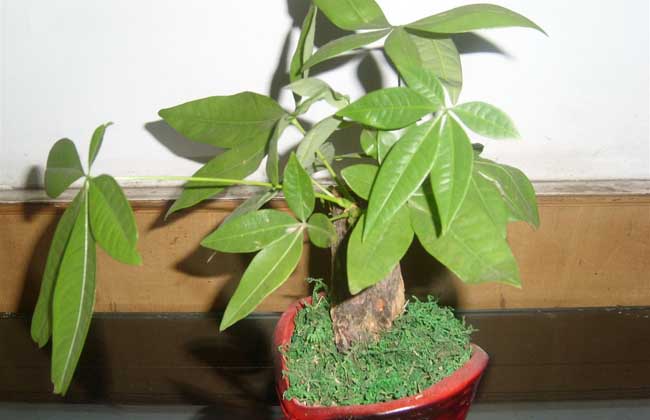
The Money Tree, also known as Malabar chestnut, Chinese cottonwood, and goose-foot money, is a small tree in the genus Pachira of the family Malvaceae. It is native to Mexico in Central America through to Costa Rica. It has an attractive shape, with stems and leaves that stay green all year round. The branches of young plants are soft and tolerate pruning, so they can be shaped into various artistic stump specimens and bonsai. In the south it is often used as a street tree and landscape tree. Now let us take a look at how to grow a potted Money Tree!
The growth habits of the Money Tree
The Money Tree is native to Mexico in Central America through to Costa Rica, and it grows normally when cultivated in Xishuangbanna, Yunnan, China. It likes a hot and humid climate and has poor cold tolerance. Seedlings cannot tolerate frost, while adult trees can withstand light frost and long periods of low temperatures of 5 to 6°C. In South China it can overwinter outdoors; in regions further north it must be moved into a greenhouse in winter for protection from the cold. It likes fertile, loose, breathable, water-retentive sandy loam, prefers acidic soil, and dislikes alkaline or heavy clay soil. It is relatively tolerant of waterlogging and also slightly tolerant of drought.
Propagation methods for the Money Tree
1. Cuttings: The best time to take Money Tree cuttings is in May and June. Cut sturdy branches with buds and insert them into sand, while paying attention to moisture retention and shading. They will take root and survive in one month. In spring, you can also use branches cut off when topping the plant, insert them into gravel or coarse sand, and keep a certain humidity; they will take root in about 30 days.
2. Sowing: Money Tree seeds should be sown immediately after harvesting. Cover the seeds with 1 cm of soil, keep moist and shaded, and control the temperature at 20 to 25°C. They will sprout in about a week. Note that the seedbed soil should be fertile and well drained, preferably containing gravel, which helps the new sprouts take root.
How do you grow a potted Money Tree?
1. Potting soil: When you buy a Money Tree, most of the time it comes in soil provided by the seller. Gardeners do not need to repot it the moment they get it home; just grow it for a while and consider repotting later. If you do repot, a potted Money Tree is generally planted in loose garden soil or peat soil, leaf mold, and coarse sand, with a small amount of compound fertilizer or chicken manure added as a base fertilizer and growing medium.
2. Light: When growing a Money Tree, place it in a spot indoors with plenty of sunlight. When positioning it, make sure the leaf surface faces the sunlight. Do not keep it shaded for long periods, otherwise the branches and leaves will twist and deform. It is best to spray water on the Money Tree leaves once every 3 to 5 days, which both helps photosynthesis and makes the branches and leaves more attractive.
3. Watering: When growing a Money Tree, too little water easily causes the branches and leaves to stop developing, while too much water may cause root rot and death; a moderate amount of water makes the branches and leaves plump. The first principle of watering a Money Tree is to prefer moist over dry. Water more in the hot summer season, water less in winter, water more during the vigorous growth period, and water less for small or newly planted specimens. Under normal conditions, watering once every 15 to 20 days is enough.
3. Fertilizing: The Money Tree has a greater demand for fertilizer than other flowering plants and trees. When repotting, the proportion of fertilized soil can be one third. Fertilized soil includes a mixture of decomposed leaf litter, miscellaneous bone meal, and bean cake residue. This kind of fertilized soil is highly effective and easy to obtain. However, note that it should be fully decomposed, so as not to burn the leaves yellow. During the Money Tree's growth period (that is, May to September), apply a decomposed liquid fertilizer or flower fertilizer once every 15 days to keep its roots deep and leaves lush.
4. Humidity: When growing a Money Tree, water frequently, watering thoroughly and evenly, leaving little standing water, and avoid overwatering. The leaves should be sprinkled with water frequently; on the one hand this maintains the plant's humidity, and on the other hand it washes away floating dust and ensures its ornamental value. For indoor growing in summer, water once every 3 to 5 days; in spring and autumn, water once every 5 to 10 days. In winter it depends on room temperature; if the room temperature is around 12°C, watering once a month is enough.
5. Temperature: The Money Tree is native to Mexico in Central America through to Costa Rica and likes a hot, moderately humid environment. Its most suitable growing temperature is 18 to 30°C. When growing it, care should be taken to maintain a temperature above 15°C and to spray the branches and leaves frequently to increase humidity. In late autumn and winter, care should be taken to protect it from cold and freezing.
6. Repotting: Newly introduced Money Tree plants do not need repotting the same year, to prevent the tree shape from becoming distorted. The suitable season for repotting is spring, or it can also be done in July or August, taking advantage of the plant's semi-dormant state during the high-temperature period. The Money Tree has relatively strict requirements for potting soil. The potting soil should preferably be slightly moist and well drained; an acidic sandy loam containing humus can be used.
7. Pests and diseases: The Money Tree commonly suffers from leaf spot disease, which can be prevented and controlled by spraying with a 50% carbendazim 1000-fold solution. The Money Tree's insect pests include scale insects, whiteflies, and leaf rollers, which can be killed by spraying with a 25% phosmet emulsifiable concentrate 1000-fold solution.
What should you do if the Money Tree's leaves turn yellow?
1. Unsuitable light: This is caused by being kept indoors without light for a long time, so the leaves cannot carry out photosynthesis to supply nutrients. If it is winter, it can be placed in a bright spot indoors; if it is spring or autumn, it can be placed in a bright spot outdoors; if it is summer, it can be grown in a spot with dappled shade outdoors. It will soon recover its vitality.
2. Temperature too high: In summer, if the Money Tree is placed in a hot spot exposed to direct strong sunlight, it is very likely to cause the tips and edges of the young leaves to scorch, or the leaves to turn yellow and fall off. At this time, it should be moved promptly to a well-ventilated, cool place.
3. Overwatering: If watered too much and the potting soil remains in a waterlogged state for a long time, it causes the root crown to rot and the leaves to turn yellow and fall off. The base of the Money Tree's stem is swollen and stores a large amount of water and nutrients, so it is very tolerant of drought; do not water too much or too often. Especially in winter, when the temperature is low, watering too much or too often can very easily cause the root crown to rot and the leaves to turn yellow, blacken, and fall off.