How to grow star jasmine (Trachelospermum jasminoides 'Variegatum') well? Detailed care methods and tips
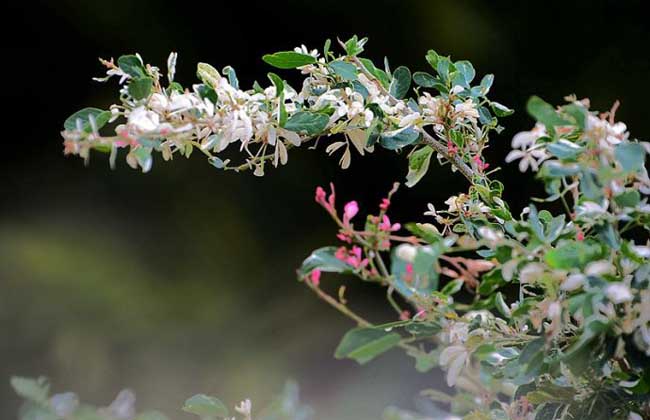
Star jasmine (Trachelospermum jasminoides 'Variegatum'), also known as 'Chuxuege' and variegated star jasmine, is an evergreen woody vine of the genus Trachelospermum in the Apocynaceae family. It loves light and is highly shade-tolerant, and prefers environments with relatively high air humidity. It can be used as a year-round “flowering” plant for various flower border arrangements, and it is also an excellent material for potted plants. Let's take a look below at how to grow star jasmine (Trachelospermum jasminoides 'Variegatum') well!
Growth habits of star jasmine (Trachelospermum jasminoides 'Variegatum')
Star jasmine (Trachelospermum jasminoides 'Variegatum') is suitable for growing in well-drained acidic and neutral soil environments. It is robust with strong disease resistance and vigorous growth, and has strong tolerance to drought, short-term flooding and cold. Its leaf color changes are related to light and growth conditions; vivid color expression requires good light conditions and vigorous growth conditions. Leaf color changes are related to light and growth conditions; vivid color expression requires sufficient light conditions and vigorous growth conditions, but at this time the plant grows slowly, with the growth in a growing month mostly around 3 cm. It is a light-loving and slightly shade-tolerant plant that prefers environments with relatively high air humidity and well-drained acidic and neutral soil. It is robust and grows relatively fast, with monthly growth in a growing month reaching more than 4 cm. At the same time, it is also a relatively drought-tolerant and cold-tolerant variety.
Propagation methods for star jasmine (Trachelospermum jasminoides 'Variegatum')
1. Cuttings: Star jasmine (Trachelospermum jasminoides 'Variegatum') can be propagated by cuttings in all four seasons, but spring, summer and autumn are the ideal seasons for cuttings. Using full-substrate cuttings, the rooting rate is above 95%. Container cuttings are preferable, mostly using plug trays or small nutrient pots. For potted star jasmine (Trachelospermum jasminoides 'Variegatum'), cuttings in small nutrient pots are ideal, with 3 to 5 plants inserted per pot. This can avoid root damage during transplanting in the propagation and cultivation process, improve the survival rate, and benefit the growth and shaping of the seedlings.
2. Layering: Layering propagation of star jasmine (Trachelospermum jasminoides 'Variegatum') is generally carried out in early spring or summer. Layering of old branches is done in early spring, while layering of young branches is suitable in summer. Press the branches into the soil 2 to 3 cm, and when roots form at the nodes or internodes and new shoots grow to 8 to 10 cm, separate them from the mother plant to form new plants. Compared with cutting propagation, layering has a smaller propagation coefficient and requires more labor, making large-scale production difficult.
3. Tissue culture: For star jasmine (Trachelospermum jasminoides 'Variegatum'), considering trait segregation during the culture process, rapid propagation is often carried out by the bud-to-bud method, with an annual multiplication rate of 200 to 300 times. However, due to limitations in facility conditions and technical requirements, plus the operation process being more complex than cuttings and layering, its promotion is subject to certain limitations.
How to grow star jasmine (Trachelospermum jasminoides 'Variegatum') well?
1. Fertilizer: Star jasmine (Trachelospermum jasminoides 'Variegatum') likes fertilizer but is not demanding; all kinds of fertilizer can be used. It can still bloom without fertilizing for a year, but with fewer flowers. For potted star jasmine (Trachelospermum jasminoides 'Variegatum'), if you want it to bloom profusely, you can apply more bone meal and phosphorus-potassium fertilizer and less nitrogen fertilizer. For ground-planted star jasmine (Trachelospermum jasminoides 'Variegatum'), applying a nitrogen-phosphorus-potassium compound fertilizer once each in spring and autumn is sufficient; do not fertilize in winter and summer.
2. Watering: Star jasmine (Trachelospermum jasminoides 'Variegatum') likes moisture. During the growing season, the potting soil should be kept slightly moist. In spring and autumn, water once every two days; in summer, water once a day; in winter, water about once every half month. The potting soil should be slightly moist but not dry, and it must never become waterlogged at any time. For potted star jasmine (Trachelospermum jasminoides 'Variegatum') placed on rooftop gardens or courtyards, attention should be paid to draining accumulated water during the rainy season. Ground-planted star jasmine should not be planted in low-lying areas, otherwise root rot is likely. During the growing season, it is not too late to water after the soil dries. Ground-planted plants in winter may not need watering.
3. Pruning: Star jasmine (Trachelospermum jasminoides 'Variegatum') is tolerant of pruning and stays evergreen all year round. It can also be combined with golden privet and red barberry for color band and color block landscaping. Controlling the vine length through pruning can promote branching and help produce a full plant shape. The first pruning is done when the vine reaches 8 cm, cutting it back to about 6 cm. After that, prune every time it grows 4 to 5 cm. Usually 2 to 3 prunings are enough to achieve a good pot shape.
4. Light: Star jasmine (Trachelospermum jasminoides 'Variegatum') is a temperate-zone flower that likes warmth and light. For ground planting, it should be planted in a sunny spot; in shady places it grows poorly, with fewer flowers and a faint fragrance, or even no flowers. For potted plants, in spring, autumn and winter they should be placed in a place with sufficient sunlight. In midsummer, if placed in a semi-shaded place where it can see the sun in the morning or evening and avoid direct strong sunlight at noon, it will bloom continuously. If it is too sunny at noon, the flowers will be sparse, or even absent. Star jasmine is relatively cold-tolerant. In the Yellow River basin and areas to its south, it can overwinter safely outdoors. In the north, it is still better to move it into a low-temperature room to overwinter.
5. Diseases and pests: The main diseases of star jasmine (Trachelospermum jasminoides 'Variegatum') include anthracnose and leaf spot. Use a 600 to 800 times dilution of 50% thiophanate-methyl, or an 800 to 1000 times dilution of 70% mancozeb wettable powder for control. For damage by red spider mites and other mites, and moth larvae, use a 1000 to 1500 times dilution of 15% pyridaben for control. For aphids, use a 1500 times dilution of 25% imidacloprid wettable powder or a 2000 to 3000 times dilution of 48% chlorpyrifos emulsifiable concentrate for control.