When Do Phalaenopsis Orchids Bloom? A Detailed Guide to Their Flowering Period
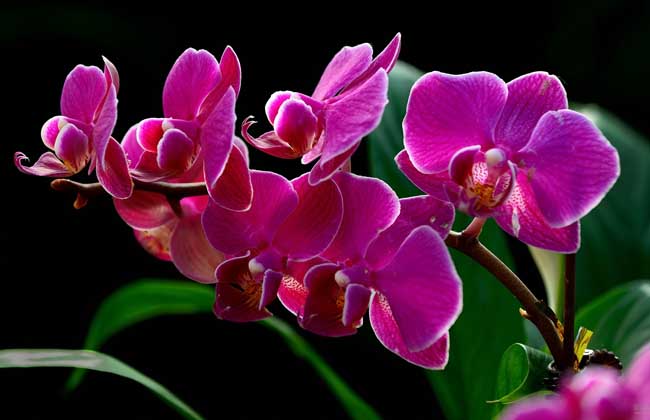
Phalaenopsis is a cut-flower orchid in the family Orchidaceae, with more than 70 native species, most of them originating in Asia, and also distributed in the Philippines, Malaysia, India and other places. They come in many colors, with elegant flower forms and fragrant blooms, making them treasures among tropical orchids and earning them the reputation of the "Queen of Orchids." Let's take a look below at when Phalaenopsis orchids bloom!
When do Phalaenopsis orchids bloom?
The flowering period of Phalaenopsis is from April to June each year. Phalaenopsis gets its name because its flowers look like dancing butterflies; its scientific name, based on the original Greek meaning, is "an orchid resembling a butterfly." They come in many colors, and breeders have used precious native species collected from various places for artificial crossbreeding, improving them into various flower colors and flower forms. Various colors such as yellow flowers with red spots, red dots, red lines, pure yellow, and white flowers with red centers can be seen at orchid exhibitions everywhere.
How long does the flowering period of Phalaenopsis last?
The flowering period of Phalaenopsis is relatively long, generally around the Spring Festival, and the ornamental period can last as long as 2 to 3 months, blooming once or twice a year. After the flowers wither, the faded flowers must be cut off as early as possible, as this can reduce the consumption of nutrients. If the flower stem is cut off at the 4th to 5th node from the base, it can bloom again after 2 to 3 months. Because growing flower spikes and blooming consumes a large amount of nutrients, it must be given sufficient recovery time. In a home growing environment, it often can only bloom once a year.
Management methods during the flowering period of Phalaenopsis
1. Temperature: During the flowering period of Phalaenopsis, temperature must be strictly controlled so that it is neither too high nor too low. The optimal temperature is 15-18°C at night and 23-25°C during the day. A sustained low temperature below 14°C can cause flower bud growth to be hindered and development to be poor, and can even freeze the sepals, causing the flowers to develop deformed and completely lose their ornamental value. But if the temperature is too high (sustained high temperatures above 20°C at night and above 27°C during the day), it will accelerate its metabolism and greatly shorten the flowering period.
2. Water: The water required throughout the flowering period of Phalaenopsis is lower than usual. On the premise of not affecting the normal growth of the plant, a slightly drier medium helps the flower colors to be vivid. The humidity should be about such that when you pinch the medium with your hand, your fingers feel moist; it must not be too dry or too wet. If the medium is too dry, the leaves will wilt, seriously reducing the overall ornamental value. If the medium is too waterlogged, it will seriously affect flower bud development; the flowers will be small and lack luster, the petal edges will be scorched yellow, and the whole plant will have no ornamental value.
3. Light: The light intensity required during the flowering period of Phalaenopsis is very different from that of the earlier stage. In the earlier stage, shade and cooling are needed, but during this period the shading material must be removed. Strong light intensity helps the flowers to open fully, the internodes of the flower spike to be even, and the flower colors to be vivid. At this time there is no need to increase light intensity, nor is there any need to follow one fixed, precise light intensity figure.
4. Humidity: Phalaenopsis originally comes from places with high temperature and high humidity, and throughout its growth cycle it needs relatively high air humidity, especially in the later stage, when the relative humidity should reach between 80-85%. Higher air humidity is beneficial for flowers to be bright and fully open. The relative humidity should preferably not be lower than 80%; if it is below 60%, the flowers will shrivel and lose their vividness. From noon to afternoon each day, when the air is dry and the sunlight is strong, water should be sprinkled on open ground several times to help increase air humidity and also help lower the temperature.
5. Air: During the flowering period of Phalaenopsis, attention should be paid to indoor air circulation, allowing indoor air to exchange with fresh outdoor air and providing Phalaenopsis with enough fresh carbon dioxide. Within a certain space, the more carbon dioxide there is, the more it helps the flowers to stay open longer.
6. Fertilizer: During the flowering period of Phalaenopsis, the plant basically stops growing, or growth is very weak. During this period, fertilization is basically unnecessary; too much fertilizer will cause root rot. However, a small amount of fertilizer helps flowering, and the flower quality is also good, while plants that are not fertilized show excessively long, hard and brittle flower spikes, overly long internodes in the inflorescence, and overly large flowers. Apply a dilute liquid fertilizer once every half day, and the fertilizer ratio should emphasize phosphorus and potassium fertilizers.