How to grow potted crown of thorns? A detailed guide to its cultivation methods
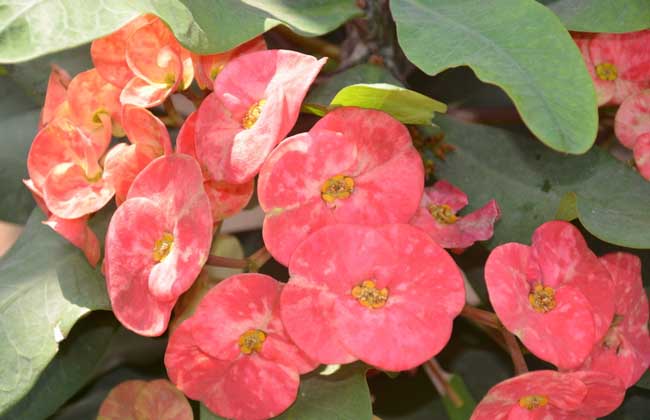
Crown of thorns, also known as iron begonia, qilin thorn, qilin flower, etc., is a trailing shrub plant of the genus Euphorbia in the family Euphorbiaceae, native to Madagascar in Africa, widely cultivated in the tropics and temperate zones of the Old World, and cultivated in both northern and southern China, commonly seen in parks, botanical gardens and courtyards, with extremely high ornamental cultivation value. Let's take a look below at how to grow potted crown of thorns!
Growth habits of crown of thorns
Crown of thorns prefers a warm, humid and sunny environment, is slightly shade-tolerant, but fears high temperatures, is relatively drought-tolerant, and is not cold-tolerant. Loose, well-drained leaf mold soil is best. If the temperature is relatively low in winter, it shows a short period of dormancy. Crown of thorns has many horticultural cultivation types, among which the one with yellow-white bracts is rather special and is cultivated in very few places in China.
Propagation methods of crown of thorns
Crown of thorns is mainly propagated by cuttings, and cuttings can be taken throughout the entire growing period, but May to June is best, with a high survival rate and the greatest ease of rooting. Choose thick, strong branches about 10 cm to 15 cm long (with 3 to 4 leaf nodes), wipe dry the white sap flowing from the cut, apply plant ash, air-dry in a cool place for 2 to 3 days, and after the wound is dry, insert into plain sand, water thoroughly, then water sparingly afterward, watering again when the potting soil is slightly dry; after about 50 to 60 days it will be able to take root.
How to grow potted crown of thorns?
1. Soil: The substrate used for potting crown of thorns can be garden soil: furnace slag = 3:1, or garden soil: medium-coarse river sand: sawdust (mushroom residue) = 4:1:2, or one of paddy soil, pond mud, and leaf mold, or peat + perlite + ceramsite = 2 parts + 2 parts + 1 part, or garden soil + furnace slag = 3 parts + 1 part, or peat + furnace slag + ceramsite = 2 parts + 2 parts + 1 part, or sawdust + vermiculite + medium-coarse river sand = 2 parts + 2 parts + 1 part.
2. Potting: When potting small crown of thorns seedlings, first place a 2 to 2 cm thick layer of coarse-grained substrate or ceramsite at the bottom of the pot as a drainage layer, sprinkle a layer of fully decomposed organic fertilizer on top as base fertilizer, about 1 to 2 cm thick, then cover with another layer of substrate about 1 to 2 cm thick, and then place the plant in, so as to separate the fertilizer from the root system and avoid burning the roots. After potting, water once thoroughly and keep it in a slightly shaded environment for one week.
3. Watering: Crown of thorns belongs to the succulent plants, is drought-tolerant, and should not be watered too much. If the potting soil is too wet for a long time, it will not only cause root rot but also endanger the plant's survival, so usually watering should be done when the potting soil is slightly dry. In summer, water evaporates quickly, so watering should be appropriately increased, but water must not accumulate in the pot. Too much watering during the flowering period will cause flowers and buds to drop, and may even cause root rot.
4. Fertilizing: Crown of thorns should be fertilized sparingly, with light fertilizer applied 2 to 3 times each spring. Fertilizing can be reduced in autumn. It does not like concentrated fertilizer; during the growing period, applying once every 3 to 4 weeks a diluted, decomposed cake fertilizer solution is sufficient. Too much fertilizer, especially too much nitrogen fertilizer, causes leggy branches that only grow leaves and do not bloom. Applying phosphorus and potassium fertilizer 1 to 2 more times during the bud stage will result in more flowers and brighter colors.
5. Light: Crown of thorns likes ample sunlight and should be given relatively sufficient light throughout all four seasons. During the flowering period, sufficient sunlight makes the bracts brightly colored and extends the flowering period. Insufficient sunlight makes the flower color dull, and if kept in shaded conditions for a long time, it will not bloom or will bloom very little. It likes warmth and is not cold-tolerant. In northern regions, it is generally moved outdoors in early May and placed in a sunny spot, then moved indoors in early October and placed in a spot indoors with sunlight.
6. Temperature: Crown of thorns likes during the wintering period, when the room temperature is low, the leaves completely fall off and it enters a semi-dormant state; at this time, watering must be strictly controlled to keep the potting soil dry. When the temperature is below 0°C, the plant will die from freeze damage. If the winter room temperature can be kept above 15°C, it will bloom continuously throughout the winter. Crown of thorns is a very suitable autumn and winter indoor flower for cultivation in the north.
7. Pruning: The flowers of crown of thorns bloom at the tips of new branches. To make crown of thorns bloom more, proper pruning must be carried out. Because if the main branches are too long, there will be fewer flowers. Therefore, after the flowering period, the overly long and irregularly growing branches should be cut short. Generally, 2 new branches grow below the cut, and when the new branches grow to 5 to 6 cm, they can bloom. Prune once a year, and after a few years, the whole plant will be covered with bright little red flowers.
8. Pests and diseases: In continuous rainy seasons, with a lot of rain, high air humidity, and an unclean potting soil surface, crown of thorns is prone to root rot and stem rot. For root rot, root rot medicine can be used as a soil drench; for stem rot, agricultural streptomycin or lythidathion can be sprayed on the stems. The main pests of crown of thorns are whiteflies and scale insects. Whiteflies can be controlled by spraying pymetrozine or acetamiprid, and scale insects can simply be caught by hand.