What Plant Is Water Hyacinth? A Comprehensive Guide in One Article
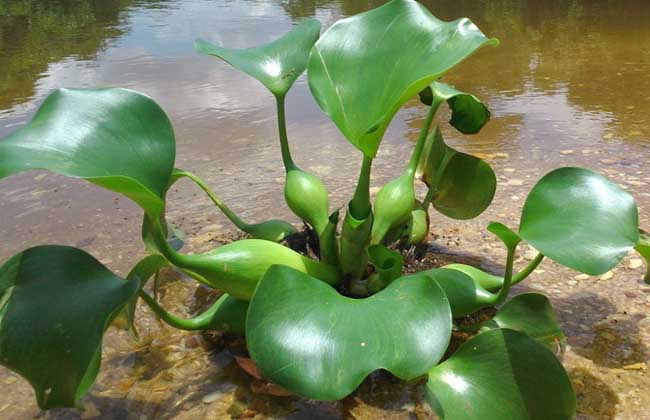
Water hyacinth, scientifically known as Eichhornia crassipes, is also called water lettuce, water hyacinth, basket plant, and floating water lily, among other names. It is a floating herbaceous plant in the genus Eichhornia of the family Pontederiaceae, native to Brazil and now widely distributed across the Yangtze River and Yellow River basins and the provinces of South China, often growing in ponds, ditches, and rice paddies. In areas suitable for its growth, it often blocks waterways and affects transportation due to overpropagation. It was once introduced by many countries and is widely distributed around the world, and has also been listed as one of the world's 100 worst invasive alien species.
Water hyacinth has well-developed fibrous roots that are brownish-black. The stem is extremely short, and the stolons are pale green. The leaves cluster at the base in a rosette arrangement; the leaf blades are round with a dark green surface, the petioles vary in length, and the base of the petiole has sheath-like yellow-green bracts. The scape is multi-angled. The spike usually bears 9 to 12 flowers; the petals are violet-blue, the corolla is slightly bilaterally symmetrical, pale purplish-red around the edges and blue in the middle, with 1 yellow round spot in the center of the blue, and the base of the tepals is fused into a tube. The capsule is ovoid. The flowering period is from July to October, and the fruiting period is from August to November.
Water hyacinth prefers a warm, humid environment with ample sunlight and is highly adaptable. The suitable water temperature is 18 to 23°C; it can still grow above 35°C, and stops growing when the air temperature falls below 10°C. It has a certain degree of cold tolerance. It prefers to grow in shallow water and can also grow in water bodies with slow flow, drifting with the water. It reproduces rapidly. After flowering, the flower stem bends into the water to grow, and the ovary develops and swells in the water.
Water hyacinth has a strong enrichment effect on various inorganic elements such as nitrogen, phosphorus, potassium, and calcium, with its enrichment effect on the macronutrient potassium being especially prominent. Among the existing ways of utilizing Eichhornia crassipes as a resource, the simpler and more common methods are composting it into organic fertilizer and producing biogas; its dried powder or the ash after burning can also be used directly as fertilizer or a soil conditioner. The flowers and tender leaves can be eaten directly; they have a fresh, fragrant, and refreshing taste and also have the effect of lubricating the intestines and relieving constipation.
Water hyacinth is a floating herbaceous plant with well-developed fibrous roots and an extremely short stem. The flowers are light blue and trumpet-shaped with multiple angles, and the upper petals are relatively large. There is an obvious bright yellow spot in the center of the petals, shaped like a phoenix eye and also like the flower spot at the tip of a peacock feather, very eye-catching and beautiful. It is often used as a landscaping material in garden waterscapes; planted in a corner of a small pond and enclosed with bamboo, it creates a serene, wild charm.
Water hyacinth is an excellent plant for monitoring environmental pollution. It can monitor whether arsenic is present in water and can also purify harmful substances such as mercury, cadmium, and lead in water. During growth, it can absorb large amounts of nutrients such as nitrogen and phosphorus as well as certain heavy metal elements from water bodies, and its effect is even more ideal for purifying water bodies such as industrial wastewater or domestic sewage containing more organic matter.