Potted Anthurium: How to Grow It and What to Watch Out For
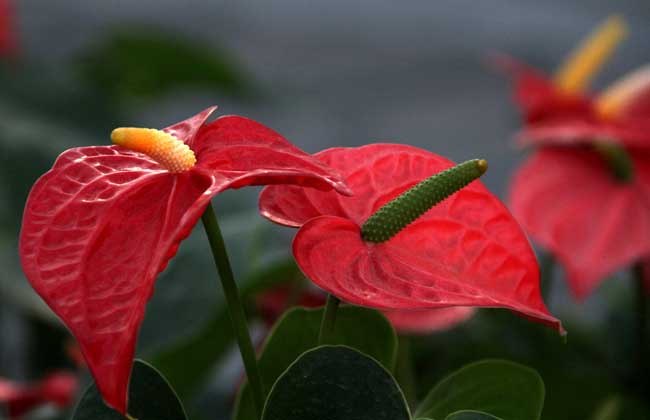
Anthurium is also known as flamingo flower, red goose-foot, and fire crane flower. It is a perennial evergreen herbaceous plant of the genus Anthurium in the Araceae family, native to tropical rainforest regions such as Costa Rica and Colombia. Its flowers are strikingly beautiful, and its blooming period is long-lasting. It is suitable for potted growing, cut flowers, or mass planting in shaded garden spots for landscaping. Let's take a look below at how to grow potted anthurium well!
Anthurium's Growth Habits
Anthurium often grows as an epiphyte on trees, sometimes on rocks or directly on the ground. It likes warm, humid, well-drained semi-shaded environments, and fears drought and intense direct sunlight. The suitable daytime temperature for growth is 26-32°C, and the nighttime temperature is 21-32°C. The highest temperature it can tolerate is 35°C, and the lowest it can tolerate is 14°C.
Anthurium Propagation Methods
1. Division: Division is mainly done in the cool, humid spring; it can also be done in cool autumn weather. Never divide in the hot summer or in dry, cold seasons.
2. Cuttings: For cuttings, cut off sections with 1-2 stem nodes and 3-4 leaves as cuttings, insert them into sphagnum moss, and plant them in pots after new roots sprout.
3. Sowing: Anthurium seeds are relatively large. Sow indoors in pots. The suitable germination temperature is 25-28°C. They germinate 20-25 days after sowing. Seedling plants need 3-4 years of cultivation before they bloom.
How to Grow Anthurium
1. Humidity: Normal growth of anthurium requires about 70% air humidity, which is generally hard to achieve in ordinary home growing. You can wipe the leaves with a clean damp towel several times a day, or spray water around the plant regularly to increase air humidity, but never sprinkle water on the flowers, as this affects their ornamental quality.
2. Fertilizer and water: Under normal growth conditions, water the potting soil about once a week, letting it dry out slightly between waterings. Generally follow the principle of not watering when the soil surface is still moist, and watering thoroughly when you do. In spring, autumn, and winter, you can appropriately reduce the frequency and amount of watering. Every half month, apply a 7-8% special nutrient solution or fertilizer water diluted 500 times along with watering.
3. Pruning: Under normal circumstances, during anthurium's growth, the leaf stalks at the base gradually degenerate; when the stipules dry out, they can be cut off promptly. After blooming, when the flower stalk turns yellow, it should also be cut off from the base as soon as possible, leaving a 2-cm protective stub.
4. Temperature: When growing anthurium, ensure the temperature as much as possible. The optimal growth temperature for anthurium is 16-24°C, and the minimum temperature should be kept above 12°C. In ordinary homes with heating facilities, this condition is easy to meet. But at the same time, note that the pot must not be placed on top of a radiator or too close to it. When the summer temperature exceeds 30°C, move the plant to a ventilated room relatively toward the north side, and you can spray water around the plant to cool it down.
5. Light: Normal growth of anthurium requires sufficient scattered light. For home growing, generally note the following: in summer, avoid strong direct sunlight on the leaves and flowers; in autumn and winter, when conditions permit, move the plant near a window to increase light exposure. Also rotate the plant regularly to ensure it receives even light, promoting a full, rounded crown shape.
What to Do When Anthurium Leaves Turn Yellow?
1. Metabolism: If you notice anthurium leaves turning yellow, pay attention to the condition of the other leaves. If the leaves are fresh, tender yellow-green while the flowers are growing well, it means new leaves are growing, and old leaves turning yellow and dropping is normal.
2. Unsuitable soil: In most northern regions, the growing medium and water contain relatively high levels of salt and alkali. Because the medium lacks the soluble iron that the plant needs to absorb, the leaves gradually lose their green color and turn yellow. The solution is to treat the medium and watering water with oxalic acid, etc.
3. Overwatering: When anthurium's new leaves turn yellow while the old leaves remain normal, this is generally due to watering too much or too often, which keeps the potting medium wet for a long time, or even waterlogged, causing some fibrous roots to rot, hindering normal respiration and nutrient absorption, and causing leaves to gradually turn yellow and drop. The solution is to water normally.
4. Dry air: In winter, when the indoor air for growing plants is too dry, leaf tips often dry out and turn yellow, or leaf edges become scorched, or leaves develop scorched spots with curled edges. The solution is to appropriately increase air humidity according to anthurium's growth characteristics.
5. Excessive shading: If anthurium is kept in a shaded spot or a place with insufficient light for a long time, its growth will weaken, the leaves will be thin and yellow, and it will not bloom or bloom very little. The solution is to appropriately increase light intensity according to anthurium's growth characteristics.
6. Unsuitable temperature: If the indoor temperature is too low in winter, the leaves will turn yellow. If the room temperature is too high, the plant transpires excessively, and the roots cannot supply enough water and nutrients, which also makes the leaves turn yellow. The solution is to keep the greenhouse temperature relatively stable.
7. Uneven fertilizing: Too little fertilizing, or not repotting or changing the soil for a long time, leads to a lack of nutrients such as nitrogen in the soil, causing weak branches and leaves, and thin, yellow leaves. In addition, excessive fertilizing can also cause new leaves to become thick and uneven, while old leaves dry at the tips, turn scorched yellow, and drop. At this point, stop fertilizing immediately, increase watering, remove some of the old soil, replace it with new potting soil, and carry out normal care.