How to care for potted bromeliads? A detailed guide to growing methods
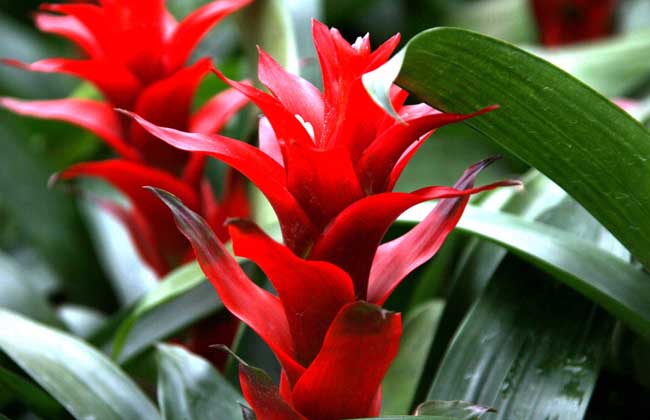
The bromeliad is a highly ornamental plant grown both for its flowers and its foliage, also known as the ornamental bromeliad, pineapple flower, and so on. It originates from the jungles stretching from Mexico to southern Brazil and northern Argentina. Its leaves are sickle-shaped, with the upper part slanting downward, arranged in 5 to 8 leaves forming a tubular rosette. It can be grown indoors as a home gardening ornamental. Let us take a look below at how to care for potted bromeliads!
The growing habits of bromeliads
Bromeliads are epiphytes, native to the tropical rainforests of Central America. Most bromeliads prefer semi-shaded environments and dislike direct sunlight. Relative humidity needs to be maintained between 68 and 75%. Daytime temperatures should be around 22 to 28°C, while at night it is best to keep them at around 20 to 21°C. However, during periods of high temperature and high humidity in summer, insufficient ventilation can easily occur, stunting growth and inviting pests and diseases, so ventilation must be maintained. Under strong light, when air humidity is below 65%, or when the air is dry with good ventilation, leaf tips can also wither. Note that after the flower spike emerges, if it encounters high temperatures (30 degrees), the color of the flower spike will fade and the flowering period will also be shortened.
Propagation methods for bromeliads
1. Division: Small shoots continuously grow from the leaf axils at the base of ornamental bromeliads. When they have grown 5 to 6 leaves, they can be cut off for propagation by cuttings, and roots will appear in about 1 month.
2. Cuttings: Bromeliad propagation by cuttings can be combined with repotting in spring. Cut off the small tubers growing from the tuberous part of the mother plant for cuttings, or use the rooted young shoots sprouting from the roots of an old bromeliad plant for division. Both require shade, moisture retention and warmth. Use a soil mix of half leaf mold and half plain sandy soil. When the roots grow to 2 to 3 cm, they can be planted out.
3. Sowing: Sow bromeliad seeds obtained after artificial pollination following flowering at 25°C to 30°C. Seedlings emerge in about 4 weeks, and in about 3 to 4 years they grow into flowering bromeliad plants.
How to care for potted bromeliads?
1. Soil: For growing bromeliads, a loose mix of peat soil, humus soil and tree fern fragments is best. For home growing, it is best to use leaf mold plus a small amount of garden soil, or a half-and-half mix of peat soil and perlite. Choosing the right soil allows bromeliads to absorb water better.
2. Temperature: The optimum growing temperature for bromeliads is 20°C to 30°C. At the highest, it should not exceed 35 degrees; at the lowest, it should not drop below about 10 degrees. Temperatures that are too high or too low both have adverse effects on bromeliads, so you must grasp the bromeliad's temperature requirements.
3. Light: Bromeliads do have certain light requirements, which also stems from their growing environment. Bromeliads are shade-loving plants, so they cannot be exposed to direct sunlight. When exposed to sunlight for too long, some leaves will turn yellow. At the same time, they do need a moderate amount of light for photosynthesis, so bromeliads are suitable for placement in semi-shaded spots, or by a window with bright light, or indoors.
4. Water: Bromeliads do not require too much or too little moisture in the soil. Make sure the soil surface in the pot is slightly dry. At the base of the bromeliad's leaves there is a leaf cup, and below the leaf cup there is a water reservoir. Make sure there is always water in the reservoir without interruption. Also be sure to spray a mist of water on the bromeliad's leaves frequently, which also maintains air humidity to meet the bromeliad's growing needs.
5. Fertilizing: Bromeliads mainly absorb nutrients through their leaf cups, so during the growing period apply nitrogen fertilizer once a week, and appropriately increase phosphorus and potassium fertilizer before flowering to promote larger flowers and richer color. Applying the right amount of fertilizer is also an indispensable part of growing bromeliads well, so during cultivation you should also pay more attention to giving bromeliads the right amount of fertilizer.