How to grow potted gladiolus well? A detailed guide to care methods
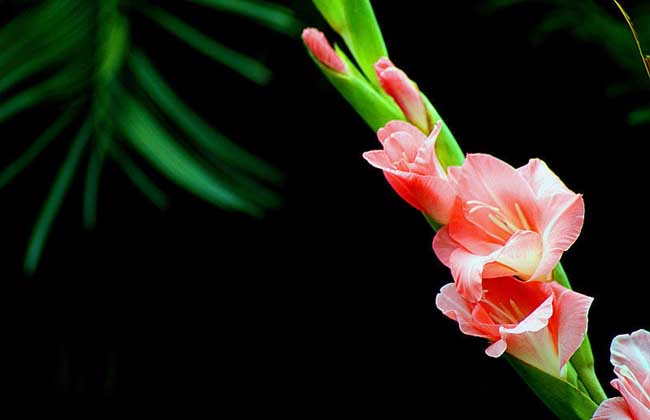
Gladiolus, whose scientific name is Gladiolus gandavensis, also known as Changlan, flat bamboo lotus, shiyangjin and so on, is a perennial herbaceous plant of the genus Gladiolus in the family Iridaceae. It is widely cultivated around the world and is an important cut flower, and can be used for flower baskets, bouquets, vase arrangements and so on, and can be used to arrange flower borders and special flower beds. Dwarf varieties can be grown in pots for ornamental viewing. Let's take a look below at how to grow potted gladiolus well!
The growth habits of gladiolus
Gladiolus is a plant that likes warmth, but too high a temperature is unfavorable to its growth. It is not cold-tolerant, and the suitable growth temperature is 20-25°C. The corms can sprout in soil temperatures above 5°C. It is a typical long-day plant; long daylight favors flower bud differentiation, and insufficient light will reduce the number of flowers, but after flower bud differentiation, short daylight favors flower bud formation and earlier flowering. The bulbs of summer-flowering varieties must all be stored indoors over winter, and the room temperature must not be lower than 0°C. The cultivation soil is best as fertile sandy loam, with a pH value not exceeding 7. It especially likes fertilizer; phosphate fertilizer can improve flower quality, and potassium fertilizer promotes improving corm quality and the number of daughter corms.
Propagation methods of gladiolus
1. Corm division: After 1 year of cultivation, each mother corm of gladiolus will produce 1-2 commercial corms and many daughter corms. For medium and large corms, use the method of digging furrows and sowing at points, with the furrow depth about 3 times the corm diameter, and the plant spacing flexibly determined according to corm size. For small corms, use the method of digging furrows and broadcasting, and daughter corms are mostly directly broadcast. Before planting, apply sufficient basal fertilizer, but note that the fertilizer must not come into direct contact with the corms. After sowing, pay attention to water management; before emergence, do not water if the soil is not dry.
2. Corm cutting: For certain rare gladiolus varieties that need to rapidly expand their propagation coefficient, plump and full commercial corms can be cut into 2-4 pieces, and each piece must retain part of the root plate and a complete, plump bud, to be used for daughter corm propagation. To prevent the seed corms from rotting, the cut surfaces should be smeared with charcoal powder or plant ash and planted immediately.
3. Tissue culture: Tissue culture propagation can rejuvenate and strengthen conventional cultivated varieties. Because long-term asexual propagation makes variety mixing and degeneration quite serious, regular tissue culture must be carried out for virus elimination and rejuvenation. Both petals and lateral buds can be used as explants. After disinfection and inoculation, they can be placed under conditions of 25°C and 2000 lux for culture, and seedlings are obtained through induction, subculture and rooting culture. If the seedlings continue to be cultured, test-tube small corms can be obtained, and after hardening and two years of planting, the test-tube corms grow into mother corms.
How to grow potted gladiolus?
1. Temperature: Gladiolus has relatively high temperature requirements, with the optimum temperature around 20°C. When the temperature is below 10°C, it begins to stop growing, and when below 3°C, it may freeze and die.
2. Light: Gladiolus is a light-loving plant with relatively long sunshine requirements, so during growth it needs long-term sunlight; otherwise insect pests or some diseases may occur.
3. Humidity: The humidity requirements of gladiolus are actually the same as those of some other plants such as bromeliads and frangipani. As long as a certain humidity is maintained, and in summer when it is hot, remember to water the leaves more to keep them moist.
4. Soil: Gladiolus relatively likes soil rich in organic matter and relatively rich in fertilizer. Generally, maintaining good ventilation and drainage is enough.
5. Watering: Gladiolus is a bulbous plant, and its water and fertilizer control is relatively strict. Before planting in pots, the soil needs to be moistened to a certain degree. The general requirement is not to water if the soil is not dry, and to water as soon as it dries.
6. Fertilizing: Fertilizing gladiolus is also very important. Generally, start fertilizing after the first leaves appear. During the bud stage, remember not to use nitrogen fertilizer when fertilizing; at this time, phosphate fertilizer is needed for flowering. Also weed it frequently.
Pest and disease control of gladiolus
1. Mosaic disease
[Symptoms] It infects leaves and also infects parts such as flowers. In the early stage of the disease, chlorotic angular spots and round spots appear on the leaves. Because the expansion of the diseased spots is limited by leaf veins, they are mostly polygonal, and finally turn brown. Diseased leaves become yellowed and twisted. Affected plants are short and have short flower spikes, and severely affected plants cannot produce flower spikes. In early summer, the symptoms on new leaves are especially obvious; in midsummer, the symptoms are not obvious, and there is a phenomenon of symptom masking.
[Control] Strengthen quarantine to control the occurrence of the disease. Test the seed corms, select virus-free corms for planting, and uniformly destroy corms with viruses to reduce reinfection of the flowers. Promptly remove diseased plants from flower beds to prevent mutual infection. When the disease occurs, spray the leaves with 58% mancozeb wettable powder at 500 times dilution, or 75% chlorothalonil wettable powder or 50% carbendazim wettable powder at 1000 times dilution, spraying once every 7 days; generally 3-4 sprays are enough.
2. Dry rot
[Symptoms] It harms the corms, leaves, flowers and roots of the plant. When the plant becomes diseased, the tips of the outer leaves first begin to yellow, then it spreads to the inner leaves, and finally they wither.
[Control] Try to avoid continuous cropping in the planted flower beds, avoid applying too much nitrogen fertilizer, and appropriately increase the amount of phosphate and potassium fertilizer used. Before planting, corms can be soaked in 50% carbendazim at 500 times dilution for 30 minutes. In the early stage of the disease, spray the leaves with 50% zineb at 1000 times dilution once every 7 days, generally spraying 3 times.