How to grow potted red spider lilies? Cultivation methods and precautions
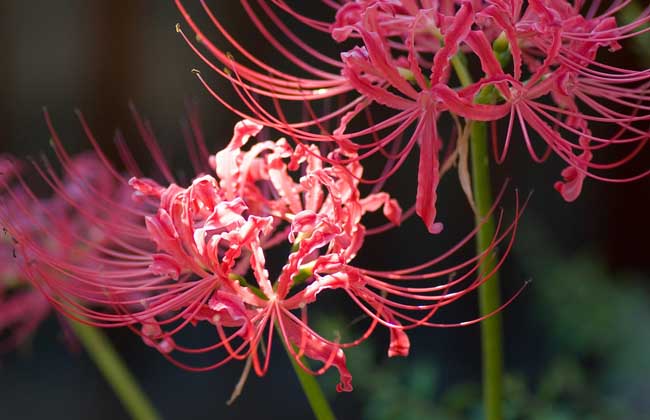
The red spider lily, whose scientific name is Lycoris radiata, also known as ghost fire flower, hell flower, dragon claw flower, etc., is a perennial herbaceous plant of the genus Lycoris in the Amaryllidaceae family. Legend says this flower is the flower that guides souls, and its fragrance has magical power that can awaken the memories of the dead from before they died. Because its flowers and leaves can never meet, it is also called the heartless and faithless flower. Let us take a look below at how to grow potted red spider lilies!
Growth habits of the red spider lily
The red spider lily is native to the middle and lower reaches of the Yangtze River and parts of southwestern China, as well as the Matsu Islands, and is also distributed in Vietnam, Malaysia and various parts of East Asia. It likes sunny and humid environments, but can also tolerate semi-shade and arid environments, is slightly cold-tolerant, has strong vitality, and has no strict requirements for soil. If the soil is fertile and well-drained, the flowers will be especially abundant. In addition, Lycoris radiata likes to grow in cemeteries, so it is also called the dead man's flower.
Propagation methods of the red spider lily
1. Bulb division: Bulb division is the simplest propagation method for the red spider lily. During the dormant period or after flowering, dig up the plant, remove the offset bulbs attached near the mother bulb and plant them. They will bloom in about one to two years.
2. Cutting method: Cut the cleaned bulb base into eight sections in a star pattern, with a cutting depth of about 1/2 to 2/3 of the bulb length. After disinfection and drying in the shade, insert into moist sand, perlite or other substrate. After 3 months, adventitious buds can be seen forming at the junction of the scales and the basal plate, gradually producing small bulbils, which can become seedlings after separation and cultivation.
3. Tissue culture method: Using MS medium, take flower stalks and ovaries as explant materials. After culture, callus tissue can be produced at the cut surface. After 1 month, adventitious roots can form, and after 3 to 4 months, adventitious buds can form. Using flower stalks and scales with stems as explant materials can also produce adventitious buds and bulbils.
4. Sowing method: Generally only used for hybrid breeding. Since the seeds have no dormancy, they should be sown immediately after collection. At 20°C, the radicle can be seen emerging after 15 days. When sown in a natural environment, only a few seedlings produce one leaf in the first growth cycle, and the seedlings can be transplanted once. Seedlings take about 4 to 5 years from sowing to flowering.
How to grow potted red spider lilies?
1. Soil: The red spider lily is not particular about soil, but it grows best in loose, fertile soil rich in humus. Wild varieties generally grow in gloomy and humid areas, with red soil as their habitat, and are accustomed to acidic soil. When planting red spider lilies, use soil with good drainage, otherwise waterlogging easily forms and the bulbs will rot.
2. Water: The red spider lily likes moisture, but can also tolerate drought. However, when planted in well-drained soil, maintaining a sufficient water supply will make the red spider lily grow better. When growing red spider lilies, if the surface soil is found to be dry and grayish-white, it is time to replenish water for the red spider lily. In summer, because the red spider lily enters dormancy, gradually reduce the frequency and amount of watering, and it is best to stop watering.
3. Light: The red spider lily likes semi-shaded environments, but can also tolerate strong sun. It enters dormancy in summer, so direct sunlight should be avoided, and it should be placed in a cool environment for cultivation.
4. Fertilization: The red spider lily is a bulbous flower with a relatively long growth period. Before planting, bury sufficient organic fertilizer in the soil, then apply topdressing once every two months. You can use homemade decomposed compost or a three-element fertilizer, with emphasis on a higher proportion of phosphorus and potassium fertilizer, to promote bulb development and flowering.
5. Temperature: The red spider lily likes warm environments, but the maximum temperature cannot exceed 30°C, and the daily average temperature cannot be higher than 24°C. In winter, the daily average temperature must be kept above 8°C, with a minimum temperature of 1°C, so as not to affect the growth of the red spider lily.
6. Pests and diseases: Common diseases of the red spider lily include anthracnose and bacterial soft rot. Before planting the bulbs, soak them in 0.3% copper sulfate solution for 30 minutes, wash with water, and plant after drying. Spray 50% carbendazim wettable powder at 500 times dilution every half month for prevention and control. In the early stage of disease onset, spray with 50% benomyl at 2500 times dilution.