How to Grow and Care for Potted Peace Lilies: Methods and Precautions
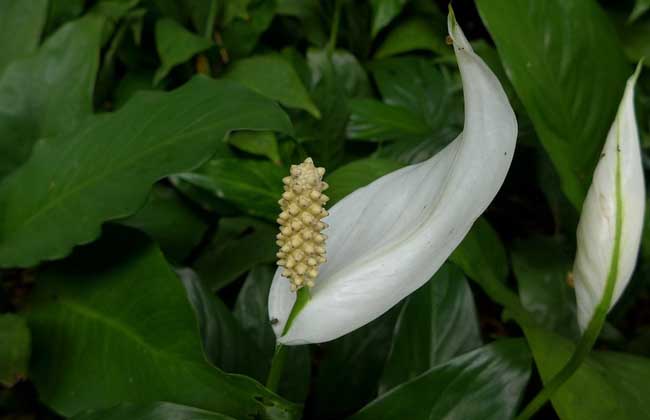
The peace lily, also known as Spathiphyllum, white sail, or "smooth sailing," is a perennial herbaceous plant of the genus Spathiphyllum in the Araceae family. It has emerald green leaves and a white spathe, making it very fresh and elegant with excellent ornamental value. It can filter indoor exhaust gases and has a certain purifying effect on ammonia, acetone, benzene, and formaldehyde. Let's take a look together at how to grow a potted peace lily!
Growth Habits of the Peace Lily
The peace lily prefers high temperatures, high humidity, and semi-shaded environments. It is relatively sensitive to humidity and afraid of strong light and scorching sun. In summer, provide 60-70% shade, but long-term insufficient light will make it difficult to bloom. The ideal soil is fertile loam rich in humus. The suitable growth temperature is 22-28°C, from March to September it should be 24-30°C, and from September to the following March it should be 18-21°C. In winter, the temperature should not be lower than 14°C; below 10°C, plant growth is hindered and leaves are prone to cold damage. During storage and transport of potted peace lilies, keep the temperature at 13-16°C and relative humidity at 80-90%; it can tolerate dark environments for 30 days.
Propagation Methods for the Peace Lily
1. Division: The best time for propagating peace lilies by division is May to June. Lift the entire plant out of the pot, cut the rhizome apart from the base of the clump, ensuring each division has at least 4 leaves. After replanting, place in a semi-shaded area to recover.
2. Seeding: After the peace lily blooms, seeds can be obtained through artificial pollination. After collecting the seeds, they must be sown immediately. The germination temperature is 30°C, and germination occurs 10-15 days after sowing. If the temperature is too low during germination, the seeds are prone to rot. After disinfection, inoculate onto an added culture medium, and after 45 days, callus tissue and adventitious buds will grow.
3. Tissue culture: Using young inflorescences and lateral buds as explants, after disinfection, inoculate onto MS medium supplemented with 10 mg/L 6-benzylaminopurine and 2 mg/L indoleacetic acid. After 40-45 days, callus tissue and adventitious buds will grow. Then transfer the adventitious buds to MS medium supplemented with 2 mg/L indoleacetic acid. After 30-40 days, roots are induced, forming complete plants.
How do you grow a potted peace lily?
1. Soil: Potted peace lilies require loose soil with good drainage and aeration. Heavy clay soil must not be used. Generally, a mix of leaf mold, peat soil, and a small amount of perlite can be used as the substrate. When planting, add a small amount of organic fertilizer as a base fertilizer.
2. Division: Peace lilies are usually divided in spring from March to May when repotting, or in autumn. Select robust two-year-old plants for division propagation. Lift the entire peace lily out of the pot, cut the rhizome apart from the base of the clump, ensuring each division has at least 3-4 leaves.
3. Potting up: Reinsert the divided plants into the pot. After planting, place in a semi-shaded area to recover and take root. Note that when cutting, you should include a portion of the stem, then apply wood ash to the wound to prevent rot. Once the root system has recovered to normal, proceed with regular care.
4. Light: Light is very important for plant growth. Peace lilies need relatively good light in winter and early spring, but as light intensity increases, gradually provide shade. If it is being enjoyed in a shaded spot, it must not be placed directly in the sun for exposure, as this is very bad for the peace lily's growth.
5. Temperature: The peace lily is a high-temperature species and should be cultivated in a high-temperature greenhouse. In winter, the minimum nighttime temperature should be 14-16°C, and the daytime temperature should be around 25°C.
6. Watering: During the growing period, the peace lily's potting soil should be kept moist regularly, but do not water excessively. Too much watering will keep the potting soil wet for a long time, easily causing root rot and the plant to turn yellow and wither.
7. Fertilizing: Do not apply concentrated fertilizer or raw fertilizer to peace lilies. After applying solid fertilizer, water once with clear water. It is best to use diluted liquid fertilizer instead of clear water for irrigation. This generally will not cause fertilizer damage, and the peace lily will grow very lushly.
8. Pests: During the growing period, peace lilies are very susceptible to pests. Regularly spray with acaricides specifically for mites, such as dicofol, hexythiazox, and pyridaben.
9. Repotting: Repot peace lilies every 1-2 years. When repotting, prune the root system, remove some old roots and overly long roots, remove old soil, and replace with fresh potting soil to promote blooming.