How to grow North American crabapple? Detailed guide to cultivation methods
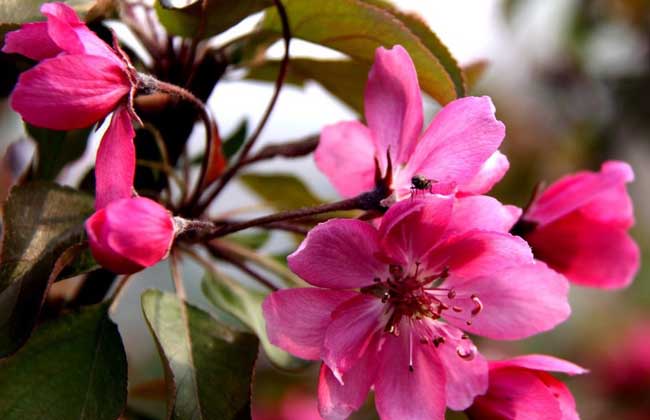
North American crabapple, scientific name Malus (American crabapple), is a deciduous small tree of the Rosaceae family, genus Malus. It has strong resistance, is cold-tolerant and tolerant of extremely poor conditions, easy to manage, and has good ornamental effect. In landscaping it is suitable for row planting along both sides of roads, and can also be planted as a specimen, in groups on lawns, or as an accent beside rocks and by lake shores. Let's take a look at the cultivation methods for North American crabapple!
Growth habits of North American crabapple
North American crabapple has strong resistance, tolerates extremely poor conditions, and is highly cold-tolerant. It likes sunlight, tolerates drought, and is averse to waterlogging, growing well in dry areas and being easy to manage. After late autumn, as temperatures gradually drop, growth is also inhibited, and it then enters a semi-dormant state, with no new branches or tender leaves and few flowers. In northern China, temperatures in January and February are low, sometimes with continuous severe freezing. If household cultivation does not pay attention to keeping warm, there is a possibility of freezing to death, so before frost the potted plants should be moved indoors to a sunny spot. Air humidity and soil pH level adjust the intensity and brightness of autumn leaf color; when rainfall is abundant, the leaf color is more vivid. In summer, give sufficient irrigation to fatten the leaves, and do not let them dry out in autumn.
Cutting propagation of North American crabapple
1. Cutting time: For home cuttings of North American crabapple, it is best to do it between April and May, when the temperature rises above 20°C. At this time air humidity is high and temperatures are warm, management is simple, and it is suitable for rapid rooting of North American crabapple. Wash river sand, dry it in the sun, and place it in a pot. River sand that has been washed and then sun-dried basically achieves the purpose of disinfection, and the sun-dried river sand helps raise the temperature through daytime sunlight, promoting healing and rooting of the cut surface of the cuttings.
2. Cutting method: Cut strong branches of North American crabapple, each segment with 3-4 nodes, cut the top into a flat shape and the bottom into a horseshoe shape, to enlarge the contact surface with the sand and promote rooting. Insert the cuttings into the sand pot at a spacing of 3 cm × 4 cm. When inserting, first use a bamboo stick of the same thickness as the cutting to poke holes in the pot sand, then insert the American crabapple branches.
3. Post-cutting management: Within 2 days after cutting, North American crabapple does not need watering, which helps the cut surface form a healing callus. On the 5th day, spray-water with water at about the same temperature as the sand, until water is seen flowing out from the bottom of the pot. Place in a cool, shady place, and generally do not water again. After about 10 days, roots 3-4 cm long can grow. At this time, place the pot in sunlight and water according to weather conditions. After another 6-7 days, it can be potted and planted out.
Cultivation methods for North American crabapple
1. Soil configuration: North American crabapple is generally planted in the ground, and can also be potted to make bonsai. Plant in spring. Because it is averse to waterlogging, it should be planted in a slightly higher place that is not prone to water accumulation and faces the sun. The soil should be neutral to slightly alkaline, with a pH value not lower than 7. The soil texture should be loose, but not too fertile; overly fertile soil easily causes excessive vegetative growth and fewer flowers. The planting hole should be determined according to the size of the root system, and should not be too deep or too large; it is best if the root system can spread out. The planting depth should be about 10 cm from the ground. It is best to plant with a soil ball, and water thoroughly after planting.
2. Light and temperature: North American crabapple is suitable for growing in an environment with sufficient light, and grows poorly in shaded environments. If potted crabapple trees are grown, they should be placed in a well-lit place during the growing season. In winter, it will not suffer freezing damage even at a low temperature of -15°C, and can overwinter outdoors in the open ground. However, in an exceptionally cold winter, cold-protection measures are needed.
3. Fertilizer and water management: Watering of North American crabapple is carried out together with fertilizing. After leaf fall each autumn, apply 1 heavy fertilizing to replenish the nutrients consumed by flowers and fruit; applying decomposed organic fertilizer is best. At the same time, combine with winter irrigation and watering. Before spring buds sprout, apply 1 application of organic fertilizer and water once thoroughly. The method of fertilizing in autumn and winter varies with tree age: for young trees, use ring-shaped digging and fertilizing, with the ring within 100 cm from the tree base; for older trees, use radial digging and fertilizing; for old trees, combine with inter-row weeding and broadcast organic fertilizer under the crown, then turn the fertilizer into the ground 30 cm deep. After the flowers fade, apply 2 additional applications of phosphorus and potassium fertilizer to ensure a certain fruit-setting rate. At the same time, pay attention to watering.
4. Pruning and training: The flower buds of North American crabapple mostly differentiate from terminal buds, and the main flowering branches are medium and short fruit branches, so medium and short fruit branches should be retained. Long branches should be shortened, and at the same time overly dense branches, dead branches, and diseased and pest-infested branches should be cut off, then prune according to the desired tree shape. If you want the crabapple crown to be full and rounded, thin out the dense growth and keep it sparse, cutting away overly dense branches, while for areas with sparse branches, prune downward so as to encourage more lateral branches and fill the gaps.