Cultivation Techniques for Black Potatoes
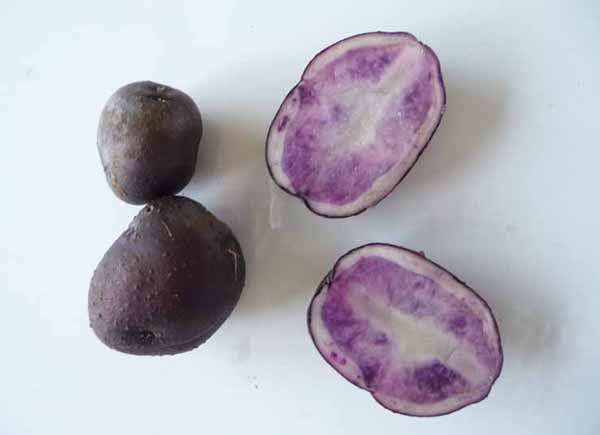
Black potatoes have high yields, strong adaptability, and a very wide range of uses. According to measurements, every 100 grams of tuber contains 2.30 grams of protein, 0.10 grams of fat, 16.50 grams of carbohydrates, 11.00 milligrams of calcium, 1.20 milligrams of iron, 64.00 milligrams of phosphorus, 342.00 milligrams of potassium, 22.90 milligrams of magnesium, 0.01 milligrams of carotene, 0.10 milligrams of thiamine, 0.03 milligrams of riboflavin, 0.40 milligrams of niacin, 16.00 milligrams of ascorbic acid, and 100.00 milligrams of anthocyanins. Their greatest feature is that they are rich in anthocyanins, with a content as high as 42.80 milligrams/kg, and they have multiple health benefits such as enhancing human immunity, delaying aging, strengthening the body, fighting cancer, beautifying the skin, and preventing high blood pressure. Therefore, black potatoes can be used as a side dish, as a specialty dish, and also as an excellent processing raw material for extracting anthocyanins. At present, the cultivated area of black potatoes in China is still small, and the market price is 6-8 yuan per kg, equivalent to 6-8 times that of ordinary potatoes. The yield is generally about 2500 kg per 667 sq m, and the economic benefit exceeds 10,000 yuan, which is quite considerable. The new variety and its supporting cultivation techniques have attracted much attention from farmers.
The whole growth period of black potatoes is about 93 days, and it is a mid-early maturing variety. It is drought-tolerant, cold-tolerant, and widely adaptable, and the tubers store well. It is resistant to early blight, late blight, ring rot, blackleg, and viral diseases. Its seedlings are upright and dark purple. The plant cluster is lush and the growth vigor is strong. The plant height is generally about 60.00 cm, the main stem is well developed, the stem thickness is 1.37 cm, the stem is dark purple, and the cross-section is triangular. There are relatively few branches, the petioles are purple, the corolla is purple, and the petals are dark purple. The tubers are oblong, with smooth skin that is black-purple, and the tuber flesh is dark purple with good quality. Tuber set is concentrated, with 6-8 tubers per plant and a single tuber weight of 120-300 grams.
Land Preparation
1. Plot selection: a loose, well-aerated soil plow layer is needed. Therefore, choosing sandy loam soil with high, dry terrain, flat ground, convenient drainage and irrigation, and a loose, deep, and fertile soil texture is the soil foundation for ensuring a high yield.
2. Crop rotation arrangement: black potatoes should not be planted continuously or rotated with solanaceous crops such as tobacco, eggplant, pepper, and sweet potato. It is better to use wheat, corn, Chinese cabbage, radish, and scallion as the previous crop.
3. Land preparation: to achieve high yield and good variety quality in black potatoes, the planting site should be deeply plowed before winter, generally to a depth of 25-30 cm. In early spring, fine land preparation should be carried out to make the soil fine and free of large clods, enhancing the soil's water-holding capacity.
4. Apply sufficient base fertilizer. Black potatoes are a high-yield, fertilizer-loving crop. Producing every 100 kg of fresh tubers requires 0.50 kg of nitrogen, 0.20 kg of phosphorus, and 0.95 kg of potassium, and the absorption ratio of nitrogen, phosphorus, and potassium is generally 2:1:4. Cattle, sheep, pig, and chicken manure, as well as green manure and compost, should be the main fertilizers, supplemented with an appropriate amount of chemical fertilizer. Determine the fertilization plan according to the soil nutrient test results and fertilizer requirement patterns. In combination with land preparation, apply 3-5 kg of decomposed organic fertilizer, 80-100 kg of superphosphate, 15-20 kg of potassium sulfate fertilizer, and 15 kg of urea per 667 sq m.
Seed Potato Treatment
1. Carefully select seed potatoes. 20-30 days before planting (generally around mid-January in this region), carry out seed potato selection, choosing seed potatoes that are disease-free, wound-free, smooth-skinned, fresh in skin color, with many eyes, uniform in size, and conforming to the variety characteristics. Remove tubers that are deformed, cracked, have necrotic eyes, or bear disease spots. About 120 kg of seed potatoes are needed per 667 sq m. For seed potato cutting, it is best to use one seed potato of one or two liang, as this will give a very high yield.
2. Seed potato cutting and sprouting. Sprouting before sowing can promote early emergence, increase the field growth period, and raise yield. Sunny beds, cellars, and greenhouses can all be used as sprouting sites. Place the selected seed potatoes in a light-avoiding environment at 20°C for warm sprouting. When the sprouts emerge to about 0.5 cm, cut the tubers. According to the arrangement of the eyes, start from the tail end of the tuber and cut in a spiral manner following the order of the eyes. Finally, split the top part into two, ensuring that each cut piece carries 1-2 strong top buds. The cut pieces should be uniform, and generally each seed potato piece should weigh about 25 grams. The cutting tools should be strictly disinfected with 75% alcohol.
3. Chemical treatment. Put the cut tubers into 0.01% boric acid or a 500-fold 50% carbendazim solution, soak for 5-10 minutes, then remove, drain, and dry in the shade. Move the shade-dried tubers to a warm, sunny place and sun them for 3-5 days, maintaining a temperature of about 15°C, so that the young sprouts turn green and become sturdy.
Sowing at the Right Time
1. Planting period. Black potato sprouts begin to germinate when the air temperature exceeds 5°C. At 18°C, they grow robustly and rapidly. Under normal circumstances, sowing can be done when the soil temperature stably passes 5°C. In the Tianjin area, the suitable open-field cultivation planting period is generally from mid-to-late March to early April. If too early, the seedlings are prone to frost damage; if too late, they cannot be marketed early, affecting planting benefits.
2. High-bed plastic film mulching. Double-row cultivation with high-bed plastic film mulching can increase the soil temperature by 3-5°C and advance the planting period by about 15 days. At the same time, it creates a healthy, loose environment for the normal growth of black potatoes and also facilitates manual or mechanical harvesting. Make turtle-back beds with a height of 20 cm, a width of 70 cm, and slightly higher in the middle according to a row spacing of 100 cm. After raking level, spray 100-150 grams of acetochlor mixed with 40-50 kg of water per 667 sq m to control field weeds. Use plastic film with a width of 90 cm and a thickness of 0.008 mm for mulching. The film should be applied tightly, with a soil strip pressed horizontally every 2-3 m to prevent strong winds from lifting the film. After mulching and warming the beds for 3-5 days, planting can begin.
3. Reasonable close planting. Black potatoes are suitable for sparse planting, using double-row cultivation with a row spacing of 40 cm and a plant spacing of 33 cm, leaving about 4000 plants per 667 sq m. When planting, use a hole punch to make planting holes 8-10 cm deep according to the plant and row spacing. Then place the seed potatoes with the sprouts facing up and seal the film holes tightly with fine soil.