Detailed Explanation of Key Points for the Prevention and Control of Corn Head Smut
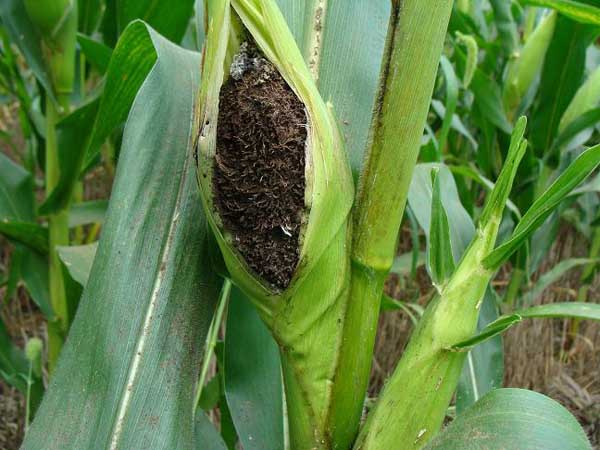
Corn head smut, also known as "wumi" or "dumb corn," occurs commonly in North China, Northeast China, Central China, Southwest China, South China and Northwest China. Since this disease was first reported in Northeast China in 1919, it has spread rapidly and occurs to varying degrees every year. In China, it is more severe in the northern spring corn region, the southwestern hilly and mountainous corn region, and the northwestern corn region. In ordinary years the incidence rate is 2%-8%, and in individual fields it reaches 60%-70%, causing heavy losses. In the 1980s, corn head smut was basically brought under control, but it remains one of the major diseases of corn production.
Symptoms of Damage Caused by Corn Head Smut
The typical symptom of corn head smut is deformation of the male floral organs, with the base of the male flower swollen and containing a mass of black powder inside, unable to form a tassel. The affected female ear becomes shorter, with a thickened base; apart from the husk leaves, the entire ear becomes a mass of black powder and scattered filamentous material, severely affecting corn yield.
1. Seedling-stage symptoms of corn head smut
Corn head smut is a systemic infectious disease that invades at the seedling stage. It generally shows typical symptoms at the ear stage, mainly damaging the female ear and the tassel. Severely affected plants may show various symptoms at the seedling stage. The seedlings tiller more and form a clustered shape; the plants are noticeably dwarfed, with shortened internodes, and the leaves are dark green and upright. Farmers describe this symptom as: "short in height, dense leaves, thick at the bottom, thin at the top, dark leaves, green in color, and the body is still bent." On some varieties, yellow-white streaks parallel to the leaf veins appear on the leaves, and on some seedlings the central leaves are tightly rolled together and curved in a whip-like shape.
2. Adult-plant-stage symptoms of corn head smut
The symptoms on diseased ears at the adult-plant stage of corn can be divided into two types, namely smut ears and abnormal deformed ears.
① Smut ears: apart from the husk leaves, the entire diseased ear becomes a mass of black powder, mixed with filamentous host vascular bundle tissue, hence the name head smut. The affected ear is relatively short, thick at the base and pointed at the tip, approximately spherical, and does not extrude silks.
② Abnormal deformed ears: this is due to deformation of the tassel floral organs so that stamens are not formed, and the glumes become leafy under stimulation by the pathogen; the glumes of the female ear may also grow excessively under pathogen stimulation into tubular long spines, resembling a hedgehog head. The base of the long spines is slightly thicker, the tip slightly thinner, and the center is hollow and loose, with varying lengths, growing in clusters from the base of the ear upward, so that the entire ear is deformed.
Transmission routes of corn head smut
The pathogen of corn head smut is Sporisorium reilianum. This fungus mainly overwinters in the soil as teliospores, while some overwinter mixed into manure or adhering to the seed surface. Soil-borne inoculum is the most important source of primary infection, while seed-borne inoculum is the main route of long-distance spread of the disease. Teliospores can survive in the soil for 2-3 years. Teliospores begin to mature at the silking stage of the corn female ear, and large numbers fall into the soil, with some falling onto the seeds (especially at harvest). After sowing, infection generally occurs when the seeds germinate or the seedlings just emerge, and some infection also occurs at the 2-3 leaf stage (some reports consider the final infection stage to be the 7-8 leaf stage). The teliospores germinate to produce septate basidiospores, and the basidiospores germinate to form infection hyphae, which invade from the embryo bud or radicle and quickly spread to the stem and grow along the growing point. When the flower buds begin to differentiate, the hyphae enter the flower primordium, invade the female ear and tassel, and finally destroy the male and female flowers. Because the corn growing tip grows relatively quickly while the hyphae spread slowly and fail to enter the stem growing point of the plant, this causes the phenomenon that some diseased plants show disease only on the female ear while the tassel is disease-free.
The pathogen overwinters in soil, manure or on seeds, becoming the primary infection source for the following year. Seed-borne inoculum is the main route of long-distance spread. Chlamydospores survive in the soil for 2-3 years. Invasion at the seedling stage is a systemic infectious disease. When corn germinates after sowing, the overwintering chlamydospores also begin to germinate, and can invade from the white-tip stage to the 4-leaf stage of corn, reaching the growing point, and as the corn plant grows and develops, they enter the flower buds and ear parts, forming large amounts of black powder, becoming head smut and producing large numbers of teliospores to overwinter. Long-term continuous cropping of corn and early sowing of corn result in more severe disease; high-cold and cool plots are prone to the disease. Sandy loam soil has mild disease. Dryland with good soil moisture has mild disease; poor soil moisture leads to severe disease.
Conditions for the occurrence of corn head smut
1. Large-scale planting of susceptible varieties is one of the factors leading to severe occurrence of head smut. In addition, new physiological races of the pathogen may appear, causing originally resistant varieties to lose resistance.
2. Long-term continuous cropping causes the soil inoculum quantity to increase rapidly. According to reports, if the diseased plant rate is used to reflect inoculum quantity, then the soil inoculum quantity can increase by about 10 times each year.
3. Use of undecomposed barnyard manure. According to experiments, the incidence rate in fields treated with pig manure was 0.1%, while the incidence rate in fields with furrow application of contaminated cow manure was as high as 17.4%-23%, and the incidence rate in fields with spread application of cow manure was 10.6%-11.1%.
4. Seed-borne inoculum that has not been disinfected and diseased plant residues that have not been properly treated will both increase the inoculum quantity in the soil, leading to severe occurrence of the disease.
5. Soil temperature and humidity during the period from corn sowing to emergence are extremely closely related to disease occurrence. Soil temperatures in the range of 15-30°C all favor pathogen invasion, with 25°C being the most suitable. Soil humidity that is too high or too low is unfavorable for pathogen invasion, and the incidence rate is highest under the condition of 20% humidity. In addition, the higher the altitude, the too-deep sowing, and the weak seed vigor, the more severe the disease. The infection temperature range is 15-35°C, the suitable infection temperature is 20-30°C, and 25°C is optimal. A soil moisture content lower than 12% or higher than 29% is unfavorable for disease occurrence.