What are the main high-yield corn seed varieties?
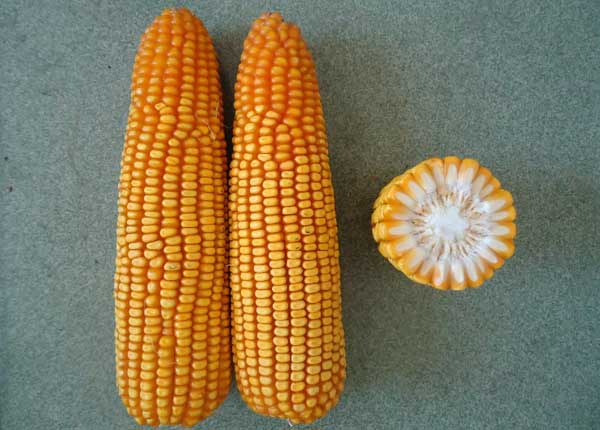
High-yield corn seed varieties
The main high-yield corn seed varieties are Longgao L2, Liangyu 99, Denghai 6702, Delinong 988, Zhongdan 909, Xundan 29 and Tunyu 808. Different corn varieties also have different requirements for the growing environment. Below we give a brief description of the characteristics of these types of corn seeds.
1. Longgao L2
The high-yield corn variety Longgao L2 is known for yielding a ton of grain per mu (667 sq m) and for its iron-like stalks that resist lodging. Under good high-water and high-fertilizer conditions, Longgao L2 set a high-yield record of 32,000 jin per hectare, which is praised by the industry.
The corn seed Longgao L2 was bred by the High-Yield Breeding Room of the Corn Research Institute of the Heilongjiang Academy of Agricultural Sciences and was approved by the Heilongjiang Provincial Variety Approval Committee in 2004. The approved name of this variety is Longgao L2, and its trade name is Baoyu Longgao L2.
This corn variety adapts to a wide range of regions, with a growth period of about 122—127 days and an approved accumulated temperature of 2350°C. Under accumulated temperature conditions above 2500°C, it will achieve ideal dehydration results and maturity, and it is suitable for planting in the first and second accumulated temperature zones of Heilongjiang Province. It grows robustly at the seedling stage, with a plant height of about 2.8 m, an ear height of 95 cm, leaves held upright, a compact plant type, strong stalks that do not lodge, and stay-green maturity. It has good drought resistance and stress resistance, and is highly resistant to northern corn leaf blight, head smut, corn smut and bacterial wilt. The ear is cylindrical, with about 18——22 rows, about 45 kernels per row, a 100-kernel weight of 35 g, dent-type kernels, orange-yellow in color, a test weight of 751 g, and horny grain. With appropriate cultivation conditions, the yield can reach more than 1000 kg.
In high-yield fields, the average yield of Longgao L2 exceeds 30,000 jin per shang, far surpassing varieties of the same maturity period, setting a high-yield record for corn in Heilongjiang Province. The commercial grain is horny grain, the grain quality is relatively hard, and the selling price is relatively high. The commercial grain is golden yellow in color and is suitable as a food raw material, feed and brewing raw material. This variety has aroused great enthusiasm among industry figures and farmers in various places.
2. Liangyu 99
[Approval number] Guoshenyu 2012008.
Liangyu 99 is a density-tolerant variety, with a spring sowing growth period of about 135 days, a plant height of 270 cm, an ear height of 100 cm, and a compact plant type. The ear is conical, with an ear length of 400px, 16-18 ear rows, yellow dent-type kernels, good quality, a 100-kernel weight of 36.5 g, and a red cob. It is planted in plots with medium fertility or above. The suitable density for spring sowing is 4000-4500 plants/mu, with a general yield of 700 kg per mu. It is suitable for planting in most late-maturing corn areas of Liaoning.
Liangyu 99 can be planted at high density, 4500--5000 plants per mu. The ears are uniform inside and out, with no empty stalks and no bare tips. It is highly resistant to lodging, with thick stems, and resistant to force-8 gales. It is highly resistant to bacterial wilt, head smut, rough dwarf disease and maize dwarf mosaic virus disease. The grain quality is good and the yield is high. The general yield is 900 kg per mu, and the high yield is more than 1100 kg, an increase of 15-20% over Zhengdan 958.
3. Denghai 6702
[Approval number] Guoshenyu 2011009.
[Approval opinion] This variety meets the national corn variety approval standards and has passed approval. It is suitable for summer sowing planting in Shandong, Baoding, Hebei and areas to the south, Henan (except Pingdingshan and Zhoukou), the Guanzhong irrigation area of Shaanxi (except Xianyang), northern Anhui, northern Jiangsu, and the Yuncheng area of Shanxi. Pay attention to preventing stalk rot, and use with caution in areas with a high incidence of corn smut and curvularia leaf spot.
4. Delinong 988
[Approval number] Guoshenyu 2011010.
[Approval opinion] This variety meets the national corn variety approval standards and has passed approval. It is suitable for summer sowing planting in Shandong, Henan (except Zhengzhou and Zhoukou), Baoding, Hebei and areas to the south (except Shijiazhuang), northern Jiangsu, and the Guanzhong irrigation area of Shaanxi. Pay attention to preventing lodging, and use with caution in areas with a high incidence of corn smut.
5. Zhongdan 909
[Approval number] Guoshenyu 2011011.
[Approval opinion] This variety meets the national corn variety approval standards and has passed approval. It is suitable for summer sowing planting in Henan, Baoding, Hebei and areas to the south, Shandong (except Binzhou), the Guanzhong irrigation area of Shaanxi, Yuncheng in Shanxi, northern Jiangsu, and northern Anhui (except Huaibei). Use with caution in areas with a high incidence of corn smut.
6. Xundan 29
[Approval number] Guoshenyu 2011012.
[Approval opinion] This variety meets the national corn variety approval standards and has passed approval. It is suitable for summer sowing planting in Henan (except Nanyang and Zhoukou), Baoding, Hebei and areas to the south (except Shijiazhuang), Shandong (except Zaozhuang), Xianyang in Shaanxi, Yuncheng in Shanxi, northern Jiangsu, and the Fuyang area of Anhui. Pay attention to preventing lodging, and use with caution in areas with a high incidence of corn smut.
7. Tunyu 808
[Approval number] Guoshenyu 2011013.
[Approval opinion] This variety meets the national corn variety approval standards and has passed approval. It is suitable for summer sowing planting in Henan, Baoding, Hebei and areas to the south (except Shijiazhuang), Shandong (except Yantai), the Guanzhong irrigation area of Shaanxi, and the Yuncheng area of Shanxi. Pay attention to preventing lodging.
How should we identify high-yield corn seeds?
1. Improve the ability to identify the quality of corn seeds
① Seed selection principles: Before selecting seeds, first clarify the type of seed to be selected and understand the local natural environment conditions, such as soil quality, accumulated temperature, precipitation, sunlight, and frost-free period. Based on the local actual environmental conditions, choose corn seed varieties suitable for local environmental characteristics. In addition, when selecting corn seeds, pay attention to choosing large seed-selling enterprises with a good reputation, and pay attention to whether the labels on the seed packaging are complete and valid and whether they meet the actual requirements stipulated by the state.
② Identifying seeds: Learn to identify corn seeds, especially old seeds. Generally, old seeds have undergone long-term storage and drying, so the seed color is often darker and duller, the embryo area is relatively hard, and when you put your hand into the seed pile, your hand will be covered with powder. In contrast, new corn seeds are bright in color and plump in shape. In addition, for adulterated corn seeds, we can identify them by their appearance. Usually, the corn seeds from one seed plot are relatively uniform in size and shape. If the corn seeds differ greatly in shape, pay attention to whether there is adulteration.