Detailed Explanation of Millet Planting Techniques and Management Methods
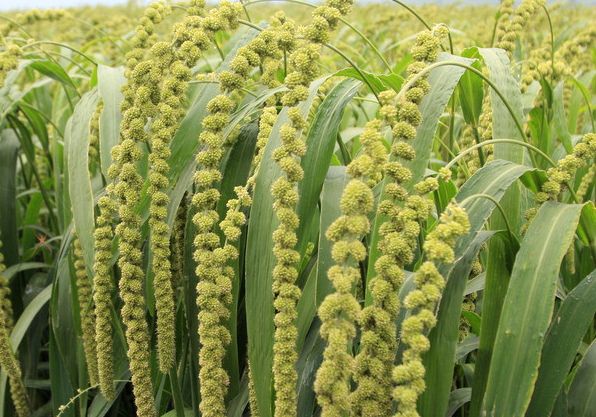
Millet, also known as foxtail millet, is the hulled grain of foxtail millet, which is a cereal plant and a type of grass. It originated in the Yellow River basin of northern China and later spread to various regions where it is grown to varying degrees. Millet comes in white, red, yellow, black, orange and purple varieties. It can be used to make wine, but is mainly used for cooking porridge.
Millet planting techniques follow pollution-free green food production procedures. The technical route is: crop rotation → fine land preparation → fertilization → seed selection → seed treatment → sowing → field management → harvest and storage → packaging and transport.
Crop Rotation
Millet should not be grown continuously on the same land; continuous cropping leads to severe disease, abundant weeds and heavy consumption of soil nutrients, easily causing "soil exhaustion." Therefore, choosing a reasonable crop rotation is conducive to a bountiful millet harvest. The most suitable preceding crops for millet are, in order, beans, potato, sweet potato, wheat and corn. To support the production of "millet zha," buckwheat and waxy corn are planned for rotation with millet.
Fine Land Preparation
Deep plowing in autumn can mature the soil, improve soil structure and enhance water retention capacity. Deepening the plow layer helps millet roots penetrate downward, making plants grow robustly and thus increasing yield. Autumn deep plowing is generally more than 20 cm deep, and base fertilizer is best applied in one application together with autumn plowing. Therefore, in autumn land preparation, deep plowing and moisture conservation must be done well to ensure the moisture needed for millet germination and seedling emergence.
Fertilization
Base fertilizer is applied once before sowing in combination with deep plowing and land preparation. It is generally mainly farmyard manure; for high-yield fields, 75,000-112,000 kg/hm2 is appropriate, and for medium-yield fields, 22,000-60,000 kg/hm2. Mixing phosphate fertilizer with farmyard manure and composting it as base fertilizer gives the best results. Base fertilizer is best applied in autumn or early spring.
Seed fertilizer has been widely used in millet production as an important yield-increasing measure. Nitrogen fertilizer used as seed fertilizer can generally increase yield by about 10%, but the amount should not be excessive. When ammonium sulfate is used as seed fertilizer, the appropriate rate is 37.5 kg/hm2, and urea 11.3-15 kg/hm2.
The period when topdressing has the greatest yield-increasing effect is the booting stage 15-20 days before heading, and generally about 75 kg/hm2 of pure nitrogen is appropriate. When nitrogen fertilizer is plentiful, apply "seed-setting fertilizer" at the beginning of jointing and "grain-filling fertilizer" at the booting stage. In the late growth period of millet, spraying phosphorus fertilizer and trace element fertilizers on the leaves can also promote flowering, seed setting and grain filling.
Sowing
1. Selection of improved varieties and seed treatment: The improved varieties selected are mainly "Huangping Glutinous Millet," "Shibing Red Millet" and "Local Glutinous Millet." In addition, varieties from other provinces such as "Dungu No. 1," "Yugu No. 5," "Yugu No. 7," "Yugu No. 9," "Qinzhou Yellow Millet" and "Jilin Green Millet" may be selected. Before sowing, millet seeds are treated; the treatment methods include sunning seeds, soaking seeds, chemical seed dressing and seed coating. Chemical seed dressing can control smut and soil-borne pests.
2. Sowing period and sowing method: Sowing at the right time is one of the important measures to ensure high and stable millet yields. Generally, sowing from early April to early May (around Grain Rain) is appropriate. Sowing methods include furrow sowing, flat planting and ridge planting. Furrow sowing, also called ridge-furrow or flat-furrow planting, is used more often on dry sloping land; its advantages are water conservation, fertilizer conservation and soil conservation.
3. Sowing rate and density: The millet sowing rate is generally about 0.8-1.0 kg/mu, with a depth of 3-5 cm. On dry land, about 40,000-50,000 plants per mu are generally retained.
Field Management
1. Ensuring full stands: Millet grains are relatively small, and the seeds do not contain much energy material. If drought occurs, it easily causes missing plants and broken rows in the field, so field management should be strengthened. Generally, when 2-3 leaves have emerged, check seedlings and reseed; when 5-6 leaves have emerged, thin and fix the seedlings.
2. Seedling hardening to promote vigor: In fields with good water and fertilizer conditions and vigorous seedling growth, seedlings should be hardened in a timely manner. The main methods of seedling hardening are timely control of fertilizer and water at the 2-3 leaf stage, deep intertillage, and so on.
3. Intertillage and weeding: Millet intertillage management is mostly carried out at the seedling stage, jointing stage and booting stage, generally 2-3 times. The first intertillage is done together with thinning and fixing seedlings, and the technique is shallow hoeing, breaking up soil clods finely and removing weeds. The second intertillage is during the jointing period and is carried out together with irrigation and topdressing. The intertillage should be deep, and soil should be banked up at the same time. The third intertillage is carried out before row closure, and the intertillage depth is generally 4-5 cm. In addition to loosening the soil and removing weeds, high banking should also be carried out to promote root development and prevent lodging.
4. Pest and disease control
① Select disease-resistant (tolerant) varieties or disease-free improved seeds: At present, varieties resistant to millet rust include "Huangping Glutinous Millet," "Shibing Red Millet" and "Local Glutinous Millet," as well as varieties from other provinces such as "Dungu No. 1," "Yugu No. 9," "Qinzhou Yellow Millet" and "Jilin Green Millet." Varieties that are also resistant to millet sheath blight include "Yugu No. 14" and "Yute No. 5." When smut occurs, in fields that are disease-free or only lightly affected, selecting disease-free ears as seed before harvest has a certain control effect on smut.