How to Prevent and Control Wheat Powdery Mildew? A Detailed Guide to Practical Methods
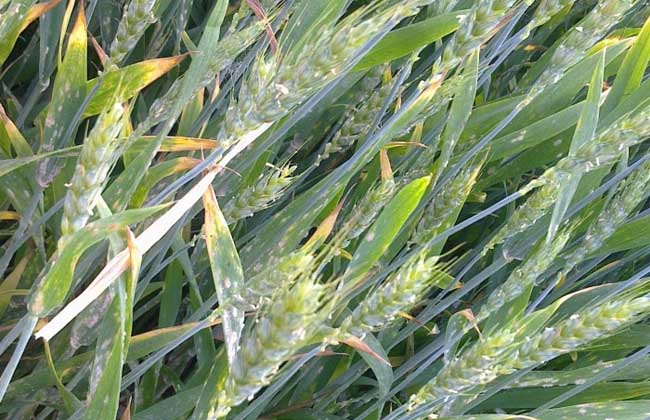
Wheat powdery mildew is a worldwide disease, found in all major wheat-producing countries. In China it is common in coastal Shandong, Sichuan, Guizhou and Yunnan, and in recent years it has been increasingly severe in the wheat regions of Northeast, North and Northwest China. It can infect all aboveground organs of the wheat plant, but mainly the leaves and leaf sheaths; in severe cases the glumes and awns can also be affected. Let's take a look at the control methods for wheat powdery mildew below!
Damage Symptoms
Wheat powdery mildew can infect all aboveground organs of the wheat plant, but mainly the leaves and leaf sheaths; in severe cases the glumes and awns can also be affected. At the initial stage, white mildew spots 1-2 mm appear on the leaf surface, then gradually expand into nearly round to oval white mildew patches. The surface of the patches has a layer of white powder that flies off immediately under external force or vibration; this powdery substance is the mycelium and conidia of the fungus. In the later stage the mildew layer on the diseased part turns grayish white to light brown, and tiny black grain-like dots the size of pinheads, namely the cleistothecia of the pathogen, are scattered on the lesions.
Conditions for Disease Development
In winter wheat regions, the inoculum causing spring disease mainly comes from local sources; in spring wheat regions, besides local sources, it also comes from nearby areas where the disease occurs early. The optimum temperature for occurrence is 15-20 degrees C; below 10 degrees C the disease develops slowly. A relative humidity greater than 70% may cause an epidemic. In areas with little rain, the disease is severe in years with more rain; in areas with plenty of rain, if rainy days and rainfall are excessive, the disease is instead slowed, because continuous rain washes away the surface conidia. Excessive nitrogen application causes the plants to stay green late and leads to severe disease. Poor management, insufficient water and fertilizer, dry soil, weak plant growth and low disease resistance also make the disease likely to occur; in addition, high density leads to severe disease.
Control Methods
1. Plant resistant varieties, chosen according to local conditions. For example, Beijing winter wheat currently uses Jing 411 as the main variety; for high-fertility wheat fields, plant Jingdong 8, Jingdong 6 and Zhongmai 9 in combination; for medium fertility and poor irrigation conditions, plant drought-tolerant and barren-tolerant varieties such as Jing 437, Jinghe 1 and Lunkang 6; for rice-stubble wheat and late-sown wheat fields, Jing 411, Jingdong 8 and Jingshuang 18 can be used.
2. Advocate the application of compost fermented with enzyme bacteria or thoroughly decomposed organic fertilizer, adopt formula fertilization techniques, appropriately increase phosphorus and potassium fertilizer, and plant at a reasonable density according to variety characteristics and soil fertility. In southern wheat regions, drain promptly after rain to prevent moisture retention. In northern wheat regions, irrigate at the right time so the host enhances its disease resistance.
3. In areas where volunteer wheat seedlings oversummer, remove volunteer wheat promptly before autumn sowing of winter wheat, which can greatly reduce the inoculum for autumn seedlings. Treat seeds with 25% triadimefon (Fenxiuning) wettable powder at 0.03% of seed weight (active ingredient); alternatively, use 20-25 g of 15% triadimefon wettable powder to treat wheat seed for 667 sq m to control powdery mildew, also controlling smut and stripe rust, etc.
4. In areas where resistant wheat varieties are few or where pathogen races vary greatly and resistance is lost quickly, when the wheat powdery mildew disease index reaches 1 or the rate of diseased leaves reaches more than 10%, begin spraying 20% triadimefon emulsifiable concentrate at 1000 times dilution or 40% Fuxing emulsifiable concentrate at 8000 times dilution. Field conditions may also allow a mixture of insecticide and fungicide for a single application at the critical period, controlling wheat powdery mildew, rust and other major diseases and pests at the same time.
5. In the middle and late stages of wheat growth, when stripe rust, powdery mildew and ear aphids occur together, use per mu 7 g active ingredient of Fenxiuning plus 3 g active ingredient of pirimicarb plus 150 g potassium dihydrogen phosphate. In areas or fields where stripe rust, powdery mildew, wheat midge and armyworm occur together, use per mu 7 g active ingredient of Fenxiuning plus 2000 times dilution of 40% omethoate plus 150 g potassium dihydrogen phosphate. In areas where fusarium head blight, powdery mildew and ear aphids occur together, use per mu 40 g active ingredient of carbendazim plus 7 g active ingredient of Fenxiuning plus 3 g active ingredient of pirimicarb plus 150 g potassium dihydrogen phosphate.