How to prevent and control tobacco brown spot disease? A detailed guide to practical methods
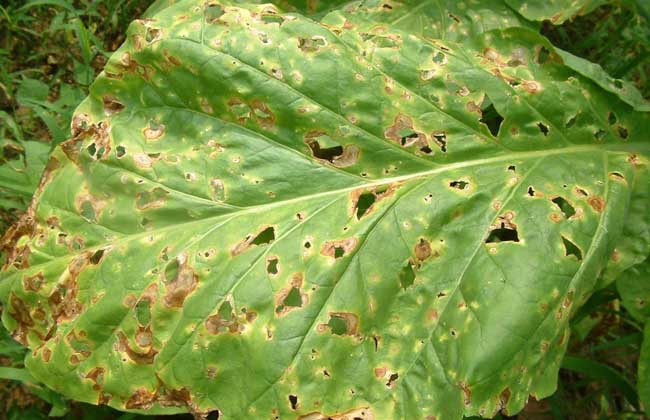
Tobacco brown spot disease is a disease caused by fungi. Tobacco farmers in China commonly call it red spot, root tiger eye, fire blister spot, etc. It is the main leaf spot disease during the tobacco leaf maturity period and occurs in all tobacco-growing areas in China. It not only makes tobacco leaves incomplete and lowers their grade, but also, because the internal quality is uncoordinated, makes the taste worse and reduces industrial use value. Let us take a look below at how to prevent and control tobacco brown spot disease!
Symptoms of tobacco brown spot disease
In the middle and late stages in the field, lesions begin to appear on the lower leaves of the tobacco plant. At first they are yellow-brown round small spots, later expanding to 1-2 cm. The lesions are round or irregularly round, with a yellow halo around them, and obvious concentric rings centered on the lesion center appear on them. They are brittle and easily broken. When the air is humid, dark brown or black-brown mold-like substances are produced on the lesions, namely the pathogen's conidiophores and conidia (the basis for field diagnosis). When the weather is dry, the center of the lesion often cracks and tends to form holes. In severe cases, the lesions can merge with each other to form large lesions and crack and fall off. When the main vein, flower stalk, capsule and stem are infected by the pathogen, smaller dark brown or black spots can be produced. Near harvest, round or nearly round dark brown sunken lesions appear on the stem.
Occurrence pattern of tobacco brown spot disease
The fungus overwinters as mycelium on diseased residues. When conditions are suitable the following year, it produces conidia, which spread by wind and rain. When disease-susceptible varieties are planted over a large area, and during the maturity period (July-August) there is concentrated rainy weather, nitrogen application is excessive, planting density is high, and field ventilation and light penetration are poor, tobacco fields are prone to an epidemic.
Agricultural control of tobacco brown spot disease
1. Select resistant (tolerant) varieties: Resistant varieties include Zhongyan 98, etc. Moderately resistant varieties include Yunyan 85, K326, RGll, G28, K346, etc. RGl7 and Zhongyan 9203 also have a certain degree of disease resistance.
2. Increase organic fertilizer application: Appropriately increase the application of organic fertilizer and cake fertilizer, control the amount of nitrogen fertilizer, strengthen field management, and improve the disease resistance of tobacco plants.
3. Reasonable close planting: Especially in areas with severe disease, the requirement is that rows do not close during the mature plant stage, and contiguous areas should be moderate in size, not too large, to avoid the disease being difficult to control once it becomes epidemic.
4. Timely topping and harvesting: Determine topping time according to soil fertility and variety. If topping is too early, the upper leaves grow too large, and the tobacco plant often becomes umbrella-shaped, so ventilation and light penetration to the lower leaves are poor and they are susceptible to damage by the pathogen. Harvesting mature tobacco leaves at the right time can prevent and control the occurrence and spread of the disease and reduce damage.
5. Reasonable crop rotation: Implement a crop rotation system of more than 2 years.
Chemical control of tobacco brown spot disease
1. At the first harvest of the bottom leaves, 40% dimethachlon wettable powder 400-500 times dilution can be used for spraying, with 50-7S kg of spray solution per mu, once every 10 days, for 2-3 consecutive times, with good control effect.
2. At the budding stage of the tobacco plant, 1.5% polyoxin 100 times dilution, or 0.3% kasugamycin 200 times dilution can be used for foliar spraying, with 50-75 kg of spray solution per mu, and applied once more half a month later, with good control effect.
3. In the early stage of disease occurrence, 10% Polyoxin wettable powder 800-1000 times dilution can be used, once every 7-10 days, for 2-3 consecutive times. Or 30% Dacronil suspension concentrate 600-800 times dilution, or 47% Baofengning wettable powder 600-900 times dilution can be used for spray control, with 50-75 kg per mu, once every 7-10 days, for a total of 2-3 sprays, with good control effect.
4. In tobacco fields where brown spot disease and wildfire disease occur together, 45% Jinyeshu wettable powder 500-600 times dilution can be used for spray control, once every 7-10 days, for a total of 2 sprays, with good control effect.