How to make corn stover silage? A detailed explanation of the technical points
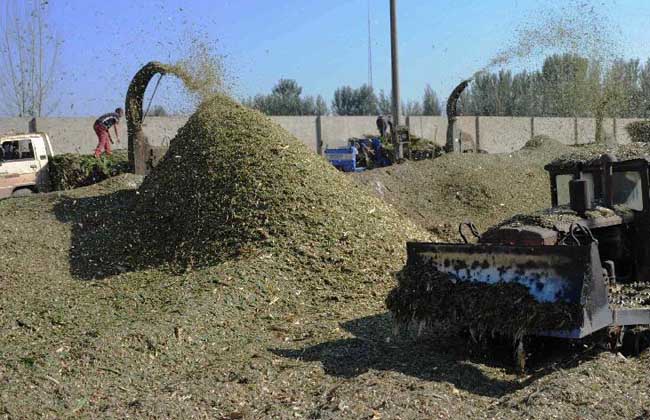
Corn stover silage technology is the preservation of corn stover that has not yet aged through special processing techniques, so that it can be used as livestock feed in autumn and winter. It preserves the feed quality and nutritional components almost as well as when fresh, allowing livestock to enjoy the greenery of summer and the grass fragrance of early autumn even in winter. This technology is specifically applied to grasses and legumes.
Harvesting process
In China's agricultural regions, when preparing corn silage, the harvesting process used for corn is mostly segmented harvesting, that is, corn plants are cut down by hand, transported by animal power or other transport machinery to the silage facility, then fed manually to a chaff cutter, and after processing and chopping, loaded into the silage facility for ensiling. The main features of this harvesting process are that the entire operation is completed in several stages, mainly by manual labor, with relatively high labor intensity and low production efficiency; the silage process generally takes 3 to 5 days. The combined harvesting process, by contrast, uses a dedicated green fodder harvester to complete in the field in one pass the cutting, conveying, chopping of the corn plants and the loading of the chopped material into a feed trailer. The trailer loads the feed into the silage facility, and after compaction and sealing, the entire corn silage process is completed.
Raw material harvesting
In order to balance feed quality and nutritional components, it is best to mix and ensile forage grasses with higher sugar content that ensile easily together with legume grasses rich in protein that do not ensile easily. For the silage mixing ratio, grasses and legumes should be 2:1 or 1:1.
Cleaning and preparation
According to the scale of silage, choose suitable silage containers or facilities, and clean them before use, removing dirt, leftover raw materials, and so on; areas where soil has fallen off should be repaired.
Determining water supplementation
The target moisture content of the silage raw material is 65%, and any shortfall must be supplemented to reach that amount. For example: corn stover with 40% moisture needs water added during ensiling (calculated per 1 tonne), 1000×65%-1000×40%=250 kg, and the rest can be calculated by analogy. If freshly harvested green grass (stover) has a moisture content above 70%, it should be slightly wilted or mixed with substances such as dry grass meal with lower moisture content to bring its moisture down to about 65%.
Raw material processing
Before ensiling, the raw material should be crushed and cut short. There are three purposes: first, it is easier to compact and expel the air between the materials. Second, it increases the contact area between the inoculant and the material, which helps the bacterial strains multiply rapidly. Third, it allows the juice in the raw material to seep out fully and moisten the surface of the raw material, which helps the microorganisms in the fermentation agent grow rapidly and improves the quality of the silage. The degree to which the raw material is chopped should be determined according to the type of livestock being fed and the quality of the raw material. Generally, green raw materials with high moisture content can be cut longer, forage fed to large livestock can be cut longer, and raw materials with low moisture content and relatively hard texture can be cut finer or ground into fine powder. Generally, the length of chopped silage material is 2 to 5 cm. For silage used to raise cattle and sheep, the straw rubbing and crushing machine produced by Shaanxi Chenshuo Environmental Protection Agriculture Co., Ltd. has a relatively good effect.
Filling with raw material
The principles for loading silage material are, first, to be quick. The silage pit must be filled the same day. It must be sealed the same day to avoid the silage material spoiling and deteriorating before it is fully loaded and sealed; even for large-scale silage, it must be loaded within 2d. At present, many farmers have generally built large pits, cannot fill and seal the pit the same day, and even leave it exposed to air for several days, causing spoilage bacteria to rapidly decompose the nutrients in the raw material under aerobic conditions, thus making the raw material moldy and deteriorated and reducing silage quality. Second, it must be compacted. The tighter the silage material is pressed, the better; large pits should be compacted by mechanical means. Places that cannot be reached by machinery should be trampled solid by hand. When using plastic bags for silage, damage to the plastic bags should be avoided.
Sealing the container
After the silage material is fully loaded, it should be sealed immediately. For small bagged silage, it is enough to tie the bag opening tightly with rope. For small containers such as sand jars, cover and seal the top opening tightly with plastic film so that no air leaks. For large silage pits, cover and seal with plastic film, then cover with a layer of reed mats, grass mats, and so on, and then cover firmly with soil.