How to ensure a full stand in direct-seeded rapeseed? Detailed explanation of high-yield cultivation techniques
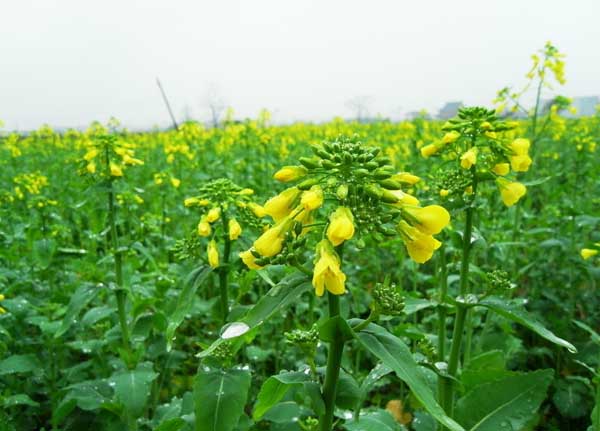
Compared with seedling raising and transplanting, direct-seeded rapeseed cultivation omits the steps of raising seedlings, pulling seedlings, planting seedlings and watering to settle the roots, reduces labor input, lowers labor intensity and production costs, and has no seedling revival period. Under supporting cultivation measures, the yield of direct-seeded rapeseed can be comparable to that of seedling raising and transplanting.
Cultivation techniques
1. Arrange the previous crop well. The previous crop should not be a variety with too long a growth period or too late maturity.
2. Variety selection. Double-low rapeseed varieties should be selected that are early-maturing and tolerant of late sowing, have strong seed germination vigor, good lodging resistance, a long main inflorescence, a compact plant type and strong disease resistance.
3. Field preparation. After the previous crop is harvested in a timely manner on a sunny day, apply base fertilizer immediately and open the "three ditches" well. Sow immediately when there is soil moisture or on rainy days. Use ammoniacal nitrogen cautiously in the base fertilizer to avoid burning the sprouts and seedlings.
4. Seed treatment and sowing. In the Yangtze River basin, the suitable sowing period is September 20 to 30, and no later than mid-October. When sowing, fully mix each kilogram of seed with sieved dry soil manure and 15% paclobutrazol 1.5 g (to prevent leggy seedlings). Sow when there is no standing water in the field and the feet do not sink, generally using 0.2 to 0.3 kg of seed per mu. If drought occurs after sowing, furrow irrigation can be used to resist drought and promote emergence, but flooding the bed surface is strictly prohibited.
5. Chemical weeding. According to the distribution of the weed community in the previous year, do a good job at the three weeding stages: before sowing, after sowing but before emergence, and at the seedling stage.
6. Fertilizer management. Adopt the principle of applying sufficient base fertilizer, applying a seedling-promoting fertilizer according to seedling condition, and applying a bolting fertilizer early. Per mu, apply 15 to 18 kg of pure nitrogen, 8 to 10 kg of phosphorus pentoxide, 8 to 12 kg of potassium oxide, and 1 to 1.5 kg of borax. Phosphate, potassium and boron fertilizers are all used as base fertilizer. 50% of the nitrogen fertilizer is used as base fertilizer, 20% as winter fertilizer or early-spring relay fertilizer, and 30% as bolting fertilizer, applying it as soon as flower buds appear (bolting height 3 to 5 cm).
7. Field management. For direct-seeded rapeseed, when there are 1 to 2 true leaves, thinning and stand establishment can be carried out, removing small ones and keeping large ones, removing mixed ones and keeping pure ones; for vigorously growing fields, 30 to 50 g of paclobutrazol per mu should be used in mid-to-late November for chemical regulation; if leaf color turns yellow at the seedling stage and new leaves emerge slowly, apply 3 to 6 kg of urea per mu as a seedling-promoting fertilizer according to soil moisture; do a good job in drought resistance, waterlogging prevention and pest and disease control.
8. Timely harvest. The suitable harvest time is about 30 days after the end of flowering in rapeseed. It is advisable to harvest when 2/3 of the siliques in the whole field are yellow-green, the siliques in the middle of the main axis are loquat-colored, and 1/3 of the siliques on the whole plant are still green. For fields harvested mechanically, the harvest time should be postponed by 3 to 5 days. The suitable harvest period for rapeseed is relatively short, so the timing must be grasped well and harvesting rushed on sunny days.
Suitable regions
Where the cropping sequence permits, this technique can be adopted in all rapeseed-producing areas of China.
Precautions
1. Determine the suitable sowing rate according to soil fertility and moisture conditions. If soil conditions are poor, the sowing rate should be increased.
2. Ensure a suitable planting density, generally 25,000 to 30,000 plants per mu.
3. Check seedlings in time, thin where too dense and fill gaps, and it is better to do this early than late.
4. Ensure the "three ditches" are unobstructed, and do a good job in preventing sclerotinia during the flowering period.