What is a reasonable planting density for corn?
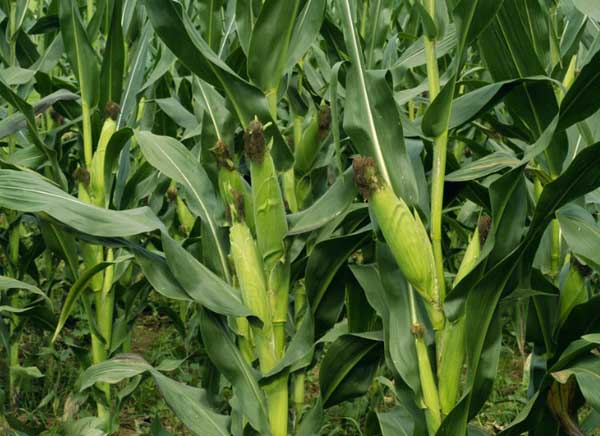
The size of the corn planting density is one of the factors that directly affects corn yield. Practice has shown that within a certain range, corn yield increases as density increases, but once density reaches a certain value, further increasing density instead causes yield to decline, so an appropriate density is the factor that determines yield.
1. Adapt to local conditions. Choose varieties suited to the local planting density. As a good seed, a variety is also relative under different conditions, so choose varieties suitable for dense planting only according to the local climate conditions, geographical conditions, and water and fertilizer conditions.
2. Variety characteristics. Different types of varieties have different tolerance to density. Compact hybrids have strong density tolerance, and when density increases, yield remains relatively stable, so a relatively high planting density is suitable. Flat-type varieties have poor density tolerance and a small range for density increase; if density is increased, yield will decline.
① Flat-type mid-to-late maturing corn hybrids. Such varieties have tall plants, relatively wide leaves, and many leaves. The average angle between each leaf above the ear and the main stalk is greater than 35 degrees, and the average angle between each leaf below the ear and the main stalk is greater than 45 degrees. It is suitable to leave 3000-3500 plants per mu, and suitable for spring sowing to make full use of light and heat resources, increase effective accumulation, and raise yield.
② Upright-leaf early-maturing density-tolerant corn hybrids. Such varieties have a compact plant type with upward-pointing leaves. The average angle between each leaf above the ear and the main stalk is less than 25 degrees, and the average angle between each leaf below the ear and the main stalk is less than 45 degrees. The density for leaving plants is 4500-5000 plants per mu. Suitable for sowing after wheat harvest.
③ Intermediate type. The angle between the leaves and the main stalk of such varieties falls between compact and flat types. Most are mid-to-early maturing density-tolerant varieties, with a density of 3500-4500 plants left per mu, suitable for interplanting in wheat ridges or sowing after rapeseed.
3. Choose a reasonable density according to variety characteristics, yield level, soil fertility, and fertilization level.
① For medium-yield fields with a yield of 400-500 kg per mu, the suitable density for flat-type corn hybrids is about 3000 plants/mu; for compact hybrids, about 4000 plants/mu.
② For a yield level of 500-600 kg per mu, the suitable density range is: about 3500 plants per mu for flat-leaf corn hybrids; about 3700-4000 plants per mu for compact mid-to-late maturing large-ear hybrids; and about 4500 plants per mu for compact upright-leaf medium-ear hybrids.
③ For a yield level above 650 kg per mu, the suitable density range is: compact medium-ear type, 5000-5500 plants per mu; compact large-ear type, 4500-5000 plants per mu.
4. Density-increasing and yield-increasing technology. According to the characteristics of corn varieties and production conditions, increase the planting density of existing density-tolerant varieties by 500-600 plants/mu according to local conditions, provided that density-tolerant varieties are selected and the field has good water and fertilizer conditions.
5. The number of ears per mu of corn is one of the three elements making up corn yield. The size of density directly determines corn yield. Because there are many factors in nature that limit the final ear formation of corn (such as pests and diseases, nutrition, light, etc.), the ear-forming rate of planting density is generally 90%-95%. To ensure that the number of ears per mu reaches the set target ear number, when leaving plants in the field, the amount should be increased by 5%-10% according to the suitable ear number, so that the expected ear number target can be achieved.