What causes wheat root rot? How to prevent and control it
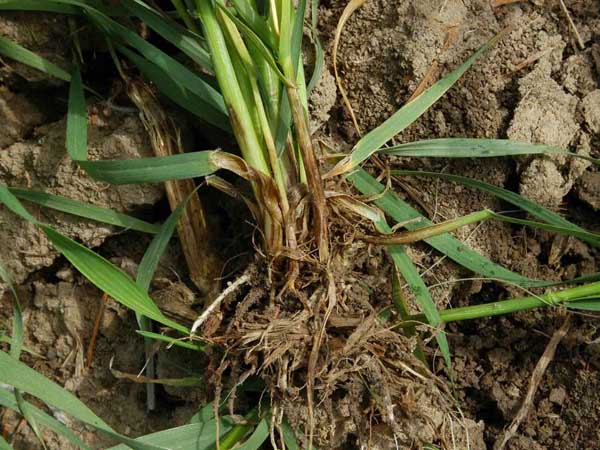
It occurs in all wheat-growing countries. In China it mainly occurs in the Northeast, Northwest, North China, Inner Mongolia and other regions, and in recent years it has continued to spread; it has also been found in the wheat regions of Guangdong and Fujian. The symptoms are similar to those of root drowning disease. After the underground roots are infected by the pathogen, it first spreads from the fibrous roots to the branch roots and then gradually to the main root, and the color gradually turns dark brown. After the disease develops, the underground roots slowly rot. In the early stage there are no obvious symptoms on the aboveground stem, but after a long time, with no roots supplying fertilizer and water, the stem will wither, the branches and leaves will turn yellow, and eventually the plant will die. Wheat, strawberry, Scutellaria baicalensis, Salvia miltiorrhiza, Isatis indigotica (woad), Astragalus membranaceus, Pseudostellaria heterophylla, peony and Codonopsis pilosula are susceptible to this disease.
The main causes of wheat root rot
Continuous cropping of wheat for many years, low soil organic matter, together with unfavorable weather; or because the soil is hilled too high where the crop is planted, or because root damage is caused when fertilizing or weeding in the furrows on both sides; or because during rain or irrigation the water volume is too large and drainage is not timely; or insufficient light, low temperature and high humidity, soil that is too sticky, soil clodding, and poor ventilation; and also when the root system is damaged and broken, it is most susceptible to invasion by the pathogen. Root rot occurs frequently in the rainy season.
The characteristics of wheat root rot
Wheat root rot is caused by the fungus Fusarium solani (Mart.) App. et Wollenw., a Deuteromycete of the subdivision Deuteromycotina, the chief culprit causing root rot. Insufficient light, highly sticky soil / excessive water, poor ventilation, and root damage are all main causes of pathogen invasion. The pathogen infects the roots, first forming brown to black lesions on the coleoptile, young leaves, root cap, root crown and underground stem, which gradually expand and cause them to rot, thereby causing dead seedlings or dead plants. After the disease develops, the roots gradually change from light brown to dark brown. The pathogen remains in the soil over winter, enters the crop the following year through the above causes, and spreads through irrigation or rain.
There are clever ways to prevent and control wheat root rot
Preventing and controlling wheat root rot combines agriculture and pesticides.
1. Agricultural control methods
① Because large accumulations of water and untimely drainage can trigger this disease, choosing relatively flat soil for planting is also very necessary.
② If the soil in the planting area is not level, that is all right too, but drainage must be done well to drain away accumulated water, especially in the rainy season.
③ Soil that is too sticky easily causes soil clodding, which easily leads to poor root development. It is similar to the way humans wearing clothes that are too tight causes physical discomfort.
④ Everyone knows that using any fertilizer that has not been fully decomposed easily increases the incidence of disease; the damping-off disease introduced earlier also has this cause. Apply decomposed organic fertilizer, potassium fertilizer and phosphorus fertilizer to make the plants “strong” so as to enhance disease resistance.
⑤ Seedbed selection: for crops to be raised as seedlings, it is best to choose a seedbed that grew a different crop last year, that is, to practice crop rotation.
⑥ Choosing high-quality seeds is also a good option. High-quality seeds can also resist the occurrence of disease to a large extent.
2. Pesticide control is closely related to hymexazol and metalaxyl-hymexazol
As with other diseases, pesticide control of root rot first involves seed disinfection, then soil disinfection, and finally the choice of root-drenching medication for crops after the disease occurs.
① Seed disinfection before planting. This is also the most common first step to reduce disease. Pesticide dosage for seed disinfection: because seeds cover a smaller area than soil treatment, relatively lower-concentration solutions can be used for seed dressing. 600-800 times dilution of hymexazol or 800-1000 times dilution of metalaxyl-hymexazol.
② Soil disinfection before planting. The second step to reduce disease. Compared with seed disinfection, soil disinfection uses relatively higher dilution solutions. 1200-1500 times dilution of hymexazol or 1500-2000 times dilution of metalaxyl-hymexazol.
③ Root drenching after the disease occurs. The third step to reduce disease. Root drenching is similar to soil disinfection, and the application area is relatively large, so the dosage is the same. 1200-1500 times dilution of hymexazol or 1500-2000 times dilution of metalaxyl-hymexazol.