What are the control measures for wheat loose smut?
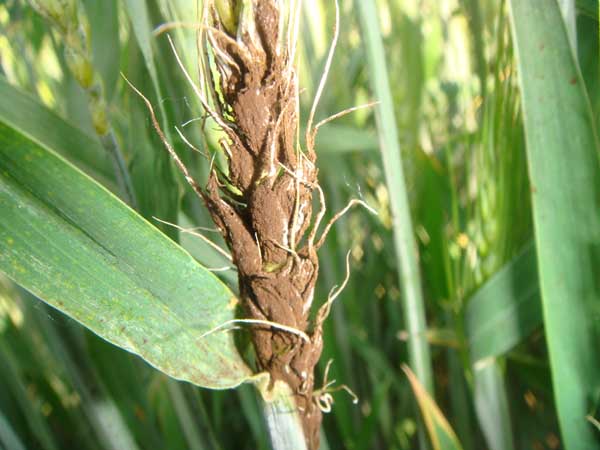
Wheat loose smut, commonly known as black smut or grey packet, occurs widely in many wheat-producing regions of China, with a general incidence rate of 1—5%, and in severe cases it can exceed 10%. In recent years, especially in areas where farmers save their own wheat seed, wheat loose smut has shown a trend of increasing year by year.
Symptoms
It mainly damages the ear, but the stem and leaves can also be affected.
1. When the ear is affected, it forms a packet of black powder covered by a thin light-grey membrane; later the outer skin ruptures, the black powder disperses, and finally a curved rachis remains. Sometimes a few healthy spikelets remain at the top of the ear while the lower part turns to black powder. In most cases, the main stem and all tillers of the diseased plant produce diseased ears, but sometimes some tillers are not affected by the pathogen and grow normally.
2. Stem damage is not easily seen in the field; the diseased part mostly occurs near the base adjacent to the rachis, with spore masses forming blister-like and striped shapes, grey-black in colour.
3. When leaves are affected, the symptoms mostly appear at the base of the leaf blade; the symptoms are similar to those on the stem, and they occur very rarely.
After the smut pathogen infects wheat, besides the typical external symptoms, its internal tissues also change, causing cells to enlarge, stomata to enlarge and increase in number, the palisade tissue of the mesophyll to become dense, and the cells to become shorter.
Causal pathogen
The pathogen of wheat loose smut is a smut fungus. The branched hyphae of wheat loose smut are monokaryotic; on culture media the colony characteristics are unstable, and hyphal growth arises only from the original promycelial cells. The teliospores are spherical to oval, light yellow to brown, with one half darker in colour and the other half lighter, and the surface has fine spines. The spores measure 5—9 microns, averaging 6.5—7 microns. The teliospores can germinate in both water and nutrient solution; the minimum germination temperature is 5°C, the optimum temperature is 20—25°C, and the maximum is 35°C.
1. Overwintering and transmission
The pathogen of wheat loose smut overwinters as dormant mycelium inside the seed embryo; therefore, the only way it overwinters is through infected seed. Teliospores can survive in the field for only a few weeks, and after overwintering there is absolutely no possibility of infection.
In the field, the teliospores of the wheat loose smut pathogen are mainly spread by wind, entering through the gaps of the protruding or opened glumes of the stamens. Generally, teliospores can spread to places more than 100 m from the disease centre, and at the farthest can spread to more than 1000 m away. The distance of spread is related to wind speed and air movement.
2. Infection
At present most people believe that the infecting hyphae of the wheat loose smut pathogen penetrate directly through the ovary wall. The flowering and pollination period is the most suitable time for pathogen infection. When the pathogen's teliospores land on the stigma, style, or ovary wall, they can germinate within 24 hours, grow a promycelium, and directly penetrate from the epidermal part of the ovary wall at the lower part of the ovary or the base of the grain's crown hairs; they then pass through the integument into the nucellus tissue, then enter the base of the grain and lie dormant in the embryo. This process takes about 18 days. The pathogen can also penetrate from the back of the grain, entering from the seed coat, nucellus, and aleurone layer to the scutellum, and then into the meristematic tissue of the embryo.
When the seed begins to germinate, the mycelium lurking in the scutellum and growing point, along with the growth of the epicotyl, invades the first node and the rhizome node of the seedling, and finally enters the ear and other meristematic tissues.
3. Conditions for disease development
The severity of wheat loose smut occurrence is closely related to the level of relative humidity during the flowering period of the previous year. After wheat heading, the field temperature is often within the optimum range required by the pathogen, so humidity becomes the dominant factor. Experiments have shown that when the relative humidity is 56—85%, the disease incidence after artificial inoculation reaches 91%, while under dry conditions (relative humidity 11—30%), the incidence rate is 22%.
The reason why high humidity during the flowering period leads to a higher incidence rate the following year may be that when relative humidity is high, the glumes generally open at a wider angle and remain open longer, giving the pathogen more opportunities to invade. In addition, under high humidity the teliospores germinate faster and the germ tubes are longer. Conversely, under drought conditions the teliospores germinate slowly and the germ tubes are shorter, which is unfavourable for pathogen invasion.
A light breeze favours spore dispersal, and foggy conditions or frequent light rain favour spore germination and invasion. Heavy rain easily washes the spores into the soil, causing them to lose the opportunity to infect, so heavy rain during the flowering period results in milder disease the following year.
Control measures
To control wheat loose smut, in addition to using resistant varieties, comprehensive control based mainly on planting disease-free seed and seed treatment should be adopted.
(1) Seed treatment
1. Chemical treatment: 50% Hesui'an wettable powder, 25% triadimefon wettable powder, and 40% banfengshuang wettable powder, used as a seed dressing at 0.2% of the seed weight, can all achieve good results. Mixing the above-treated seed with a coating agent and then dressing the seed can improve the control effect. When dressing seed with some chemicals, be careful not to exceed the specified amount to avoid phytotoxicity.
2. Physical disinfection
(1) Hot water seed soaking
① Variable-temperature seed soaking: first pre-soak the seed in cold water for 4—6 hours to activate the mycelium, then soak in water at 49°C for 1 minute, and then in water at 52—54 for 10 minutes. This method has a relatively good control effect, but the temperature must be strictly controlled and the operation is rather complicated, making it inconvenient to promote and apply over a large area.
② Constant-temperature seed soaking: soak the seed in water at 44—46°C for 3 hours, then remove, cool, and dry for later use. Constant-temperature seed soaking is relatively safe and has a good control effect, reducing the incidence rate to below 0.5%, and it is convenient for treating large areas.