How to prevent and control wheat head blight? Keep these control measures in mind
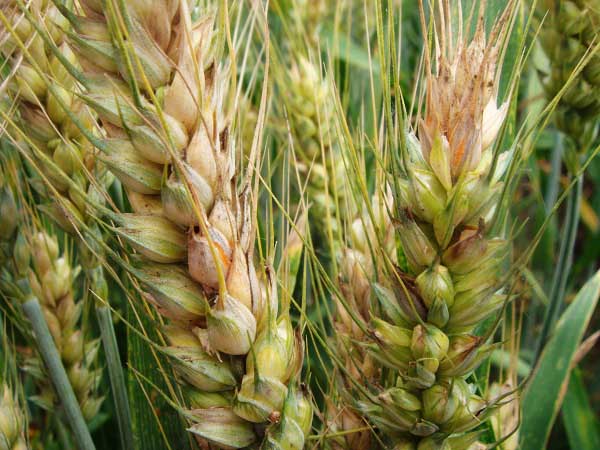
Wheat head blight, also known as withered wheat ear, rotten wheat head, and red wheat head. It mainly causes seedling blight, ear rot, stem base rot, and stalk rot, and can be damaged from seedling to heading stage. Among them, ear rot is the most serious.
Symptom classification
1. Seedling rot
It is caused by seed-borne bacteria or infection from diseased residues in the soil. First the bud turns brown, then the root crown rots accordingly. In mild cases, the diseased seedlings are yellow and thin; in severe cases, they die. When the humidity is high, dead seedlings produce pink mold-like substances (pathogen conidia and stroma).
2. Ear rot
When wheat is flowering, water-soaked light brown spots appear on the spikelets and glumes, gradually expanding to the entire spikelet, and the spikelet turns withered yellow. When humidity is high, a pink gelatinous mold layer forms at the diseased spots. Later, dense blue-black small particles (pathogen ascocarps) form on it. When touched by hand, they feel protruding and cannot be wiped off. The grains are shriveled and accompanied by white to pink mold. After the spikelet becomes diseased, it spreads to the rachis, the diseased part turns withered brown, causing the spikelets above the damaged part to form withered white ears.
3. Stem base rot
It can occur from seedling emergence to maturity. After the tissue at the base of the wheat plant is damaged, it turns brown and rots, causing the whole plant to die.
4. Stalk rot
It mostly occurs at the first and second nodes below the ear. Initially, water-soaked chlorotic spots appear on the leaf sheath, then expand into light brown to reddish-brown irregular spots or extend into the stem. In severe cases, the part above the diseased area turns withered yellow, and sometimes the ear cannot emerge or a withered yellow ear emerges. When the climate is humid, a pink mold layer can be seen on the diseased part.
Causal pathogens
The disease is caused by a variety of Fusarium species, mainly Fusarium graminearum, Fusarium avenaceum, Fusarium culmorum, Fusarium moniliforme, and Fusarium sporotrichioides, all belonging to the Deuteromycotina fungi. The dominant species is Fusarium graminearum. Its macroconidia are sickle-shaped, with 3—7 septa, bluntly rounded at the apex, with a distinct foot cell at the base; individual spores are colorless, and when gathered together they appear pink and viscous. Microconidia are rarely produced. The sexual state is Gibberella zeae, belonging to the Ascomycotina fungi. Perithecia are scattered or clustered on the surface of host tissue, slightly enclosed in the stroma, pear-shaped, with an ostiole, and the top has wart-like protrusions, purple-red or purple-blue to purple-black. Asci are colorless, club-shaped, size 100—250×15—150(μm), containing 8 ascospores. Ascospores are colorless, spindle-shaped, bluntly rounded at both ends, mostly with 3 septa, size 16—33×3—6(μm).
Transmission routes and disease conditions
In the rice-wheat double-cropping areas of central and southern China, the pathogen not only oversummers on diseased residues, but also overwinters as a saprophyte in the diseased residues of various crops such as rice, corn, and cotton. The perithecia formed on these diseased residues the following year are the main source of infection. The ascospores mature right at the wheat flowering stage. They are spread by airflow, wind, and rain, splash onto the withered anthers of the floral organs and germinate, first living as saprophytes, then infecting the spikelets, and after a few days produce a large amount of pink mold layer (pathogen conidia). The infection rate is highest from flowering to full bloom. The conidia formed by ear rot have little effect on reinfection of the same field, but have a greater effect on infection of nearby late wheat. The fungus can also oversummer and overwinter as mycelium in diseased seeds.
In the wheat areas of northern and northeastern China, the pathogen can overwinter as mycelium or perithecia on wheat plant residues, diseased seeds, and residues of other plants such as barnyardgrass, corn, and soybean red knotweed. In the northern winter wheat areas, it oversummers and overwinters as mycelium on wheat and corn rachis, and when conditions are suitable the following year, it produces perithecia that release ascospores for infection. Head blight is mainly spread by wind and rain, with rain playing a greater role. When the spring temperature is above 7°C and the soil moisture content is greater than 50%, perithecia form; when the temperature is above 12°C, ascospores form. Under rainfall or humid air conditions, the ascospores mature and fall on the anthers, infecting the spikelets through the filaments and causing disease. Late-maturing varieties with thicker glumes and poor fertilizer tolerance are more severely affected; a large amount of pathogen in field diseased residues leads to more severe disease; low-lying terrain, poor drainage, heavy clay soil, excessive nitrogen fertilizer application, high density, and closed field canopy lead to more severe disease.
Control methods
1. Select disease-resistant (tolerant) varieties
Although immune varieties have not yet been found, there are some disease-tolerant varieties with good agronomic traits, such as Sumai 3, Sumai 2, Xiangmai 1, Yangmai 4, Wanya 2, Yangmai 5, No. 158, Liaochun 4, Zaimai 5, Xingmai 17, Xinong 88, Xinong 881, Zhoumai 9—Aiyou 688 series, Xinbaofeng (7228) Mianmai 26, Wanmai 27, Wannian 2, Zhengyin 1, 2133, Ning 8026, Ning 8017, etc. Spring wheat includes Dingfeng 3 and Ningchun 24. All localities can select according to local conditions.
2. Agricultural control
Rational irrigation and drainage; wet land should have ditches for drainage. After harvest, deep plowing should be carried out to destroy stubble and reduce pathogen sources. Sow at the right time to avoid rain during the flowering stage. Advocate the application of compost fermented with enzyme bacteria, adopt formula fertilization technology, fertilize at the right time, avoid excessive nitrogen fertilizer application, and improve plant disease resistance.
3. Soak seeds in lime water before sowing; for the method, see wheat loose smut.
4. Chemical control
① Dress seeds with yield-increasing bacteria. Use 100—150g of solid bacterial agent or 50ml of liquid bacterial agent per 6672, mix with water, spray the seeds and mix well, dry them, and then sow.