Key Field Management Techniques for Rice During the Heading and Grain-Filling Stage
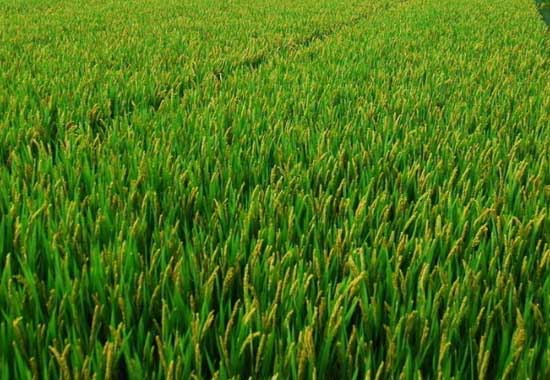
The heading and grain-filling stage of rice refers to the period from heading to grain maturity. Generally, early-maturing varieties require about 25-30 days, medium-maturing varieties require 30-35 days, and late-maturing varieties require about 40-45 days. The growth characteristics and growth appearance during the heading and grain-filling stage:
1. Growth Characteristics
During this period, leaf growth stops, all parts of the spikelets have completed development, and stem elongation reaches its maximum after heading. The growth center shifts from spike differentiation in the previous stage to grain growth. Physiological metabolism is dominated by carbon metabolism, and 2/3 of the dry matter accumulated in the grains comes from the photosynthetic products of green leaves after flowering. This period is the key period that determines the number of filled grains and grain weight. The main direction of field management is to protect the panicles, boost grain filling, and increase grain weight.
2. Growth Appearance Indicators
The late-stage appearance of high-yield rice is to maintain an appropriate leaf area index and a corresponding number of green leaves per stem. It is required that within 20 days after flowering, each effective tiller can still maintain 3-4 green leaves, with a leaf area index of 4-5. At the full-ripening stage, japonica rice is required to maintain 2 leaves, and indica rice is required to maintain 1-2 leaves, or the flag leaf and the second leaf from the top are not completely yellow, with a leaf area index of about 2, until maturity.
The heading and grain-filling stage of rice is the final stage for grain filling and plump grain formation to produce yield, improve quality, and maintain long-term good conditions in autumn. The time runs from full heading to harvest. The central tasks in this period should focus on foliar fertilization, intermittent irrigation, control of rice locusts, and maintaining green stems at maturity without lodging. The specific measures and operations are as follows:
① Spraying foliar fertilizer
The purpose of spraying foliar fertilizer is to plump the grains and improve maturity and fullness. From the perspective of improving quality, it is not advisable to broadcast urea and other long-acting nitrogen fertilizers again. Instead, it is better to spray foliar fertilizer after full heading on fields where leaf color has turned yellow. Generally, 2-2.5 kg of monopotassium phosphate and 4-5 kg of urea are applied per hectare, diluted with 400 kg of water for spraying, and spraying at the flowering stage gives good results. Alternatively, biological potassium, Jinmanli, Huimanfeng, and plant growth regulators can be used in combination. This is not only very effective for plumping grains and increasing yield, but also plays a very important role in prolonging root activity, maintaining green-stem maturity, preventing lodging, and improving quality.
If the leaf color turns yellow 10 days after heading, and the degree of yellowing is more severe than the "yellowing at the booting stage," then grain fertilizer should be used. If grain fertilizer is not applied at this time, the plants will lose vigor, which will accelerate the decomposition of chlorophyll, lower maturity, and lead to reduced yield. The usual amount of grain fertilizer is 3-5 kg of ammonium sulfate per mu. When applying fertilizer, shallow water should be kept in the field, and after application no water should be irrigated, allowing it to dry naturally.
Topdressing according to seedling condition. After rice heading and flowering, maintaining an appropriate nitrogen level in the rice plants is highly beneficial for improving leaf photosynthetic efficiency and prolonging leaf functional period. At this time, for fields where the mid-season panicle fertilizer was insufficient or no panicle fertilizer was applied, nitrogen grain fertilizer should be topdressed at the early heading stage, together with phosphorus and potassium fertilizers. Broadcast 1.5-2.5 kg of urea per mu; for foliar fertilization, apply 100-250 g of monopotassium phosphate per mu each time, or use 0.5-1.0 kg of urea, first dissolved in 20-30 kg of water, soaked for 24 hours, then filtered to remove residue, and then add 50 kg of water for spraying. Foliar fertilization can not only solve the problem of weak root fertilizer absorption capacity in the late growth stage of rice, but also has high and quick fertilizer efficiency.
For foliar fertilization, on sunny days it should be done in the evening or from 3-4 p.m., so that the fertilizer solution adheres to the leaf surface for a longer time and is absorbed thoroughly. On cloudy days, it can be sprayed throughout the day. During the flowering stage of rice, the period from 9-12 a.m. should be avoided to prevent affecting flowering and pollination.
② Intermittent irrigation
When rice enters the grain-filling stage after heading and flowering, intermittent irrigation is adopted, which means irrigating once and then irrigating again after the water dries, with the previous water not visible when the next water comes. When the previous water infiltrates down, then the next water is irrigated. This can increase soil aeration, achieve aeration for root development, preserve leaves through roots, and preserve yield through leaves, making rice roots deep and leaves vigorous, ensuring three functional leaves in the late growth stage of rice, with green branches and leaves not senescing early, improving leaf photosynthesis, increasing dry matter accumulation in grains, accelerating the grain-filling rate, promoting grain maturity, improving maturity, increasing 1000-grain weight, and achieving high yield.
After rice heading, leaf transpiration decreases, and in the late growth stage the effect of water temperature on rice is less than that of air temperature. The basic principle of water management from heading to maturity in rice is: within 20 days after heading, adopt intermittent irrigation to keep the soil in a saturated state, that is, water just reaching the soil surface, with each irrigation depth of 3-5 cm; from 20-35 days after heading, adopt the "horse-running water" measure to maintain a moisture state of 80% of maximum capacity. After that, decide the time to stop irrigation and drain water according to the maturity situation. For clayey soil with poor drainage or low-lying land, stop irrigation and dry the field at about 25 days after heading; for leaky fields, the irrigation time should be appropriately extended; for rice fields with low groundwater level and good drainage, stop irrigation and dry the field at about 35 days after heading. It is necessary to prevent lodging or reduction of green leaf area caused by excessively early water shortage in the soil.
③ Timely control of pests and diseases
After rice heading, leaf blight, sheath blight, rice neck blast and panicle blast, as well as pests such as rice planthoppers and armyworms, may still occur. Inspections should be made frequently, and once pest or disease damage is found, control should be carried out promptly.
For rice brown spot, akiochi disease, and rice blast, early prevention should be carried out. Use 800-fold diluted Shuangxiao micro-fertilizer for uniform spraying; if rain falls within 6 hours after spraying, re-spray. It has good preventive and control effects on the above several diseases, and can increase rice yield by about 15%. During this period, it is necessary to promptly carry out coordinated control of rice locusts at field edges to ensure that functional leaves are not damaged, so as to achieve increased yield, increased income, and improved quality.
④ Eliminate late-stage weeds
Promptly control floating duckweed, algae, and other weeds, and remove large weeds in the field and weeds on pond ridges, channels, and field edges, so as to avoid shading that affects the rise of water temperature, reduce next year's weed infestation, and lower sources of pest and disease transmission.
⑤ Prevent lodging
The main causes of lodging in production are: first, improper fertilization, excessive nitrogen fertilizer application, excessive early-stage heavy fertilization forcing overly vigorous growth, and later-stage nutrient deficiency causing starvation and early senescence, withered stems and leaves, poor water management, pest and disease damage, and the effects of wind and rain, resulting in lodging and flattened plants. To fundamentally control lodging and flattened plants, we should start by changing unscientific fertilization and by selecting excellent varieties, sparse sowing and sparse transplanting, frequent shallow irrigation, timely field drying, and comprehensively improving all aspects of cultivation management.