How can the tillering rate of rice at the seedling stage be increased?
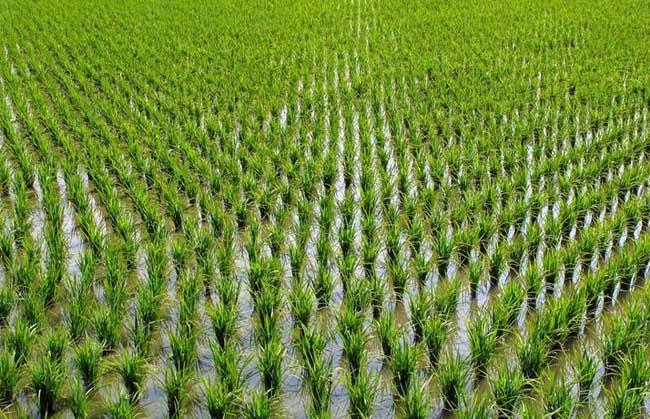
Apply tiller-promoting fertilizer early, and apply tiller-preserving fertilizer as appropriate
Nitrogen nutrition plays a leading role in rice tillering. The amount of fertilizer applied during the rice tillering stage is 25-30% of the whole growth period, so applying quick-acting nitrogen tiller-promoting fertilizer early to make the leaf color turn dark green rapidly is the main measure to promote early tillering. Early-maturing varieties have a short tillering stage, and the tiller-promoting fertilizer must be applied all at once within 7-10 days after transplanting. For medium- and late-maturing varieties, the tiller-promoting fertilizer is generally applied about 15 days after transplanting. At the end of the effective tillering stage, if the number of effective stems is obviously less than the expected suitable number of panicles, tiller-preserving fertilizer should be applied as appropriate to promote steady growth of tillers.
Keep a water layer of one cun to establish the seedlings, and use shallow water to help them recover
When transplanting rice, thin water is generally used for transplanting to facilitate shallow planting. After transplanting, the water layer should be appropriately deepened to reduce leaf evaporation, lessen transplanting injury, and help the seedlings turn green and survive. However, it should not be too deep, so as to avoid drowning the lower leaves, lowering the water temperature, and affecting root development. Generally, 1-1.5 cun is suitable, which is what is meant by “one cun of water to establish the seedlings.” After the seedlings turn green, the water layer should immediately be lowered to 0.5-1.0 cun to favor tillering and root development. This is because the occurrence of tillering and the growth of the root system are closely related to temperature. During the tillering stage, shallow irrigation is required, but water must never be cut off to the point of drought; shallow water must be irrigated frequently.
Weed carefully, and drain the field to dry at the right time
After the seedlings recover, herbicide can be applied to control weeds. To control barnyardgrass and broadleaf weeds: use 150-200 grams per hectare of butachlor + bensulfuron-methyl or pyrazosulfuron-ethyl; to control large barnyardgrass older than three leaves and triangular bulrush: use 500 grams per hectare of 50% quizalofop-p-ethyl + 2 kg of bentazone, and spray with 300 kg of water. This can achieve the weed-killing effect. At the late tillering stage of rice, the field should be drained and dried at the right time. The timing of field drying is very important. First, look at the tillering situation and implement “dry the field when there are enough seedlings”; second, look at the growth of the rice plants. If growth is vigorous, leaf color is dark, and there is a tendency to grow excessively, it should be dried early and heavily; if growth is slow and leaf color is relatively light, it can be dried later and lightly; third, look at the soil condition. Fields with rotten soil and deep mud should be dried early and heavily. For low-lying fields and cold-waterlogged fields, even if the rice plants are not growing vigorously and there are not enough tillers, water should still be drained early and the field lightly dried. After field drying in saline-alkali land, salt accumulation is likely to occur; in newly opened rice fields with poor water retention, field drying will aggravate seepage; and in some cold regions, the method of “deep water to submerge tillers” can be used to suppress late tillering. A depth of about 10 cm is suitable, and the time should not be short. Generally, it should not exceed 10 days, so as to avoid excessive elongation of the basal internodes, which can easily cause lodging.