What technical requirements must rice transplanting meet?
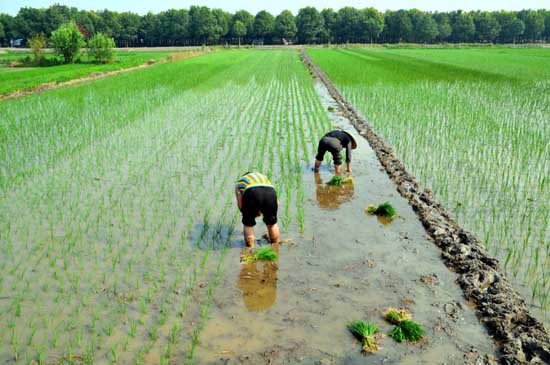
The key technical points of rice transplanting can be summarized as suitable water depth, field surface hardness, three pre-transplanting treatments, optimal transplanting depth, appropriately aged strong seedlings, reasonable dense planting, scientific irrigation, early application of tillering fertilizer, timely pest control, timely early transplanting, full and tight transplanting, and transplanting in sequence.
1. Suitable water depth
The requirement is to adjust the water layer of the paddy field to about 1 cm one day before transplanting (in a state of partial water exposure), which is beneficial to the operation of the transplanting machine. If there is too little water on the field surface, the transplanting machine has difficulty walking, mud easily sticks in the seedling claws and traps the seedlings, the seedling grooves easily become clogged with debris, seedling supply is uneven and irregular, and seedlings may even be broken, causing serious missing hills. If the field surface water is too deep, the seedlings do not stand upright, transplanting depth is uneven, floating seedlings and missing hills are numerous, and the transplanting machine easily pushes and presses seedlings during movement, making it impossible to ensure transplanting quality.
2. Field surface hardness
The method for checking field surface hardness at transplanting is to insert the index finger one segment (about 2 cm) deep into the field surface and draw a furrow; if the surrounding soft mud slowly closes back together, this is the optimal transplanting state. If settling is poor and the field surface is too soft and thin, the seedlings are not firmly planted, the standing posture of the seedlings is disordered, the transplanting machine pushes and presses the edge-row seedlings, and after transplanting the seedlings easily sink, affecting seedling recovery and tillering growth. If the field surface is too hard, transplanting resistance is great, seedlings are easily damaged, transplanting depth becomes shallow, and the transplanting marks cannot close in time, causing floating seedlings and missing hills.
3. Optimal transplanting depth
Whether the depth of mechanical transplanting is suitable has an enormous impact on seedling greening, tillering, and full stand retention. Generally, when transplanting depth is 0.5 cm, seedlings easily scatter, and there are more collapsed seedlings and floating seedlings. When transplanting depth is 3 cm or more, it inhibits seedling greening and tillering, especially obvious is the inhibition of tillering at low nodes, while late tillers at high nodes increase, tillering is delayed, and tillering quality is poor. Weak seedlings transplanted deeply may also become stiff seedlings. When transplanting depth is about 2 cm, however, collapsed seedlings and floating seedlings do not occur, plants produce more roots, grow robustly, and have strong tillering ability. Therefore, the depth of mechanical rice transplanting should be controlled at about 2 cm; manual transplanting depth should be 1-1.5 cm; for pot-raised carpet transplanting, the pot surface should be level with the mud surface; for seedling-throwing cultivation, it is suitable for the pot surface to enter the soil by 2/3 (seedling throwing in muddy state).
4. Three pre-transplanting treatments
According to the agricultural timing arrangement for transplanting, carry out the three treatments in a planned way one day before transplanting, doing the three treatments while transplanting, and never complete all three pre-transplanting treatments at once, so as to avoid fertilizer burn to seedlings caused by excessive fertilizer concentration. At the same time, this can also extend the time for controlling leafminers and improve the preventive effect against leafminers. The three pre-transplanting treatments are: first, phosphorus: diammonium phosphate 125-150 g/sq m; second, pesticide: 70% Admire 6-8 g or 25% Actara 6-8 g per 100 sq m; third, biological fertilizer, such as Yiwai yield-increasing bacteria, Shilü biological fertilizer, etc., used according to the instructions.
5. Appropriately aged strong seedlings
The quality of seedlings at the transplanting stage has an enormous impact on seedling greening and tillering. Generally, dry-raised medium seedlings (3.1-3.5 leaves) and dry-raised large seedlings (4.1-4.5 leaves) are required to be strong seedlings with white and vigorous roots, thick and sturdy stems, upright and green leaves, appropriate seedling age, uniform and neat, high dry matter weight, and strong stress resistance. Such seedlings recover quickly after transplanting, tiller early, and grow vigorously. In contrast, spindly seedlings with poor seedling quality have leaves drooping on the water surface after transplanting, are extremely susceptible to leafminer damage, and their leaves quickly rot. Even if the leaves remain intact, after draining the water the leaves stand upright very slowly, recovery is slow, and greening is delayed. If adverse environmental conditions occur, the rate of dead leaves and dead seedlings is high.
6. Reasonable dense planting
The transplanting density (basic number of seedlings per square meter) should be determined according to comprehensive factors such as soil fertility, seedling quality, climatic conditions, and cultivation level. The basic number of seedlings per unit area is preferably 1/4-1/5 of the planned number of panicles (more than 600 panicles harvested per square meter). Generally, fields with fertile soil, high fertilization level, strong fertilizer supply capacity, good seedling quality, and good climatic conditions can be transplanted appropriately sparsely, and the basic number of seedlings per square meter should not be too large, generally about 125 plants/sq m is quite suitable; while fields with relatively barren soil, poor fertilizer supply capacity, and poor climatic conditions can appropriately increase density, and the basic number of seedlings per square meter controlled at 140 plants/sq m is more suitable.
7. Scientific irrigation
Immediately after transplanting, add seedling-protecting water to ensure greening, with a water depth of about 4-6 cm, at 2/3 of seedling height, based on not submerging the seedling heart leaf, to promote early greening, early tillering, and early rapid growth of seedlings. At normal temperature, when the surface water is in a state of partial water exposure, the number of days required for seedling greening is 9-10 days; when the seedling-protecting water depth is 2 cm, the number of days required for seedling greening is 6-7 days; when the seedling-protecting water depth is 4 cm, the number of days required for seedling greening is 4-5 days. Under certain conditions, for every 2 cm increase in seedling-protecting water depth, plant height increases by 1 cm and the number of roots increases by about 2. After rice greens up, immediately drain the shallow water layer and maintain a shallow water layer of about 3 cm to help increase water temperature and mud temperature and accelerate rice tillering. The optimal air temperature for rice tillering is 30-32°C, and the optimal water temperature is 32-34°C. When air temperature is below 20°C and water temperature is below 22°C, tillering is slow; when air temperature is below 15°C and water temperature is below 16°C, or when air temperature exceeds 40°C and water temperature exceeds 42°C, tillering stops. Maintaining a shallow water layer can increase mud temperature, reduce the diurnal temperature difference, improve the availability of soil nutrients, and help promote tillering. No water or deep water easily lowers mud temperature and inhibits tillering. Leave an outlet in advance, with an outlet height of 5 cm, to prevent water depth from submerging seedlings when rainfall is excessive or from long-term deep-water flooding, which reduces root vigor.
8. Early application of tillering fertilizer
Apply tillering fertilizer immediately after seedlings green up 3-5 days after transplanting. The fertilization amount is 30% of the total nitrogen fertilizer. Of this, 80% of the total tillering fertilizer is applied to the whole field 4-5 days after transplanting, and the other 20% (about 1 kg urea per mu) is applied 7-9 days later by inspecting the field and applying where yellow and weak, prompting the fertilizer effect to appear at the 6-7 leaf stage (the leaf position of peak effective tillering), promoting early tillering, fast tillering, and more tillering of seedlings, and reducing ineffective tillering. To extend the fertilizer effect period, sulfuric acid and urea can be mixed and used, with 3 kg ammonium sulfate replacing 1 kg urea. During the tillering stage, the critical amounts of the three elements in rice plants are nitrogen 2.5%, phosphorus pentoxide 0.25%, and potassium oxide 0.5%. When leaf nitrogen content is 3.5%, tillering is vigorous; when potassium content is 1.5%, tillering proceeds smoothly. Biological silicon fertilizer is all used as tillering fertilizer, 5 kg per mu applied together with the first tillering fertilizer.
9. Timely pest control
Before the outbreak of rice leafminer, from late May to early June, conduct timely pest surveys after transplanting, and spray pesticide promptly when leafminer damage is found. The survey method is to select leaves of seedlings 8-10 days after transplanting that are close to the water surface and lying flat (drooping) on the water surface, gently stroke the leaves by hand, and if small particles are found in the middle of the leaves, they are leafminer larvae, and pesticide should be sprayed immediately for control.