What are the main technical measures for rice seedbed management?
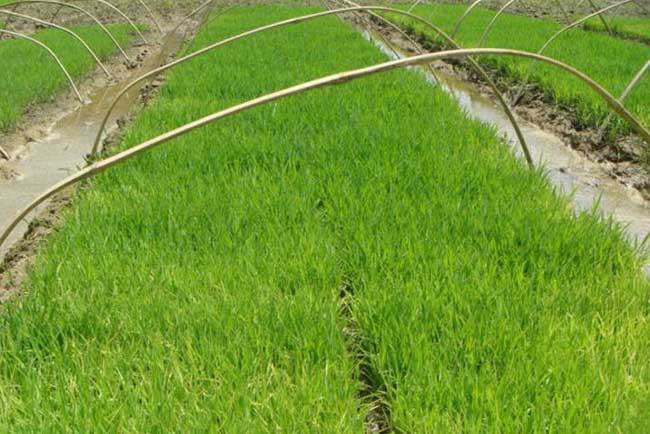
When rice enters the critical period of seedbed management, effectively strengthening seedbed management plays a vital role in cultivating strong seedlings and ensuring a good rice harvest. To do a good job in field management during the dry-raised seedling stage of rice, attention should be focused on the following 7 aspects:
1. Regulate film temperature. From sowing until the needle stage, the main task of seedbed management is to promote emergence and full stand. When sowing in early spring, outdoor temperatures are low, so temperature management focuses mainly on sealing the film to retain heat. After sowing, check frequently for exposed seeds or air leaks; if seeds are exposed or air is leaking, promptly cover with soil and seal the film. Before emergence, keep the temperature inside the film at 30-32°C. From emergence until the 1.5-leaf stage, keep the daytime temperature inside the film below 25°C. After removing the film, if the average daily temperature exceeds 20°C, the seedbed should also take shading and cooling measures.
2. Remove the film at the needle stage. Covering with film when sowing in early spring aims to increase temperature and preserve moisture, promoting early and uniform emergence. However, if the film is removed too early, in low-temperature areas the seedlings grow slowly and may even become stunted; if removed too late, as temperatures rise, the temperature inside the film becomes high, causing seedlings to grow leggy and have poor resistance, and the first leaf node struggles to tiller. Under normal circumstances, the best time to remove the film is 5-7 days after sowing, before the first complete leaf unfolds (needle-shaped, about 2 cm). On the day of film removal, if it is a cloudy or rainy day with high air humidity and relatively low temperature, the film should be removed in the morning; if it is a sunny day, the film should preferably be removed in the evening.
3. Water thoroughly when removing the film. When removing the film, you must water while removing it, and water thoroughly. This is because after the film is removed, the air temperature around the seedlings rises sharply, while root water uptake often cannot keep up, making bacterial wilt and seedling death likely. Therefore, water thoroughly in time when removing the film to supplement the soil moisture deficit after film removal, so the seedlings can adapt to environmental changes as quickly as possible.
4. Supplement with “weaning” water. At the 2-3 leaf stage, seedlings have the poorest tolerance, the shortest time from leaf curling to death, and are most sensitive to water deficit. This period is also the most critical time for preventing seedling death and increasing the seedling survival rate. If the film-removal water was insufficient and evaporation is excessive, and soil moisture is poor, “weaning” water must be supplemented in time.
5. Moderate chemical control. For seedbeds whose soil was not treated with strong seedling agent, especially when cultivating older large seedlings, spray 250-300 ppm paclobutrazol solution mixed with Saisheng seaweed acid iodine at the 1-leaf-1-heart and 3-leaf-1-heart stages respectively, to promote tillering and dwarf the seedlings.
6. After the 3-leaf stage, control water for dry raising. After the 3-leaf stage, the seedlings are larger and the root system gradually develops. Generally, do not water at will; focus mainly on water control for dry raising to prevent excessive growth from too much water. If high temperature and drought occur, and the leaves wilt and “roll into tubes” at noon and do not unfold at night, water promptly in the evening. But the amount of water should not be large, and the frequency should not be high.
7. Water thoroughly with “send-off” water. In the evening of the day before transplanting, apply 1% urea water solution to apply the send-off water and send-off fertilizer at one time. This watering is very particular: it must be moderate, neither too much nor too little; and it must be timely, neither too early nor too late, so as to pull the seedlings without effort and damage the root system as little as possible. After transplanting, spray Jiomiao seaweed acid iodine as soon as possible to promote root healing and growth.