Field Management Measures and Technical Points for Rice in the Late Stage
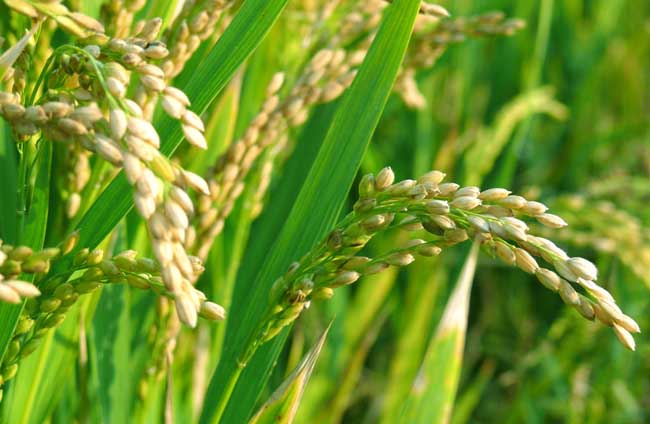
Protecting the stems and leaves, preventing premature senescence, enhancing the photosynthetic efficiency of rice plants after heading, and promoting high accumulation and high translocation of nutrients are among the key measures for achieving high yield and good quality in hybrid rice.
Supplementary Application of Grain Fertilizer
After hybrid rice heads, the functional leaves gradually turn yellow and wither. If fertilizer is lacking, the leaves will turn yellow prematurely and die, and the photosynthetic capacity of the rice plants will be weakened. Therefore, supplementing fertilizer to increase the source, extending leaf lifespan, and improving leaf photosynthetic capacity are among the effective measures for promoting more and fuller grains. The application of grain fertilizer is generally based mainly on foliar spraying of leaf fertilizer, sprayed 2 to 3 times from the breaking stage to the grain-filling stage, each time using 100 grams of potassium dihydrogen phosphate and 0.5 to 1 kg of urea per mu, dissolved in 50 kg of water, then adding 15 to 20 ml of 802 and mixing before spraying evenly onto the stems and leaves of the rice plants. For fields with insufficient base fertilizer where leaves show nitrogen deficiency and yellowing relatively early, it is advisable to topdress 2.5 to 4 kg of urea per mu before heading, which can promote further differentiation of flower buds and prevent degeneration of glumous flowers, giving play to the large-panicle advantage of hybrid rice.
Regulating Water
Hybrid rice has stricter water requirements during the heading and flowering stage. The heading and flowering stage is most vulnerable to damage from high temperatures, so appropriate deep irrigation should be carried out to increase field humidity, lower temperature, and promote uniform heading and normal flowering and pollination. If abnormally high-temperature weather occurs, clear water should also be sprayed to improve the microclimate of the panicle layer and reduce the impact. After heading, the plant root system ages, so under the condition of ensuring water supply, soil aeration opportunities should be increased to nourish roots with air, nourish roots and protect leaves, and prevent root decline and leaf failure. From heading to the early pollination stage, a certain water layer should be maintained in the field to meet the physiological water requirements of the plants; afterward, moist irrigation should be maintained, and water should be managed on the principle of alternating dry and wet. During the grain-filling stage, wet conditions should predominate; during the dough stage, dry conditions may predominate, alternating dry and wet until maturity. Water must never be cut off too early, otherwise premature senescence will also be artificially induced, causing reduced yield and lower rice quality. Generally, it is advisable to cut off water about 5 days before harvest.
Prevention and Control of Diseases and Insect Pests
Diseases and insect pests are severe in the late stage of hybrid rice. They are important factors affecting "protecting the sink," "strengthening the source," and "smooth flow," and are obstacles to achieving high yield and good quality. They must be controlled in a timely manner to protect stems and leaves from damage. The leaf-destroying diseases and insect pests of hybrid rice mainly include late-stage syndrome, rice blast, bacterial leaf blight, and rice leaf roller; the stem-damaging diseases and insect pests mainly include sheath blight, rice planthopper, and stem borers. Emphasis should be placed on the control of late-stage syndrome, because it is the result of a mixture of multiple fungal diseases, often causing leaf scorch, damaged leaf tips, and severe premature senescence, and can reduce rice grain by about 20%, so prevention must be vigorously pursued. At the breaking stage, use 50 to 75 grams per mu of 40% Hekuling or Lülübao wettable powder, dilute with 50 kg of water, and spray evenly on the stems and leaves of the rice plants, which can achieve significant effects in preventing disease, protecting leaves, and preventing premature senescence. For areas where rice blast occurs frequently and areas affected by bacterial leaf blight, to prevent disease onset, tricyclazole, yekuning, and other corresponding agents can be added at the breaking stage for mixed spraying.
Spraying Boron Fertilizer
During the flowering and seed-setting stage of hybrid rice, a sufficient supply of boron fertilizer can increase the seed-setting rate and increase 1000-grain weight. According to experiments, spraying boron fertilizer solution in the late stage of hybrid rice can increase the seed-setting rate by 4.3% and increase 1000-grain weight by 0.5 to 1 gram. Therefore, in boron-deficient fields or rice fields following rapeseed, it should be sprayed once each at the initial heading stage and full heading stage, and can be mixed with grain fertilizer spraying. Each time, use 100 grams of borax or 100 grams of photosynthetic micro-fertilizer per mu, dilute with 50 kg of water, and spray evenly. When preparing the borax solution, first fully dissolve the borax with a small amount of warm water, and spray promptly after preparation.