National efforts in cultural and creative industries need clear goals, says Egret Foundation Chairwoman Chen Yu-hsiu
Egret Foundation Chairwoman Chen Yu-hsiu: National efforts in cultural and creative industries need clear goals
(Taiwan TB News Network / Reporter Zeng Caixuan) Ask what cultural and creative industries are, and not only do the internationally active veterans of the arts and cultural world not understand it, but no one across the countries of the world talks about it either. It turns out it was first proposed in Taiwan, as early as 2002 when Chen Yu-hsiu served as chairwoman of the Council for Cultural Affairs, when she proposed, "My cultural and creative industry policy has only 4 words: industrial upgrading." Let art and culture create new value. She then left office in 2004, too late to put it into practice, and could only lament it.
The Hong Junpei Education and Culture Foundation invited Egret Education and Culture Foundation Chairwoman Chen Yu-hsiu on February 20 to give a keynote speech on "Promoting Cultural and Creative Industries - All Citizens Should Follow," sharing her many years of experience and insights in teaching, research and serving society.
Chairwoman Chen Yu-hsiu served as chairwoman of the Council for Cultural Affairs from 2000-2004. Upon taking office, she designated 2001 as Cultural Heritage Year, and afterward actively launched a series of policies to promote cultural and creative industries, gradually building the content of a "Taiwan subject culture."
However, more than ten years later, Chen Yu-hsiu said bluntly that the current direction promoted by the Ministry of Culture is very different from her framework and ideas, and there is no entry point, no leading industry category, and no flagship plan; in pursuing cultural and creative industries, current investment leans too much toward end-product production and parks, while neglecting front-end development, environmental preparation, space (urban and rural design), and services (creative administration). "The government has invested in the wrong things!"
Taiwan's cultural and creative industries should emphasize "industrial upgrading." Taiwan is strong in technology and traditional industries. If art and culture are added, they can be upgraded, and with technological invention and modern management and business models added, the entire industry can be transformed, driving the country's economic development. Outsiders often think culture has no output value and that the Ministry of Culture only spends money and gives subsidies. If it can connect with industry and penetrate daily life, it can create a different value.
Culture broadly refers to artistic creation, the art of living and so on. Culture is in daily life. The biggest blind spot in Taiwan's promotion of cultural and creative industries is the lack of direction and content. Taiwan has no entry point and no flagship plan. If film, television and music are touted as the flagship, has that become a common trend over nearly 10 years of promotion? A flagship plan requires cross-ministerial full-force investment; it is useless for only the Ministry of Culture to do it. When developing the technology industry in the past, many policies and incentives were proposed, and government and private sector worked and invested together, which is why it was fast!
Chairwoman Chen Yu-hsiu said: "Cultural and creative industries are attached to industry; industry is the main body, and industrializing art and culture is a completely different matter. Earlier, at the Council for Cultural Affairs, I separately allocated budgets for promoting the development of art and culture and for cultural and creative industries. Later everyone conflated them, which is why it became unclear."
"In promoting cultural and creative industries, I believe the government has invested in the wrong things!" Chairwoman Chen Yu-hsiu said the government should invest in space, services and products, but at present most of it is doing end-product production, cultural and artistic packaging, and parks, while neglecting front-end development, environmental preparation, and using creativity to solve life's problems from the demand side, including living space and spiritual-level services.
There is a need for themes and flagship plans so that government and the private sector move toward the same goal. "What the government should do is space, not parks." Chairwoman Chen Yu-hsiu believes that since cultural and creative industries involve cross-ministerial cooperation, "creative administration" services should take the lead, breaking down departmental and bureau sectionalism, proposing flagship plans, integrating resources, and building a cultural and creative industry chain. For example, the Ministry of Science and Technology develops 4G and 5G, while application content belongs to the education and culture ministries. Only by applying both software and hardware can the entire national economy be transformed.
Profile of Egret Education and Culture Foundation Chairwoman Chen Yu-hsiu
A graduate of the National Conservatory of Music in Paris, France, she is a well-known pianist, music educator and cultural administrative leader; she has served as chairwoman of the Council for Cultural Affairs, national policy advisor to the Presidential Office, roving ambassador of the Ministry of Foreign Affairs, secretary-general of the National Cultural Association, chairwoman of the National Chiang Kai-shek Cultural Center's two theaters and concert halls, board member of the National Culture and Arts Foundation, chairwoman of the Department of Music at National Taiwan Normal University, director of the graduate institute and dean of the College of Arts, among other positions.
She currently serves as chairwoman of the Egret Education and Culture Foundation, chairwoman of the Taiwan-France Cultural Association, board member of the Public Television Service Foundation, board member of Xue Xue Institute, independent director of Eslite Spectrum, adjunct professor at National Taiwan Normal University and National Chengchi University, and municipal advisor to the Taichung City Government and Tainan City Government, among other positions.
She has been awarded honors including France's "National Order of Merit, Knight," France's "National Order of the Legion of Honour, Knight," and France's "Order of Arts and Letters, Officer"; she also has related edited and authored works such as "A Study of Ravel's Piano Works," "Zhang Fuxing - Taiwan's First Modern Musician," "Musical Taiwan," "A Century of Taiwan Music Images," "Cultural Taiwan," "Diamond Taiwan - Diverse Natural Ecology Volume: A Gorgeous and Colorful Land," "Diamond Taiwan - Diverse History Volume," "Taiwan Music Encyclopedia Dictionary," "An Analysis of Administrative Corporations - Policy and Practice of the Two Theaters and Concert Halls," "Cultural and Creative Grand View 1: Taiwan's First Lesson in Cultural and Creative Industries," and "Cultural and Creative Grand View 2: The Road Taiwan Brands Have Come."
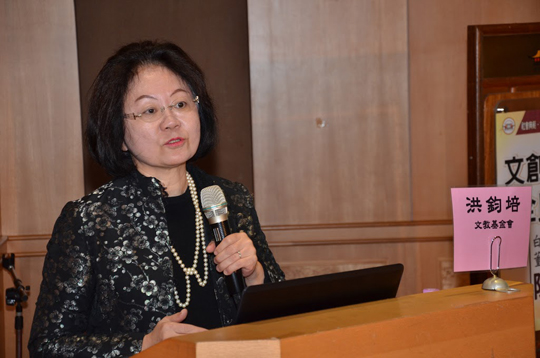
▲Egret Foundation Chairwoman Chen Yu-hsiu: National efforts in cultural and creative industries need clear goals