The 5 most common mistakes made by bonsai beginners
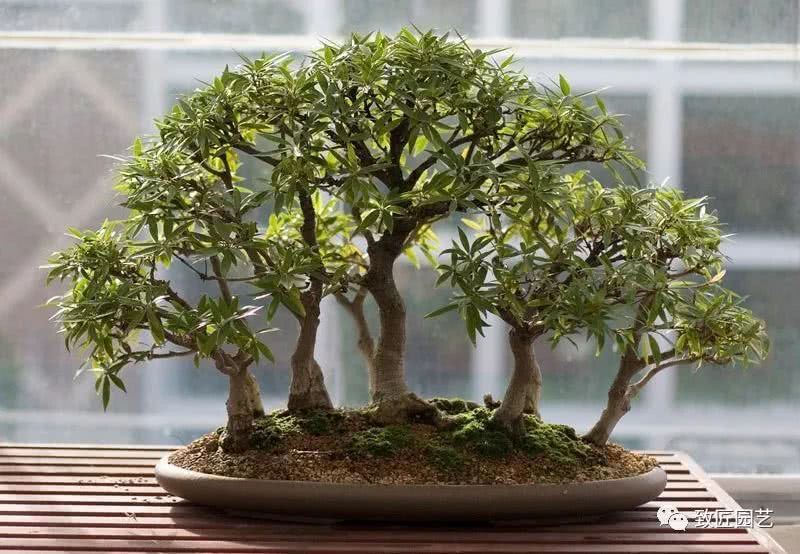
1. Valuing form over substance (being infatuated with the display of form while neglecting the pursuit of substance)
Bonsai beginners are often overly obsessed with whether a tree stump is withered and ancient, whether it has holes, and whether it resembles some kind of animal. They very easily neglect the essence of a bonsai artwork in expressing the content of social life and the author's thoughts and feelings. They have not yet realized that conveying emotion through scenery and blending emotion with scenery is what makes a true bonsai. A bonsai that resembles an animal is only one aspect of interesting potted plant shaping. Form must serve content and be consistent with the theme of the work. Form for form's sake is not necessarily good form. Diligently exploring toward greater depth of feeling and scene is the higher-level pursuit.
2. Valuing pictures over text (being satisfied with copying mechanically and unwilling to create with care)
Some bonsai authors love collecting bonsai pictures. Some even save the pictures from magazines, tearing out and discarding the articles; some compare their own works with works published in newspapers and magazines, and whatever matches proves that their own work is a good work. Because magazines must consider encouraging and supporting new authors and promoting development in less advanced regions, it is inevitable that some not fully mature works are published. If one merely copies the styles in pictures and lacks original works with new ideas, it is like copying paintings: no matter how many one copies, one can never become a painter.
3. Valuing pruning over wiring (emphasizing trunk chopping and branch growing while giving up wiring and binding to shape)
In the Su, Wan, and Zhe regions of China, bonsai techniques are known for wiring, and many wiring and binding methods have been summarized. For fast-paced modern people, many fellow enthusiasts dislike wiring as very labor-intensive and time-consuming, and one after another imitate Lingnan by only pruning and not wiring. Because climate conditions differ from place to place, they should be treated differently. Lingnan has a high average temperature and plants grow quickly, so trunk chopping and branch growing is a good method. From central to northern China, if one only prunes and does not wire, the time for a bonsai to take shape lengthens. Therefore in the Central Plains and in Hubei, the method of combining pruning and wiring has appeared. It can achieve twice the result with half the effort. Learning advanced techniques should also suit local conditions, achieving a combination of pruning and wiring.
4. Valuing technique over art (emphasizing the pursuit of technique while lacking artistic study)
In the process of creating bonsai, technique serves art. The pursuit of technique is about universal laws, while the pursuit of art is about individual characteristics. The two have a cause-and-effect relationship. Bonsai creation cannot remain merely at various fixed "styles," nor can it be said that every branch conforms to standards and every pot has a provenance. It is also wrong to always think that combination bonsai are makeshift and that tree-and-stone bonsai have low technical content. Only by working hard on creating a unique artistic style and on expressing the artistic conception of bonsai can we do better. Absorb the nourishment of bonsai artworks from different periods, such as the "rule style," "natural large-tree form," and "wind-blown style." In this way, both technique and art develop together. Open up and innovate, and keep moving forward.
5. Valuing practice over theory (burying oneself in practical exploration while belittling theoretical discussion)
Theory guides practice, and practice enriches theory. This is a truth everyone understands. Yet when it comes to actual practice, it is easy to bury oneself only in practice and belittle theory. Some people think there is too much controversy in theoretical articles, saying that "one side says one thing is right, and the other side says another thing is right." The author has experienced this: at first reading a theoretical article, one may be at a loss as to which to follow, and only after reading carefully and reading it several more times does one understand the reasoning in it. It is precisely the active discussion of bonsai artists that can make issues clearer through debate and unify them onto correct theory. The older generation in China's aesthetics circles and bonsai circles has, on the basis of practice, summarized much theory linking technique with practice and aesthetic theory, which can fully be applied to bonsai theory.
The above discussions are not evaluations of technique, and they seem to have little to do with the material materials in bonsai works, such as trees, stones, pots, stands, and shelves. But one must see that human consciousness plays an active role and is bound to influence the direction of bonsai art's development. No matter how good a technical method or bonsai form is, if we are unwilling to accept it, it will be shut out. As long as those who are interested believe that "good medicine tastes bitter and honest advice grates on the ear," so as to avoid the appearance of preaching, and everyone uses artistic dialectics to correctly grasp the relationship between the important and the unimportant, with a proper sense of proportion and just right, that is the purpose of presenting this article to everyone.
Featured content