Do these 5 things for succulents and they will still grow stronger in the summer rainy season
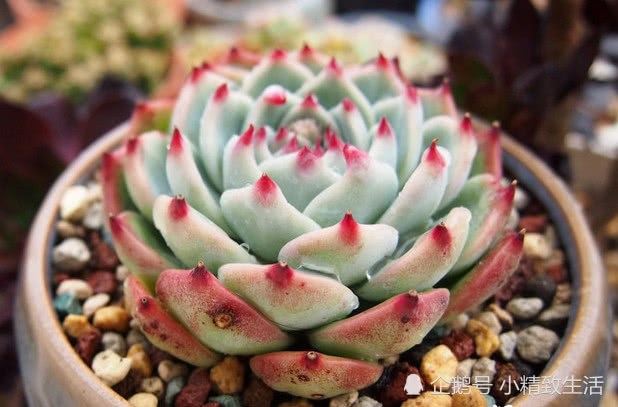
The summer rainy season, especially in the south, is the hardest period for most succulents to get through. But actually, if you adopt the appropriate care methods for succulents at different growth stages, apart from the fact that their colors may not come out so easily, the rainy season is actually not that frightening; on the contrary, the succulents may grow even more vigorously. Below, Little Exquisite Life will learn together with everyone how to care for succulents at different growth stages during the summer rainy season.
1. Strong, mature succulents should be given free-range care
First, let us define what a strong, mature succulent is. The sturdiness of a succulent mainly refers to a strong root system; the outward sign is that after they lack water and their leaves soften, you water them thoroughly once, and they recover within 24 hours. For such succulents, the rainy season is not frightening at all; on the contrary, they will grow even more vigorously. As long as the potting soil has good enough air permeability, then let the wind blow and let the rain fall. Then after the rainy season passes, you will be pleasantly surprised to find that many of these succulents have filled their pots.
2. Newly potted succulents should be given intensive care
For succulents in the root-establishing stage, rainy days have more advantages than sunny days. Because the basic elements of the environment for succulents to establish roots are ventilation and scattered light. On rainy days there is no intense sunlight, so there is no need to deliberately look for shade. Newly potted succulents do not yet have a well-developed root system. At this time, too much water will cause black rot, and too little water will cause them to dry up, so the moisture in the potting soil must be precisely controlled, which is commonly known as "intensive care."
The first watering after potting a succulent is very important. Never skip watering just because the rainy season is humid, because although the air humidity during the rainy season is very high, the potting soil itself does not contain much moisture. When watering, try to water thoroughly by going around the edge of the pot, so that the moisture naturally soaks into the center of the potting soil.
In addition, during the rainy season do not water at fixed time intervals, because during consecutive cloudy days the potting soil may not dry out for ten days or half a month, while on sunny days the potting soil may dry out in a single day. So you can use the method of inserting a bamboo skewer into the potting soil to test the moisture, and water when the potting soil is dry.
3. Low, dense succulents should be given ventilated care
Ventilation is itself one of the essential factors in succulent care. For rosette-type succulents, as well as relatively low clustering succulents, most of the lower leaves press tightly against the surface of the potting soil, and mold can easily breed. Rainy and cloudy days are already the best weather for mold to reproduce, and this makes it even worse. So succulents with relatively dense leaves like these need extra care and should be placed in the most ventilated environment for care. Again, the same words: if all else fails, use a fan.
In addition, many gardening friends habitually do not fill the pot full of soil when potting succulents, letting the pot rim stand a section above the potting soil (as shown in the picture below). In fact, this method greatly hinders air circulation over the soil surface, especially in rainy weather, when mold breeds very easily. The correct approach is to fill the pot as level as possible with potting soil, which is beneficial for ventilation in the space above the soil surface and below the lower leaves of the succulent.
4. Cuttings of leaves and branches should be given slow care
The humid air of rainy weather is actually very favorable for leaf cuttings or stem cuttings to root and sprout. In this season, they will basically survive and grow on their own without special management. If you want to manage them, occasionally misting the surface of the cutting potting soil is enough; try not to give them a heavy watering. Because heavy watering not only fails to help the succulents root and sprout quickly, but also makes them more prone to mold. So at this time, all you need is patience to wait quietly.
5. Leggy succulents should be left to grow as they please
During the rainy season, because of insufficient light, and even on sunny days because the sunlight is too intense and shade is needed, many succulents will become extremely leggy. Here, Little Exquisite Life wants to say: in this season, just let them go leggy, or it is fine. Save beheading and water control for autumn. Because beheading at this time not only easily causes black rot, but even if they survive, what you are likely to get is two succulents that become leggy again; and controlling water to shape them requires enough insight, and blindly controlling water without sunlight will only make them lose the chance to grow quickly. For leggy succulents, all we can give them is as much sufficient light as possible.
As long as you do the above, after one rainy season the succulents will not only not die, but their root systems and size will both become considerably stronger. So, face this rainy season with optimism!
The above is compiled and published by Little Exquisite Life, and we hope it is helpful to you.