Orchid Appreciation Knowledge: Teaching You How to Appreciate the Beauty of Orchids
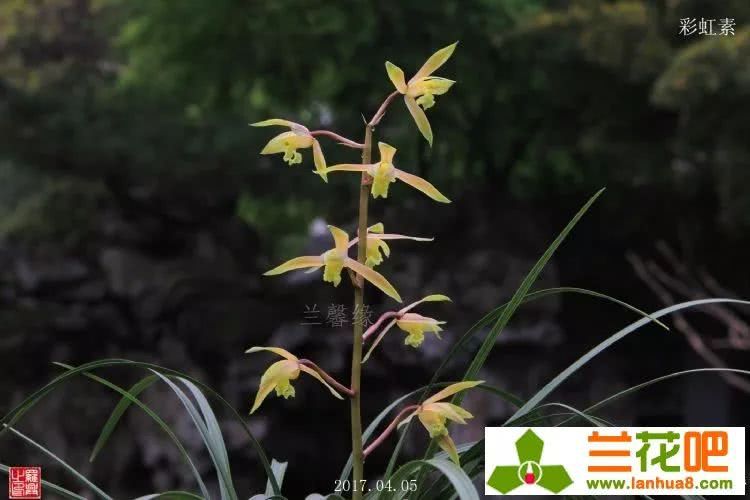
Promote Chinese orchid culture, spread orchid knowledge
Orchid appreciation is a profound and complex issue; as the saying goes, "To those who know it, it is a treasure; to those who do not, it is just a clump of grass." Why? Because orchids display their value as a kind of living artwork. For artworks, including handicrafts (if one may put it that way; we could also call ornamental garden flowers such as orchids "horticultural works," to parallel the "handicrafts" that are artworks among industrial products), the appraisal and evaluation of the artistic value of horticultural works is far more complex and difficult than the appraisal and evaluation of ordinary practical industrial products and agricultural products. The appraisal and evaluation of ordinary industrial and agricultural products can be carried out with the help of chemical, physical, biological and other methods, and can have unified testing standards. The appraisal and evaluation of artworks, by contrast, relies entirely on the artistic feeling and perception of people with strong aesthetic ability, including artistic eyesight, hearing (in the case of music), smell, taste (such as the ability to discern fragrances, the appraisal and evaluation of culinary art, etc.), touch, thought, imagination, association, and various other abilities. And people, unlike chemicals or physical instruments, have individual personalities, each with their own interests, preferences and inclinations.
Therefore, the evaluation of artworks (let alone living artworks with biological life) is indeed a complex and profound matter. Even so, people with artistic and aesthetic ability are, after all, all human, and artworks are, after all, all artworks; there are still certain common artistic laws that everyone can grasp together. That is, on the question of evaluating artworks, besides individual language, there is also a common, shared language. Thus, on the question of orchid appreciation, opinions are not simply divided with no consensus; there are also certain common standards. All kinds of artworks arise among the people of a certain nation and a certain region in a certain historical period, that is, they arise from a certain cultural background. Therefore, artworks often carry the bloodline of their national cultural tradition, and the appreciation and evaluation of artworks is also guided by the aesthetic concepts of the cultural tradition from which they arose. Chinese orchids originate in China, have a long history, and possess the traditional background of Eastern art. Therefore, the appreciation and evaluation of Chinese orchids must also be guided by traditional Chinese aesthetic concepts and aesthetic psychology. The reasoning here is interlinked with the aesthetic concepts and aesthetic psychology of ancient China regarding poetry and prose, Chinese painting, Chinese calligraphy, garden architecture, flowers and bonsai, gold and jade ornaments, ceramic ware, and so on. Looking across traditional Chinese artistic and aesthetic thought, and combining it with the appreciation and evaluation of Chinese orchids, there are roughly four aspects, as follows.
One: Bone structure. Flowers and leaves await bone; the form establishes the frame. Bone structure includes the texture, layout and growth momentum of the whole orchid plant, the whole leaf, the whole flower scape, and the whole flower. Whether the texture is thick and solid, whether it is supple and resilient. Whether the layout is well formed, whether it has a certain pattern. Whether the growth momentum has force, whether it has momentum. Bone structure can be divided into upright form, strange form, and the form in which upright and strange give rise to each other. The upright form can further be divided into the firm and upright form, that is, the whole orchid plant is firm and vigorous, upright and handsome, with momentum, such as Qijian Zimo Su, whose whole plant from leaves to flower stem appears smooth, upright and handsome. The plum-petal form of the Spring Orchid Song Mei is also beautiful for its uprightness, with a kind of awe-inspiring uprightness. Duan Hui Mei is the same. Next is the upright and elegant form, such as Xiandian Baimo Su, Liuye Youmo Su, Spring Orchid Da Fugui, and so on. There can also be the strict and rigorous form, such as certain Cymbidium orchids, whose leaves emerge in opposite pairs and are neatly arranged, and whose raceme arrangement is also neat and beautiful. Certain Tai orchids also have very rigorous growth momentum. The strange form wins by strangeness, such as Yingzhua Lümo, whose flowers also have bone structure, with petals firm and powerful, many-petaled yet irregular and asymmetrical, opening like eagle claws in a hooked and spread posture, thus forming the strange form. The form in which upright and strange give rise to each other is like the Spring Orchid Sixi Hudie, whose petals are more numerous and stranger than other flowers, yet whose layout is also quite neat, which is again upright, forming a style of its own. Certain leaf-variegated orchids also have this characteristic; this is what is meant by "clear and strange bone structure." In traditional Chinese aesthetic concepts, "uprightness" takes upright character, purity and uprightness, noble purity, and elegance as the highest "uprightness." Therefore, traditional orchid aesthetics regard pure-hearted, solid-colored orchids as the highest level of uprightness. Fragrance is also regarded as highest when pure, upright, clear and far-reaching. This aesthetic tradition resonates with certain concepts of Chinese Confucianism, Buddhism and Daoism; it has a broad mass base in China, and also accords with the relatively reserved, restrained, refined and modest mentality of Eastern people. Such aesthetic psychology is probably not easy to change, nor is there any need to follow Western aesthetic concepts. We may allow other aesthetic concepts to exist; so long as they are loved and accepted by the masses and harmless to society, there is no need to eliminate harmless traditional aesthetic concepts at their expense. This is a self-evident truth.
Two: Charm. The sense of movement and the growing posture of the bone structure are charm. The most striking and beautiful expression of charm is grace and lingering appeal. Charm also has various styles. The plump and abundant, such as the lotus-petal-type flowers of Spring Orchid Zheng Tong He, Zheng Xiao He, and so on. Autumn Orchid's Daye Hehua Su and Daye Fengwei Su, whose flower type and leaf type both give a sense of robustness and abundance. The elegant and beautiful, such as Qinghua Hanlan, Autumn Orchid Jinzhi Yuye, and so on. The free and untrammeled, clear and unrestrained, such as Liuye Baimo, Chuixie Hanlan, and so on. The soft, charming, graceful and elegant, such as Renhua Jinbian Lan, Yu, Renhua Bai, and so on. Charm is mainly expressed in the posture and shape of the leaves, flower stems and flowers, and also in the arrangement of the individual flowers within the raceme. In short, the growth momentum of the whole orchid plant should give people a sense of rhythm and cadence; only then does it have grace and lingering appeal.
Three: Pattern and color. This mainly refers to the beauty of lines, the beauty of color, and the beauty of luster. Traditional Chinese art attaches great importance to the beauty of lines; the calligraphic art of Chinese characters and the line-drawing art of Chinese painting both have very high aesthetic value in the beauty of lines. The lines of orchid leaves, whether upright, semi-upright, drooping, mid-drooping or curled, always give a sense of linear beauty when their growth momentum is in form. The petal types of narrow-petaled orchids can also often give a sense of linear beauty. The lines in leaf variegation and flower variegation, such as golden edges and silver edges, and the lines on the leaves of "Huangdao" and "Daxun," look as if they were inlaid, and are very beautiful. The colored lines within the petals of certain Cymbidium orchids, Autumn Orchids and Spring Orchids are also highly aesthetic. In leaf variegation and flower variegation, lines are valued for being distinct and clear; when the lines are distinct, the pattern emerges. Whatever color the leaves and flowers may be, those that are deep, solid and bright have greater ornamental value. The brightness of the flower is also shown in whether it stands above the leaves (that is, rises above the leaf surface); those that stand above are excellent, those level with the leaves are second. If the flower stem is shorter than the leaf surface but still distinct and bright, it can also be acceptable. If the flowers are hidden among the leaves and hard to see, their ornamental value is relatively poor. Although flowers are best when of solid and pure color, if a variegated flower has good color contrast and bright colors, it is also acceptable. If the color lines and spots on the petals are vivid and of good color, they too have ornamental value. The same applies to the lip; if the lip spots have distinctive features, sometimes they even become strange flowers. For example, if an Autumn Orchid's whole flower is white with a vermilion tip on the lip, it is Meijiao Su; if there is a bright red round dot at the center of the lip, it is Zhuying Su; both are famous flowers.
Four: Spirit. Traditional Chinese aesthetics attaches great importance to the inner beauty of artworks and natural objects, that is, whether they have spirit. Spirit is soul, that is, whether there is inner spirituality, inner spirit. The most moving aspect of artworks and beautiful natural objects lies not only in the beauty of their external form, but even more in their inner meaning, that is, in whether they can stir people's hearts, inspire people's imagination and association, arouse people's emotions, and move them. Bao Hui of the Song Dynasty said: "Whenever its splendor and brilliance leak out and are exposed, blazing forth entirely on the surface, while within it is barren and utterly without remaining richness, that is shallow; if its flavor and charm are reserved and understated, quietly harbored within, while its surface is plain as if without external adornment, that is deep." What he discusses is precisely this emphasis on inner beauty. Spring Orchid Song Mei, Autumn Orchid Yu, simple and steady, are extremely rich in inner beauty, so their reputation as famous flowers has endured without decline. Wang Fuzhi said: "Qi is living qi, that is, the harmonious qi of heaven." Su Shi said: "What is qi? It is that which cannot be named; it is as if ghosts and spirits secretly assist it." Qi is a kind of inner vitality, flowing within the aesthetic object, and it is the most attractive thing. Leaf-variegated orchids such as Dama and Daxun are both free and vigorous, solid and weighty, and the feeling they give is that their qi is very full. Because the qi is full, they appear soaring and prominent, very spirited. Traditional orchid aesthetics attaches great importance to whether the flower stem and flowers stand above the leaves (that is, rise above the leaf surface); this too is an expression of valuing their spirit. According to ancient Chinese theories of plant growth, the reason grasses and trees flourish upward is that they are led upward by their own inner "qi"; the fuller the qi, the better the growth momentum looks. The flower stem rising straight and soaring upward, even standing above the leaves, is an expression of full qi and also an expression of spirit. Qijian or Ruanye Baimo Su often, at the year's end in the twelfth lunar month, with five or seven stems per pot, snow-white, fresh and handsome, stand upright like brushes, then extend their stalks left and right in alternation, form buds and even bloom, with abundant spirit and clear qi, a scene full of joy, and the demeanor of a refined gentleman; thus it is a famous flower. Spring Orchid Cuigai, Zhendie and others, although they do not stand above the leaves and their flowers are below the leaves, have distinctive bearing, with several small flowers, each like a little "spirit," full of lively spirituality, and are also treasures. The above four aspects of bone structure, charm, pattern and color, and spirit often do not exist in isolation from one another, but are closely interconnected. For example, we can also express them with terms such as "fenggu," "fengcai," "fengshen," "shenyun," "shencai," "qiyun," "guqi," and so on. Among these, pattern and color mostly express external beauty; charm and bone structure have both external and inner beauty; spirit mostly expresses inner beauty. By comprehensively appreciating several aspects together and attending to both form and spirit, one can appreciate and appraise orchids. As stated above, domestic orchids have a long history and are especially Chinese in flavor, and must be appreciated and evaluated with traditional Chinese aesthetic concepts. This traditional Chinese aesthetic view has its profound philosophical foundation, chiefly the philosophical foundation of Confucianism. Confucius's theory of "mountains and waters, benevolence and wisdom" regarded the process of contemplating all natural things as the process of the subject's moral aesthetic concepts seeking to be reproduced in the object, that is, personifying natural mountains, waters, flowers and plants (note: here it is not merely using natural mountains, waters, flowers and plants as a simple metaphor, but rather people entering into natural mountains, waters, flowers and plants, seeking therein things that express their own morality, sentiment and sense of beauty, and then expressing this experience, which indeed has a somewhat symbolic flavor), so as to attain the realm of "heaven and man responding to each other" and "heaven and man as one."
Therefore, the appreciation terms we discussed above, such as bone structure, charm, pattern and color, and spirit, can be used to appreciate flowers and plants, and can also be used to evaluate people themselves, as when we say a person has "clear and strange bone structure" or is "quite charming." So when we speak of an orchid's bone structure, charm, pattern and color, and spirit, we are not entirely speaking of the orchid as an object; into this we also inject the flower appreciator's aesthetic pursuit of the above, and there is also their subjective emotion and consciousness, which the flower appreciator feels and speaks out while appreciating the flower. From this point of view, one could say that the flower appreciator "bestows" beauty upon the orchid (in fact, it is merely that the orchid itself has its own inherent, objective factors of beauty that can be discovered by the appreciator, while the appreciator has the aesthetic ability to discover this beauty; the appreciator merely reveals the orchid's beauty through appreciation). Conversely, one could also say that the orchid causes the appreciator to produce a sense of beauty through stimulation, and that the orchid cultivates the appreciator's aesthetic ability. In the art world there is a famous saying: "It is excellent actors who cultivate and raise the audience's ability and level of appreciation," and also, "It is cultivated audiences who cultivate and raise actors' ability and level of performance." Somewhat similarly, we might also say, "It is famous orchids that cultivate and raise the aesthetic ability and level of orchid appreciators," and also, "It is orchid appreciators with aesthetic ability and level who discover the beauty of orchids, and through the efforts of horticulturists, raise the aesthetic value of orchids." This belongs to the psychology of appreciation, aesthetics, and the creation of beauty. That is all on the appreciation of orchids.
Orchid Bar, your good teacher on the path of growing orchids