If your succulents haven't grown for a long time and the leaves keep getting softer, they may not have adapted to their pot yet.
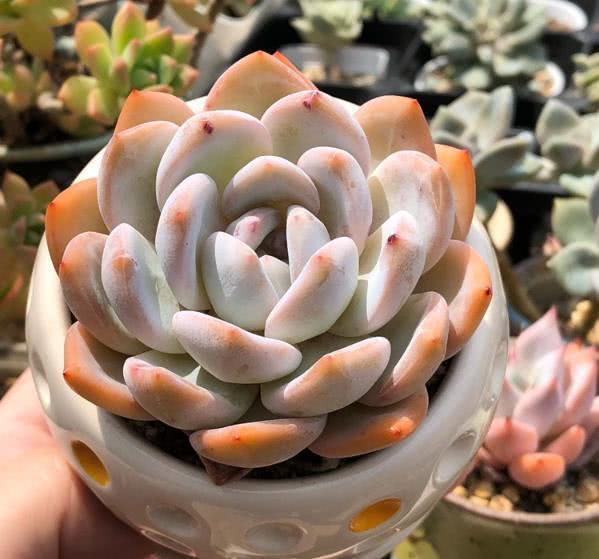
Some growers have said that the succulents they planted grow extremely slowly, and some don't even grow a single leaf in half a year. Why is that? This phenomenon in succulents may mean they have never adapted to their pot at all. As we all know, to grow a pot of succulents well, the prerequisite is that they must have adapted to their pot; without adapting, they simply cannot grow afterwards. For newly purchased succulents, or when repotting and changing soil for your succulents in spring, the plants need a period to adjust to the change in environment. This process is called adapting to the pot. During this period the succulents are rather fragile, and if your care methods are improper, your beloved succulents may well die. So how do you get succulents to adapt to their pot as quickly as possible, and grow healthily with strong roots?
The key to succulents adapting to their pot is having a healthy, well-developed root system, plump leaves, and the ability to produce new leaves. From this, we can judge whether a succulent has adapted to its pot by observing its root system and leaves. Generally speaking, growers with a bit of experience can tell whether a succulent has adapted to its pot just from how the leaves are growing. Adapting to the pot simply means that after being planted, the plant can enter a normal, healthy state of growth; exceptions include plants kept under controlled conditions, such as the mountain rose in summer.
Most newly planted succulents will show leaves becoming thinner and softer, with the ring of leaves at the bottom slowly withering. This is the process of adapting to the pot. When you see your succulent losing weight and getting thinner, with leaves withering, don't be too nervous, and even more importantly, don't diligently water it or pull it out to take a look, otherwise the succulent may very likely die before it can make it safely through the pot-adaptation period. Following the plant's growth characteristics when planting is the easiest way to achieve pot adaptation. Specifically, this relates to the growing environment you give it, the plant's variety, planting techniques, and the climate. For example, if we plant succulents in granular soil in autumn, place them in a spot with good ventilation and good light, and water moderately, the succulents will adapt to their pot very easily. But if we plant during the plant's dormant period, we deviate from its own growth rhythm, and the result is that adapting to the pot is difficult.
The first watering is the best time to check the drainage of the potting soil. If you pour a little water and it immediately comes out of the bottom hole, it means there are relatively few soil particles and there are gaps between the soil and the pot wall; at this point it is best to repot and replant. If after watering the water floats on the soil surface without seeping in, it means too much peat-type fibrous material has been added; at this point you also need to repot and replant. If after a thorough watering the water pools on the soil surface and drains out of the bottom hole very slowly, it may be that the bottom layer is too dense, and repotting is also needed. If it is during the dormant period, then continue growing it dry and wait for the growing season to arrive.
Newly planted succulents should be planted in a well-mixed moist soil. After planting, water according to the condition of the soil 4 to 7 days later. During the pot-adaptation period, succulents should be watered sparingly, must not be exposed to blazing sun, and do well in a drier environment with diffused light through a window. Succulents that have adapted to their pot will grow healthily; those that should send out small offsets will send out small offsets, and those that should bloom will bloom, and we can very intuitively see their vigorous vitality. Succulents that have not adapted to their pot, on the other hand, are thin, weak, unhealthy, and prone to disease. So if your succulents show no growth for a long time, or never even reach a plump state, you should consider whether they have simply never adapted to their pot since being planted. If necessary, you can pull them out to check the roots, trim them again, and repot them.
During the root-recovery period, the plant may show the bottom leaves wilting, turning yellow and drying up. This is because the nutrients needed for rooting must be obtained from the plant itself; this is normal and no cause for alarm. Once the root system recovers, these symptoms will all disappear. During the root-recovery period, watering should follow the rule of watering thoroughly only after the soil has dried out, because it takes time for the root system to go from nothing to a thriving mass, and this requires a great deal of patience from the grower. As for light, it should be increased gradually, and be sure not to place the plant in a dark, damp corner.
This is a gathering place for succulent lovers, sharing succulent care tips. You are welcome to follow and exchange ideas.