These ball-shaped plants are all plump and round, 100 times more fun than a football
Lately, April hasn't been all that happy - lots of friends have run off to watch the ball games. Remember how you all said in the comments back then, "let's be each other's angels"?
Football always makes some people excessively obsessed, making it impossible for them to stop chasing after it. Ball sports are fiery, flamboyant and get your blood pumping, while the balls of the plant world, though they also grow round, rolling heads, are a bunch of little cuties.
If the plant world had its own World Cup, among these flowers that grow into spheres, which ball would be your champion? If you say cactus, step forward - I promise I won't beat you to death with a cactus.
{ Miss Peony Vol.794 }
x
The ball stars of the plant world
When it comes to ball-shaped flowers, what's the first thing that comes to mind?
Just one look and it's confirmed - if you're a true fan of the medicine, you'll definitely think of the hydrangea we introduced not long ago, that is, the bigleaf hydrangea. The hydrangea is the high-appeal ball unanimously recognized by florists worldwide, so let me ask you"Between the hydrangea and the football, which is more beautiful?"
The hydrangea's round, rolling flower shape comes from its cyme, which takes an umbel-like form. Thesingle hydrangea stem we get is actually made up of about 30 small flowers clustered together.
Looking at this diagram of inflorescences, you'll surely be able to tell at a glance which type of inflorescence most easily produces ball-shaped flowers. Correct!Corymb, umbel, compound umbel and cyme - these four umbrellas - plus the capitulum are the ones that most easily form "flower balls"~
The Japanese snowball viburnum, often mistaken for a hydrangea,
has a cyme.
Its small white flowers need to cluster together
to form a ball.
Allium and wax flower are also cymes
Allium Wax flower
Sweet alyssum is a corymb
Image from Duotang
Calliandra is a capitulum,
relying on its whole body of exploded red fluff.
Dahlia is also a capitulum,
with layer upon layer of petals forming a ball.
The axillary capitulum of Adina pilulifera,
with its slender styles, extends beyond the "flower ball."
Edgeworthia, widely distributed in our country, is commonly called the knotting tree or knotting flower among the people.Its capitulum bears 30-50 fluffy small flowers, and both the yellow and red ones have a girlish look.
Cymes and capitula easily produce ball-shaped flowers, which is not hard to understand, because their flowers are like open umbrellas, densely spread into a ball. Ball-shaped flowers also have a great sense of line, and each one is a tall model, so florists all love them.
Today, the "flower balls" April is going to introduce, judging purely by appearance, are all contestants that could directly qualify for the plant World Cup.
/ Allium /
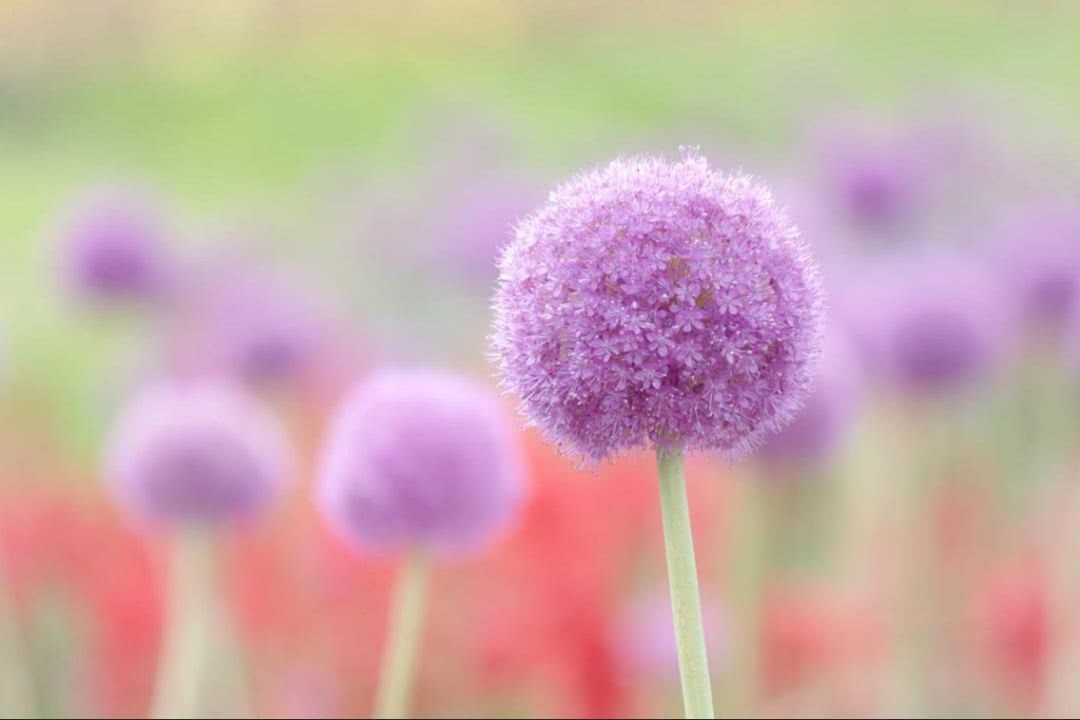
Allium, also known as Persian shallot and giant onion, has been a bit of an internet celebrity these past two years. Though not as famous as the hydrangea, it can still be counted as a rising star among the ball stars. It originated in central Asia, and because it grows tall and beautiful, it can be seen in gardens all over the world.
Allium can grow to sixty or seventy cm,
and kids love to compare heights with it.
An allium that hasn't bloomed yet
looks like a big pink belly.
After blooming, at first it's still rather sparse,
with a hint of green showing through the pink,
looking as fresh and green as a girl who has just grown up.
Once fully grown, the allium sheds its freshness and becomes alluring,
and the small ball turns into a dense big ball.
It holds its bright, gorgeous head high,
making it the most eye-catching one in the garden.
But the allium is really too big,its inflorescence bears 2000-3000 star-shaped small flowers, and its diameter can reach 18 cm, so there are certain limitations to its use in floral art.
Making use of the allium's own sense of line,
and placing it alone in a vase,
is a fairly common and hard-to-go-wrong approach.
If used in a bouquet, one or two stems are enough.
/ Globe thistle /
If the allium is a football, then the globe thistle is at most a little tennis ball, with a diameter of only 4-5 cm. But this little thing doesn't go for the cute style; its small blue-purple ball gives it an innate cool elegance.
Though not as popular as the hydrangea, the globe thistle is also very well loved.It is distributed in Russia, central and southern Europe, and the Tianshan region of Xinjiang in our country, and it is also the national flower of Scotland.
Before blooming, its buds are pointy,
indeed like a little prickly head covered in thorns.
Its star-like small flowers
slowly open from the top.
The small flowers give the globe thistle a halo of its own,
producing a blue-purple gradient effect.
For florists, the small globe thistle is an excellent companion flower material; unopened globe thistles can be preserved longer and are used more in floral art.
Put a single small flower straight into a vase,
and a cool Nordic style arrives.
If you're arranging just a bunch of globe thistles,
you need to remove the excess leaves
to present a sense of freely growing lines.
An immature globe thistle is somewhat green,
a perfect match with eucalyptus leaves.
/ Golden ball /
Everyone is familiar with the golden ball; when buying dried flowers you often see its little golden head. Actually, golden ball is just a pet name for it,its real name is actually golden drumstick, and its scientific name is Australian drumstick daisy.
As its name suggests, it really does look like a little drumstick.
Every year in July and August is the season when the golden ball blooms,
poking out its little yellow head,
it opens to face the fiercest sunlight.
The golden ball has a long vase life,
with full, small and cute flowers that last a long time.
Its bright yellow, paired with a combination vase,
will light up the whole home.
The flower meaning of the golden ball is eternal happiness,so abroad it is often used in wedding bouquets, and it can also be seen in holiday table floral arrangements.
In a light white-and-green color scheme,
it is the warmest touch.
In a bouquet of many colors,
its small, concentrated yellow makes it the focal point,
and also gives the bouquet clear layers.
/ Ping-pong chrysanthemum /
Some people think the yellow ping-pong chrysanthemum and the golden ball look a bit alike. April finds them very easy to tell apart: the golden ball is a tall skinny one, while the ping-pong chrysanthemum is a short, chubby little cutie.
The ping-pong chrysanthemum gets its name because it looks like a ping-pong ball.It originated in Japan, and in our country it is mainly distributed in Kunming. Yellow is the most common, and there are also green, white and pink ones.
The ping-pong chrysanthemum, like the golden ball,
belongs to the super-long-lasting type,
and with proper care, it will be fine in a vase for 20 days.
In the floral world, some are responsible for beauty, some for cool aloofness, and some flowers are willing to play a supporting role, while the ping-pong chrysanthemum only needs to be responsible for being cute. The ping-pong chrysanthemum can count as the cuteness ambassador of the floral world; I suspect it grew up eating cuteness.
The white ones become little pigs and bunnies
Image from @gardenoftheday
The yellow ones can instantly turn into a little yellow duck
Image from @tsis.florist
With no expression at all,
tying a small bunch of flowers can still be very fresh.
/ Sweet scabious /
Sweet scabious is also called pincushion flower, and compared with the previous "flower balls" it isn't round enough. With a raised center surrounded by a ring of cute lace, it counts as a lovely hemispherical flower.
An unopened sweet scabious
has a center that is green tinged with purple,
like a bulging little hill.
After fully opening, its slender styles extend out,
and only then does it begin to look like a ball.
The "little lotus pod" at the center of the sweet scabious
is very eye-catching in a bouquet, instantly giving the bouquet a sense of layering.
The sweet scabious is a very honest little girl; the fruit it bears doesn't look like fruit but rather like a flower, and in the flower market it is called the pinwheel fruit.
Each one is a tiny trumpet as thin as a cicada's wing,
and gathered together, they pull back the curtain and begin to play.
A dot of green at the center
is its disguise as a "flower."
Small and exquisite, with light and elegant colors, it never steals the spotlight, and its mini ball shape is quite unique, so it has become the go-to supporting player for florists.
The dried pinwheel fruit isn't very different from the fresh one, just a little darker in color, making it very suitable for minimalist-style home decor.
Ball-shaped flowers that can be cute or alluring, cool or fresh - they are handy little gardening helpers, can dress up a home, and are also crossover queens of weddings, home decor and dining. Aren't they really a hundred times prettier than football?
After talking about so many spherical flowers,
who is the champion "flower ball" in your heart?
Today we are not betting on balls, just having a heart-to-heart talk,
tell us about that "ball" you love most.
END