Autumn zephyr lily is a bulbous flower that loves plenty of sunlight and prefers fertile, slightly clayey soil.
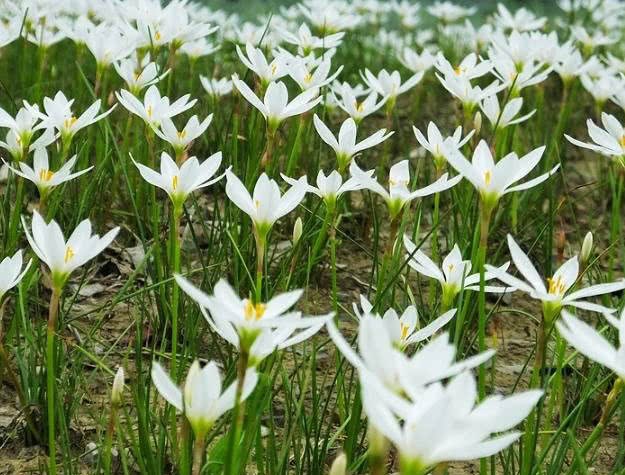
Autumn zephyr lily, also known as autumn crocus, is a perennial evergreen bulbous flower of the amaryllis family. As its name suggests, its leaves look like scallions, as delicate and green as scallions, as graceful and upright as scallions. Autumn crocus originated in the Americas and is the most common groundcover plant in the Jiangnan region. It loves plenty of sunlight, tolerates partial shade and low humidity, and prefers fertile, slightly clayey, well-drained soil. It is relatively cold-tolerant and can remain evergreen in the Yangtze River basin, and can survive for a fairly long time below 0°C. At around -10°C, it will not freeze in a short time, but may freeze to death if the period is longer.
Division propagation. Division time: preferably after the soil thaws in early spring (February or March). Division method: take the mother plant out of the flower pot, shake off excess potting soil, separate the tangled root system as much as possible, and cut it apart with a sharp knife into two or more plants. Each divided plant must have a considerable amount of roots, and its leaves should be properly trimmed to help it survive. Potting and disinfection: soak the divided small plants in a 1500-fold chlorothalonil solution for five minutes, then take them out and let them dry before potting. You can also drench the roots with chlorothalonil immediately after potting.
Management after division: after dividing and potting, drench the roots or water once thoroughly. Because its root system is heavily damaged and its water-absorbing capacity is very weak, it takes about 3 to 4 weeks to recover and sprout new roots. Therefore, within 3 to 4 weeks after division, watering should be controlled to avoid root rot. However, the transpiration of its leaves is not affected, so to maintain the water balance of the leaves, spray the leaf surface 1 to 3 times a day (spray more when the temperature is high, and less or not at all when the temperature is low). Do not fertilize during this period either. After division, also be careful of excessively strong sunlight; it is best to keep it in a shade house for care.
Potting or transplanting: first place a 2 to 3 cm thick coarse substrate at the bottom of the pot as a drainage layer, then place the plant in. The substrate for potting can be one of the following: peat: perlite: ceramsite = 2:2:1; peat: vermiculite = 1:1; or peat: cinder: ceramsite = 2:2:1; sawdust: vermiculite: medium-coarse river sand = 2:2:1; vegetable garden soil: cinder = 3:1; or garden soil: medium-coarse river sand: sawdust (mushroom residue) = 4:1:2; or paddy soil, pond mud, leaf mold, etc. After potting, water once thoroughly and keep it in a shaded environment for care.