How to grow Dendrobium in summer? Do this, and the stems will be sturdy with leaves sprouting nonstop
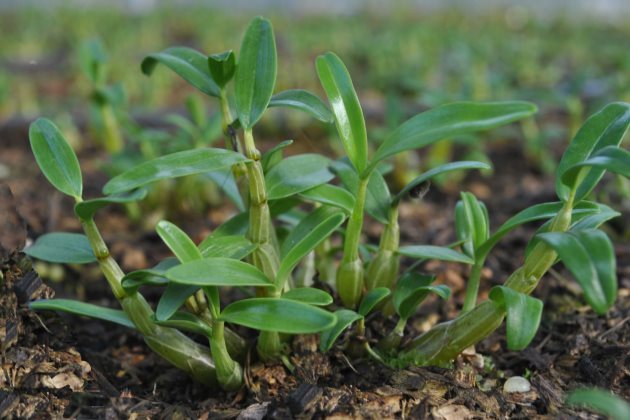
Recently I have chatted with quite a few flower enthusiasts about growing Dendrobium, and what left the deepest impression was that most people are not growing it for the beauty the plant itself brings. Most people are drawn to the legendary efficacies and effects of Dendrobium. Things like clearing deficiency heat, strengthening the bones and muscles, and tonifying the spleen and stomach roll off many enthusiasts' tongues with ease.
Perhaps because their purpose in growing Dendrobium is too clear-cut, they chase growth speed too much when cultivating it and always unintentionally overlook some issues, so from what they say in conversation, it seems the Dendrobium they grow is not ideal. For example, some enthusiasts say that all that is left of the Dendrobium they grow is the stems, and the stems at the tips have already dried out and turned white; some even find that the Dendrobium they grow has lost all its root hairs; and those who grow it a bit better only have plants that are relatively thin and weak, with leaves that are there but rather small. So in the scorching summer, how should Dendrobium be grown to do well? Today Hua'er Gu will study it together with everyone.
How to grow Dendrobium in summer?
This is a topic that makes one think deeply, especially in regions where the four seasons are clearly divided, where we have to consider such questions every time the season changes. How to grow Dendrobium in spring? How to grow it in autumn? How to grow it in winter? All the growing methods change along with the seasons, and you can imagine the horticultural skill required. Without a certain foundation in flower-growing technique, Dendrobium is all the harder to grow.
But perhaps things are not as complicated as imagined. For growing Dendrobium in summer, we need to analyze it according to the characteristics of the season, and perhaps then we will have a rough direction for how to grow it.
For example, in summer, high temperatures and strong light are very obvious features, and along with high temperatures and strong light, water evaporation inevitably increases, so watering is one of the issues we need to pay attention to.
In addition, under strong light our Dendrobium inevitably needs shading care, because Dendrobium is a plant that likes a semi-shady, moist environment. If it is not shaded, it cannot meet the environmental needs of Dendrobium's growth, which we know from its growing habits. So in summer, shading must be at least above 80% to be sufficient.
Dendrobium, which likes moisture, naturally has requirements for air humidity in an environment with strong evaporation, so giving Dendrobium the necessary misting every day to preserve moisture and lower the temperature seems very necessary.
Of course, due to regional differences, many things cannot be quantified for people to refer to uniformly, but a basic environment for growth and care is the foundation, and we learn from one another. Below let us talk specifically about these growth conditions that, although they cannot be specifically quantified, can still serve as a reference.
The growing medium
For growing Dendrobium, it is recommended that you use some moss, small stones, pine bark, or some wood shavings. When using small stones, you need to pair them with more moss, which can help retain water. However, if conditions allow, we can use pine bark to grow it, which is a very ideal growing medium. Pine bark has its own unique advantages in water retention, drainage, and aeration. When pine bark is used to pot Dendrobium for the first time, we need to soak it all in water for at least 24 hours or more. This allows water to fully penetrate it. Afterward, watering will more easily penetrate the interior and maintain a good water-storing effect.
Watering and moisture retention
When growing Dendrobium in summer, you deal with water every day. Besides watering thoroughly after the bark on the surface of the medium has dried out, on sunny days with high temperatures you basically need to mist Dendrobium every evening to preserve moisture and replenish water. If you cannot mist frequently, the leaves of the Dendrobium will either fail to grow out or will quickly dry up after they do.
Shading and ventilation
In summer, strong light and high temperatures coexist, and ultraviolet rays are very intense, so Dendrobium grown in the open will stop growing leaves or have its leaves wither, and in the end only bare, dried-out, whitened stems will remain on the surface. When the surrounding environment is relatively stuffy and hot, it inhibits the growth of Dendrobium, and in severe cases it can lead to the death of the plant. So in summer, if Dendrobium is to grow well, shading of above 80% is very necessary. Shading must not come at the expense of the ventilation of the environment either, otherwise it will lead to poor growth of the Dendrobium.
The above are some methods Hua'er Gu introduces for you on how to grow Dendrobium in summer. We should know that Dendrobium is a plant that likes a semi-shady environment, likes a moist environment, a warm climate, and high air humidity, and strong light, high temperatures, and dryness naturally cannot grow it well. For example, in some of the Dendrobium growing situations shown in the pictures above, the shading falls far short of the requirement, amounting to being exposed to sunlight, and the growth of such Dendrobium is inhibited, with less than ideal results.