Everyone has a "face-covering girl" in their heart
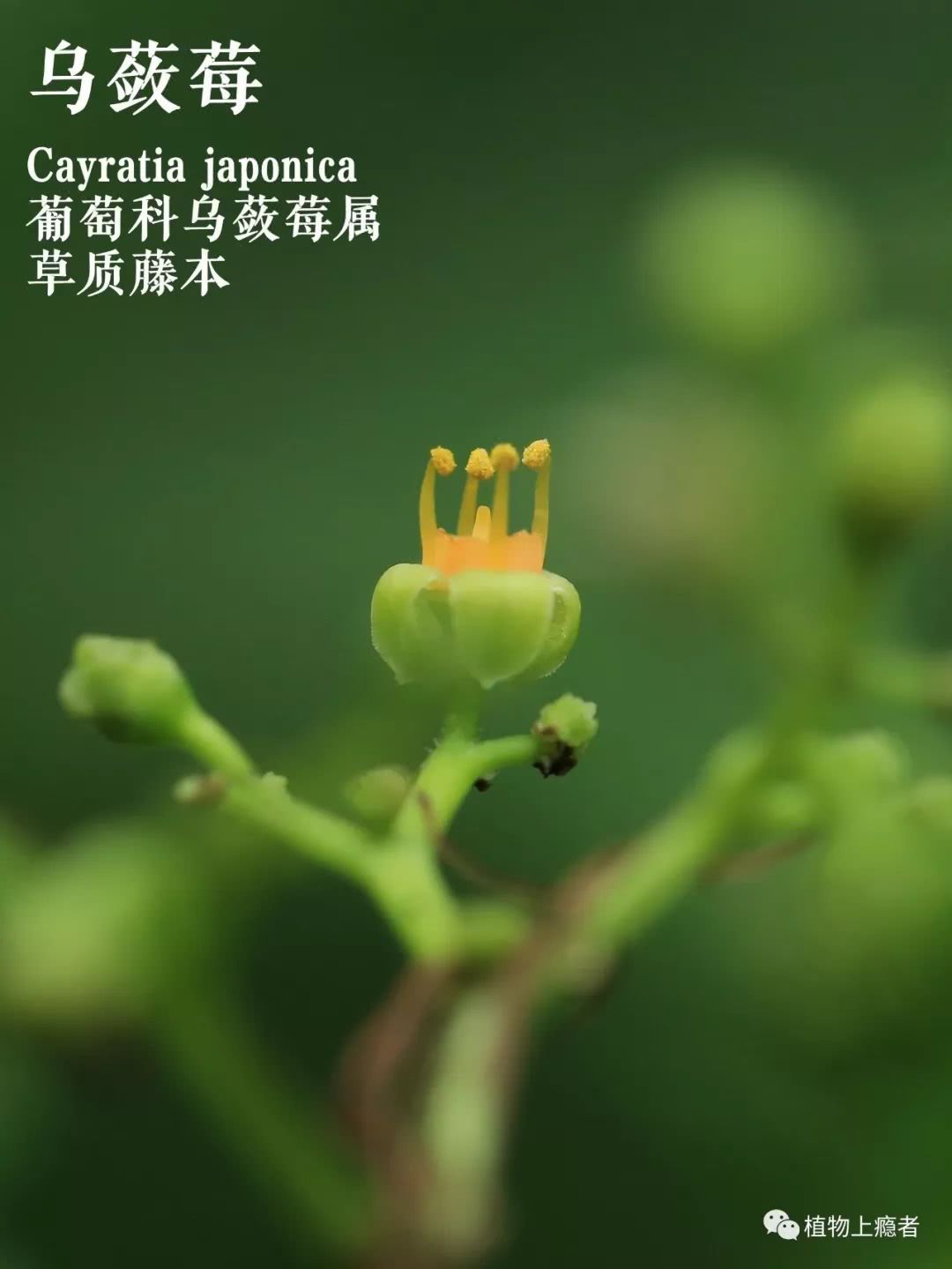
Cayratia japonica, often jokingly called the "face-covering girl" by flower lovers - right now is the best time to observe it, because it is flowering and fruiting. But there are also plenty of Cayratia japonica plants that only climb as vines and have never been seen flowering or fruiting. This may be related to their often being mercilessly cleared away as weeds.
In the urban area of Chongqing, Cayratia japonica is very common. It will pop up from anywhere you pass: on roadside fences, in the hedges and on the lawns of residential compounds, even in cracks between stones. Even when it is not flowering, its signature 5 leaflets make it stand out and easy to recognize.
But perhaps you would not expect that the life of Cayratia japonica is far older than ours. Five thousand years up and down, a quartet of east and west, everyone has a Brokeback Mountain in their heart, and everyone also has a "face-covering girl" of different charm in their heart.
First movement: Yabukare
Starring: the Japanese
The species epithet japonica of Cayratia japonica means "of Japan," so let us start with its life in Japan.
In Japan, Cayratia japonica is called "yabukare," also called poor kudzu or poor vine. All three names reveal a kind of negative message. Japanese horticulturist Yanagisawa Tami, author of "Zassōki" (A Record of Weeds), said that Cayratia japonica's vitality is too strong: "Above ground its branches and leaves flourish, underground it runs rampant for a thousand li." As soon as it encounters a tree, its tendrils wrap around it until the entire crown is covered. The large tree can no longer get sunlight and cannot carry out photosynthesis, and in the end naturally withers and dies.
Westerners' impression is probably much the same as the Japanese one. The English common name of Cayratia japonica is simply bushkiller.
Second movement: The vine spreads in the wild
Starring: a Chinese woman mourning her dead husband
The same Cayratia japonica, in China, has a completely different image. It is the backdrop of deepest feeling, a masterpiece through the ages. Like Leonurus japonicus, Cayratia japonica already appeared in the Book of Songs:
The kudzu grows over the thorns, the vine spreads in the wild. My beloved has died here; with whom shall I dwell alone?
The kudzu grows over the brambles, the vine spreads in the field. My beloved has died here; with whom shall I rest alone?
The horn pillow shines, the brocade quilt glitters. My beloved has died here. With whom shall I wait alone until dawn!
Summer days, winter nights. After a hundred years, I return to his dwelling!
Winter nights, summer days. After a hundred years, I return to his chamber!
-"Tang Feng: Ge Sheng"
Translated into modern language, it is unexpectedly deeply moving:
The kudzu vine has covered the vitex, the Cayratia japonica spreads in the fields. My beloved is buried here; who will accompany lonely me?
The kudzu vine has covered the wild jujube tree, the Cayratia japonica spreads over the grave. My beloved is buried here; who will accompany me sleeping alone?
The horn pillow is bright, the brocade quilt is vivid. My beloved is buried here; who will accompany me through the lonely daylight?
Summer is cruelly long, winter nights stretch endlessly. Only after a hundred years shall we meet again!
Winter nights stretch endlessly, summer is cruelly long. Only after a hundred years shall we meet again!
The mood of this poem is strikingly similar to Su Dongpo's famous mourning lyric: "Ten years, alive and dead, both vast and dim; if I do not think of it, it is hard to forget... I expect the place where my heart breaks every year is the moonlit night, the short pine ridge." If set to music, it is a ready-made excellent love song.
If not for Cayratia japonica, I would not have known that this poem has always been highly praised, "not only as the ancestor of mourning poems, but also as the masterpiece of mourning poems." Even Yuan Zhen, who wrote "Once having seen the great ocean, no water can compare; apart from Mount Wu, no cloud is a cloud," received the comment that he "could not escape the mold of this poem."
Third movement: The secret of the orange jelly
Starring: plant addicts
In the eyes of many flower lovers, the "face-covering girl" is a rather interesting plant, because both its flowers and leaves are worth looking at.
Cayratia japonica displays a new leaf type appearing for the first time on this public account: bird's-foot compound leaves. Each of its leaves is a palmate compound leaf made up of 5 leaflets, but what is special is that the petiolules of the two lateral leaflets are mostly fused into a single common stalk. This leaf shape is special enough to become the identifying mark of Cayratia japonica. The tendrils are opposite the leaves, 2-3 branched.
Bird's-foot-shaped 5 leaflets, alternate
Leaflet margins coarsely serrate, hairs on the veins on the back
Tendrils opposite the leaves
The flowers of Cayratia japonica are very small, but the mass of orange-red in the center of the flower is very brilliant, shining with a crystal-clear jelly-like luster. This is its floral disc. The floral disc has three functions, each of great significance: first, it gives every small flower a visual focus, guiding pollinating insects to pounce accurately on it. Second, the floral disc secretes a large amount of nectar, making pollinators drool. Finally, as compensation for the flowers being too small, the floral disc also provides pollinators with a spacious landing place. After pollination is complete, the color of the floral disc gradually fades, retiring after success.
Floral disc
The floral disc seems to be a specialty of small flowers. For example, Saxifraga stolonifera, Fatsia japonica, Torilis scabra, and others have all evolved their own floral discs to make up for the shortcomings of flowers that are not beautiful enough, not large enough, not fragrant enough. Whenever I see through these little schemes of the flowers, I am amazed by their cleverness: no matter what kind of outer form heaven gives them, they can all try their best to live out their own splendor.
The floral disc of Saxifraga stolonifera is also very brilliant
Each small flower of Cayratia japonica has 4 greenish petals, free, with the apex raised like a small horn. When in full bloom, the petals curl back downward, which by contrast makes the 4 stamens inserted on the floral disc appear light and slender, just like the legs of a ballerina.
Stamens 4, petals green, apex with small horns
Petals free
Compound dichasial cyme
Plants with large, colorful flowers are attractive in themselves and usually have very simple structures. The smaller and more inconspicuous the flower, the more exquisite and complex its structure, and the more fun and satisfying it is to observe.
Fourth movement: Sow vine
Starring: the broad masses of the people
The fruit is somewhat like Solanum nigrum, green when raw and purple when ripe
Common name five-clawed dragon, occasionally six-clawed and seven-clawed
The berries of Cayratia japonica turn blackish when ripe, hence the name. According to the Compendium of Materia Medica: "Its five leaves are like white Ampelopsis, so it is called black Ampelopsis, commonly named five-clawed dragon. In Jiangdong it is called dragon tail, also called tiger kudzu... its fruit is as large as a Solanum nigrum seed, green when raw and purple when ripe..."
In particular, it must be said: the fruit of Cayratia japonica cannot be eaten! "Lu Shu" (short for Lu Ji of the Three Kingdoms Wu's "Mao Shi Cao Mu Niao Shou Chong Yu Shu") says: "Ampelopsis... its seeds are truly black like wild grape, and cannot be eaten. Its stems and leaves are boiled to feed cattle, to remove heat."
The broad masses of the people cannot be bothered to call it by such a literary name as Cayratia japonica. I pulled up a few vines of Cayratia japonica and brought them home, and my dad took one look and said, "This is sow vine!" This is its most widely known name, indeed blunt and plain.
Finale: "The flower nobody loves"
In the process of observing and looking up information, I discovered one thing: Cayratia japonica seems to be disliked by many people. The main reasons are that its vitality is too strong and it does not look beautiful.
However, as the book "The Story of Weeds" says, "All definitions of weeds start from the human perspective. They are plants that get in humanity's way." In the view of author Richard Mabey, humanity's definition of weeds is full of contradictions: when useful, they are good; when useless, they are disliked; the standard changes at any time. He wrote, "If you do not really have some grand plan or long-term blueprint, they are just fresh and simple green shadows, not hateful at all."
Fortunately, weeds do not lack appreciators with such discerning eyes. American poet Ella Wheeler Wilcox wrote a poem "THE WEED," pointing out concisely: "A weed is but an unloved flower." She wrote out my heart.
Article and plant photos (unless otherwise credited) are all original by the author
If you like it, please share, thank you for your support
Plant Addict
WeChat ID: plantfiend
Discover the unique beauty of every plant