Succulent granular soil: my experience, and which types have you tried?
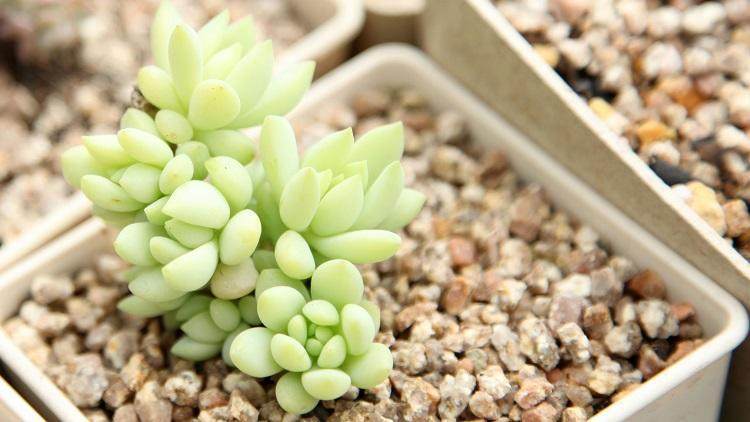
Below I'll walk you through the question of soil mixes for succulents. Some succulent fans who just got into the hobby may think that one particular ring works extremely well, but that is not actually the case, because when choosing a soil mix we also have to take into account the growing environment, our own habits, the type of mix, and the watering frequency.
Compared with other kinds of indoor plants, succulents are still a type that is simpler to care for and manage, but that does not mean we can just toss a succulent into a pot and then ignore it completely, so a soil mix is indispensable for the plant's growth (of course, some succulents grown outdoors in cheat-mode regions can grow well no matter what, but that is probably only a small minority).
1. The drawbacks of a single medium
Actually, for succulent fans like me who got into the hobby early, the usual routine is to repot once every growing season and then swap in fresh soil. Succulents may grow fast, but the money can't keep up. Later I saw online that in some areas, to make succulents' colors more extreme, people grow them in pure granules. It's true that you don't need to repot or change the soil for 3-4 years, and the succulents' colors really do look better, but they die easily.
Specialty succulent peat soil not only has good water retention and aeration, it is also the most commonly used material for succulent potting mixes, and this medium can also maintain the soil's moisture and fertility well, promote the reproduction of microorganisms, and has a relatively low density, so the mixing ratio can be adjusted appropriately according to your local conditions.
2. A good, correct formula
I recommend that everyone absolutely not grow succulents using a mix that is entirely granules; it is best to switch to granules : peat soil (seedling peat, the very fine kind) = about 8:2 (be sure not to choose the kind of sticky medium that easily mixes with granules into mud, because this kind of peat not only tends to cake and harden, but also easily causes succulents to wither and die).
Volcanic rock succulent granular soil not only has many pores, it also combines the water retention and aeration characteristics of granular soil. It is hard in texture, even harder than akadama, and in the short term there is no worry about it breaking down into powder; you don't have to worry about it carrying bacteria or insect eggs, and it also contains some trace nutrients.
Akadama for succulent green plants in pots is a very rare material, formed mainly from accumulated volcanic ash. It is round in shape (its shape helps with water storage and drainage), and it also has high permeability; because it is a volcanic material, there are no fungi or bacteria inside, and its pH is mainly slightly acidic.
3. A coloring formula for succulents
If you want to bring color to your succulents, then I personally suggest using a ratio of granular soil : peat = 1:1, and then in late autumn and early winter maintaining good light, ventilation, and temperature differences in the growing environment. Then the succulents will quickly take on rich colors (and they will also be fatter than succulents grown in a conventional mix).
Diatomite is a white granular soil that is relatively light in texture, so it easily grinds into powder; it has low density, many pores, and a rough feel. At the same time, diatomite has physical adsorption properties and can also effectively destroy the waxy outer layer of pests' exoskeletons, causing the pests to dehydrate and die.
Kanuma soil is mainly formed from volcanic soil, so it takes the form of volcanic sand. Its pH is acidic, and it has very high permeability, water retention, and aeration. Although kanuma soil is not uniform in size, it has many pores. So whether it is used for professional production, home cultivation, or soil improvement, it all has good results.
Of course, besides helping plants color up and get fatter, granular soils also have excellent drainage and rich mineral elements! Which kind of soil have you all used to care for your succulents? Feel free to leave a comment.