Why do these 4 flowers need to be repotted frequently?
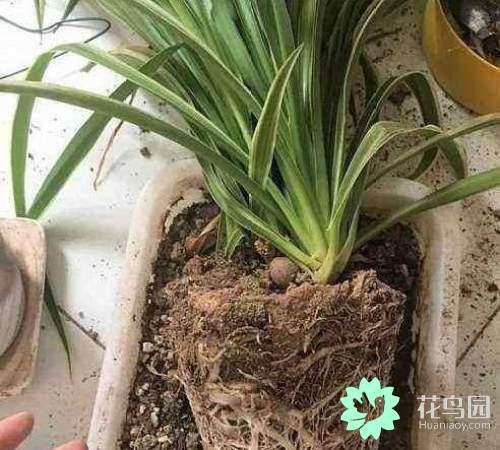
When growing flowers, you need to grow the roots - this is a principle many people understand. But if the roots are grown too well, it can cause trouble, because when the root system is too lush, you have to repot frequently. If you don't repot, the nutrients in the pot cannot meet the plant's growth needs, and it easily causes the leaves to turn yellow and dry up, and even prevents flowering. For example, with these 4 flowers - Clivia (Clivia miniata), orchids, spider plants (Chlorophytum comosum), and cyclamen (Cyclamen persicum) - be sure to remember to repot them often.
Why do these 4 flowers need frequent repotting? Because these plants share a common trait: they all have "fleshy roots." Any plant with fleshy roots grows its root system quickly and has strong vitality. Next, take a look at just how "spectacular" the root systems of these flowers become when they are not repotted!
1. Spider plant not repotted for a long time - the roots look like this
As one of the more common foliage plants, the spider plant (Chlorophytum comosum) has purifying abilities and can green up a room, making it very popular. Speaking of spider plants, they are also very easy to care for. Spider plant care: the optimal growth temperature is 15-25°C, and it has low soil requirements, though it grows best in well-drained, loose, fertile sandy soil. In addition, spider plants are best kept about one meter away from a balcony, where they can receive scattered light, which benefits their growth.
2. Orchids not repotted for a long time - the roots look like this
Orchids, as one of China's top ten famous flowers, are also known as spring orchid, orchid grass, orchid flower, secluded orchid, mountain orchid, and valley fairy. They have a fresh fragrance - with one pot in the room, the fragrance fills the air. Their flower posture is dignified and elegant, graceful and noble; placing a few pots of orchids indoors instantly gives a feeling of vitality.
Orchid care:
Orchids are suited to growing in fertile soil rich in humus. They prefer a shady environment and are most afraid of direct sunlight, so they are not suited to being kept on a balcony. If kept indoors, be sure to maintain air circulation, as this benefits the growth and flowering of orchids.
3. Clivia not repotted for a long time - the roots look like this
Look at the root system of Clivia (Clivia miniata) - doesn't it look quite "frightening" when not repotted for a long time? Clivia's root system is actually more developed than that of almost any plant. Many flower growers think that only by watering and fertilizing more will Clivia have glossy green leaves, bloom quickly, and not have its flower stalk stuck between the leaves. Little do they know that Clivia's root care needs even more attention. If not repotted for a long time, the soil in the pot is entirely used up by the roots - where will the nutrients come from? Gradually, Clivia will show yellow leaves and fail to bloom. It is recommended to check Clivia's root system every three months.
4. Cyclamen not repotted for a long time - the roots look like this
Cyclamen (Cyclamen persicum) is a very beautiful flowering plant, with a flowering period lasting as long as half a year. It has a beautiful, distinctive plant shape, abundant and vividly colored flowers, and some varieties are fragrant. In addition, its leaves can absorb sulfur dioxide and, through oxidation, convert it into non-toxic or low-toxicity substances such as sulfate. So such a wonderful flower is definitely one to keep a pot of.
Cyclamen care: Cyclamen grows best in a cool environment and in fertile sandy loam rich in humus. It is not tolerant of high temperatures; above 35°C the plant easily rots and dries up. This flower can be kept on a balcony and, like geraniums, is one of the typical balcony flowers.