Growing orchid new shoots into strong seedlings is not mysterious, and the key is not necessarily more fertilizer.
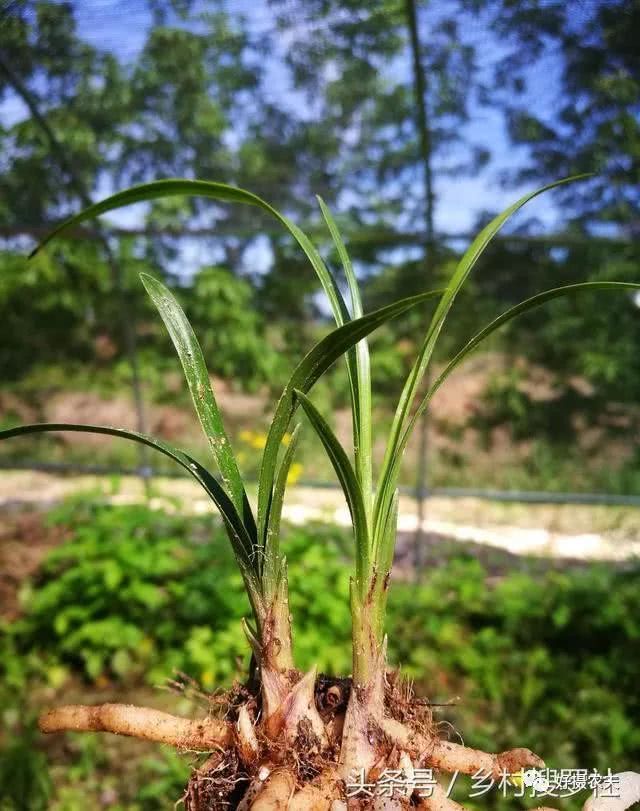
At the end of April this year, before this Cymbidium goeringii (spring orchid) was potted, I sent photos to fellow orchid growers to look at. This is a dwarf Cymbidium goeringii, no more than 20 cm overall, with two seedling plants (meaning seed-grown seedlings), because after careful observation, beside it there were no traces of aged orchid seedlings (whether it is a seedling plant is only a personal judgment).
Before potting, what could be seen were 3 new shoot points, plus a little new root crystal tip the size of a grain of rice. Several orchid-growing friends of Haoshe Farmer wanted this Cymbidium goeringii; hehe, since there was only this one dwarf type, I potted it myself. The sprouting rate like this is still quite high: two plants sprouted three shoot points, a sprouting rate of 150%. But could all these shoot points be grown into seedlings? Actually, I was not sure either.
More than a month later (June 6), all three new shoots had grown this large, and they looked very healthy, so this could reach a 100% seedling formation rate. The last picture is from June 27 (that is, today), and the leaves of the new seedlings are obviously much larger than 20 days ago. Haoshe Farmer gave this Cymbidium goeringii no special care, but managed it together with a large batch of orchids. Today Haoshe Farmer will tell fellow orchid growers about this management process; actually it is very simple.
In growing orchids, Haoshe Farmer personally thinks the most important things are environment, environment, environment. As long as the overall environment suits its growth, management can be quite extensive. Of course, this is also the worry of urban orchid growers. This dwarf Cymbidium goeringii has always been placed in the orchid shed, with a shade net on the shed roof, and the flower pot placed on the ground without a stand. The growing medium used was pine bark + hickory shell + humus soil mixed by Haoshe Farmer himself, with no fertilizer applied, only one foliar fertilizer spray in May (monopotassium phosphate + urea).
Never watered; in the rainy weather of the first half of the year, there was simply no need to water at all.Carbendazim and mancozeb have been sprayed once every 15 days from May 5 to now. Fellow orchid growers can still see carbendazim residue on the orchid leaves. So Haoshe Farmer thinks the importance of conditions for growing orchids, in order, is: overall environment, artificial micro-environment, growing medium, water, fertilizer. I put fertilizer last because I think that if fertilizer is not truly needed, it is better not to apply it.
Netizens, what do you think? If you have good suggestions and opinions, please leave them in the comments section.