Detailed Guide to High-Efficiency, High-Yield Cultivation Techniques for the Chinese Medicinal Herb Mustard Seed
Mustard seed, also known as mustard seed, green vegetable seed, yellow mustard seed, white mustard seed, white mustard, and mustard powder seed, is the dried mature seed of the cruciferous plants white mustard Sinapis alba L. or mustard Brassica juncea (L.) Czern. et Coss. The former is commonly called "white mustard seed," and the latter is commonly called "yellow mustard seed." When the fruit ripens in late summer and early autumn, the plants are cut, sun-dried, the seeds threshed out, and impurities removed. Mustard seed is a relatively commonly used Chinese medicinal herb. It was first recorded in the "Record of Famous Doctors' Materia Medica" and listed as a superior-grade drug. Its flavor is pungent, its nature warm; it enters the Lung meridian. It has the effects of warming the lungs, eliminating phlegm, and regulating qi, and of dissipating nodules, unblocking collaterals, and relieving pain. It is mainly used for cold-phlegm cough, distending pain in the chest and hypochondrium, phlegm stagnating in the collaterals, numbness and pain of the joints, phlegm-dampness pouring and spreading, and yin flat abscesses and swelling toxins, among other conditions. Mustard seed is widely distributed across production areas, among which white mustard seed is mainly produced in Fuyang and Guoyang in Anhui; Shangqiu, Xiayi, and Xuchang in Henan; Jining and Heze in Shandong; Wanxian, Zhongjiang, and Nanchong in Sichuan; Baoding, Chengde, and Zhangjiakou in Hebei; Shiquan, Hanzhong, and Luonan in Shaanxi; Jiashan and Jiaxing in Zhejiang; and Enshi and Yichang in Hubei. Yellow mustard seed is cultivated in all regions. Henan and Anhui have the largest output. Besides medicinal use, mustard seed can also be used as a spice and seasoning, and is a medicinal-and-edible dual-use variety. So, how should mustard seed be planted, and which key cultivation technique points must be mastered to achieve high efficiency and high yield?
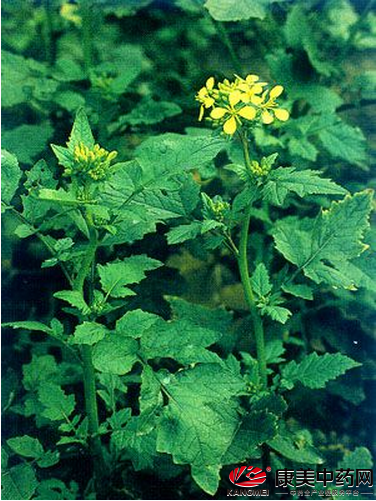
[Cultivation Techniques]
I. Land Selection and Land Preparation
Mustard seeds are very small, so the land must be leveled and finely prepared, weeds and debris picked out, and deep furrows with high beds made for drainage and irrigation. The bed width is generally 2.5 m (including the furrow).
II. Planting Methods
1. Seed Collection and Seed Treatment
Propagation is by seed. Before sowing, first soak the seeds in 15% salt water for 20 min, or soak them in 30°C warm water for 2-4 h, take them out, dry them slightly, mix in double the amount of fine soil, sow in rows, cover with 10 cm of soil, press down lightly, and water.
2. Sowing Methods
The sowing time for mustard is generally preferably July 5 to 8, and it is best to sow a few days earlier than radish and Chinese cabbage, or at the same time. Whether to water the planting holes depends on soil moisture. Put 5-6 seeds per hole, cover with 3 cm of soil, and press the surface firm to help emergence. Seedlings emerge about 10-15 days after sowing.
III. Field Management
1. Seedling Stage Management
When the seedlings grow to 3-4 leaves, begin thinning. Keep 40 plants per linear meter, pull out clustered seedlings so they are loosened, and remove small, poor, and weak seedlings; when the seedlings grow to 5-6 leaves, final thinning can be done, one plant per hole, selecting and keeping tall, thick, and strong seedlings, and pulling out all the rest, keeping 27-30 plants per linear meter.
2. Planting and Management
Before and after final thinning, timely hoeing and ridging should be carried out. Depending on drought conditions, decide the number of irrigations. Generally, 2-3 rounds of hoeing and ridging are best.
[Pest and Disease Control]
I. Diseases
Downy mildew:It mainly harms the leaves. The lesions occur on both sides of the leaf, and the lesions are yellow-green or gradually turn yellow. Because they are restricted by the leaf veins, they expand from nearly round to polygonal, with a diameter of 3-12 mm. When humidity is high, a white mold layer grows on the underside of the leaf, namely the sporangiophores and sporangia of the pathogen. In severe cases, the leaves dry up, affecting yield and quality.
Control methods: select disease-resistant varieties; strengthen fertilizer and water management; provide ventilation between plants and rows; at the early stage of disease, spray fungicides: 40% fosetyl-aluminum wettable powder at 300 times; 75% chlorothalonil wettable powder at 600 times; 65% zineb wettable powder at 500 times; 58% Ridomil MZ wettable powder at 600 times; 80% Pencozeb wettable powder at 500-800 times. Spray once every 10 days, for a total of 2-3 times.
II. Insect Pests
Aphids:Adult aphids and nymphs suck sap on the underside of leaves. In mild cases, they cause faded spots on the leaves and yellowing of the leaves; in severe cases, the leaf surface curls, shrinks, and becomes deformed, and the plant may even fail to bolt normally. They can also transmit viral diseases. Generally, more than 10 generations occur each year, with two peak occurrence periods each year in spring and autumn.
Control methods: (1) Use 20% acetamiprid diluted with water at 3000 times, or 10% Yibianjing (imidacloprid) diluted with water at 1000 times for spray control;
(2) The following agents can also be used for control: 50% menazon emulsifiable concentrate diluted with water at 1000-1500 times, 40% fenvalerate-malathion emulsifiable concentrate or 40% fenvalerate-cypermethrin emulsifiable concentrate diluted with water at 1500-2000 times, 2.5% lambda-cyhalothrin emulsifiable concentrate diluted with water at 2000 times, 20% fenpropathrin emulsifiable concentrate diluted with water at 2000 times.
[Harvesting and Processing]
In late summer and early autumn, when the siliques turn from green to white and the beak becomes withered, they are mature. Cut back the aboveground parts, expose them to strong sun, thresh out the seeds, remove all impurities, and sun-dry again until completely dry. Those that are plump and solid and pure white in color are considered the best.