How to grow chicory? Cultivation methods for a medicinal herb with high nutritional and medicinal value
Chicory is a commonly used medicinal herb of the Uyghur people. It is the dried aerial part or root of the Asteraceae plant Cichorium glandulosum Boiss.et Huet or chicory Cichorium intybus L. The aerial part is harvested in summer and autumn, or the root is dug up in late autumn, then the soil and impurities are removed and it is sun-dried. Its taste is slightly bitter and salty; its nature is cool; it enters the liver, gallbladder and stomach meridians; it has the effects of clearing the liver and promoting gallbladder function, strengthening the stomach and aiding digestion, and promoting diuresis and reducing swelling. It is mainly used for damp-heat jaundice, stomach pain with little food intake, edema with scanty urine and other conditions. Chicory has a relatively wide distribution of production areas, mainly produced in **, Shandong, Jiangxi and the Northeast, North China and other places, and has been introduced and cultivated in Sichuan (Chengdu) and Guangdong in China.
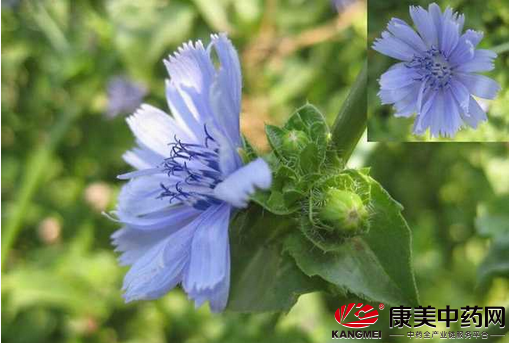
Photo of the original chicory plant
Chicory contains many kinds of nutrients. Chicory leaves are tender and juicy, rich in nutrition. The crude protein content at the rosette stage is 22.87%, at the early flowering stage it is 14.73%, with an average protein content of 17%, and the crude protein yield reaches 250kg per mu. It can regulate endocrine disorders in the human body, and can also improve gastrointestinal function, clear the intestines and relieve constipation, reduce internal heat and moisten dryness, and has health benefits such as enhancing human immunity. At the same time, its rich potassium can effectively increase oxygen supply to the brain and regulate heart rhythm, etc. The most remarkable thing is the special components contained in chicory, such as aesculetin, esculin, etc., which have significant medicinal value for conditions such as high blood pressure and high blood lipids. As a medicinal herb with rich nutrition and high medicinal value, how should the chicory plant be cultivated? The cultivation techniques and pests and diseases of the chicory medicinal plant are introduced below;
[Cultivation Techniques]
I. Site selection and land preparation
Chicory has no strict requirements for soil and is tolerant of saline-alkali soil, but grows best in soil with high fertility and a pH value of 6. Because chicory seeds are small, the land must be prepared finely before sowing, the soil must be deeply plowed and raked level, so that the soil layer is loose, and ditches should be opened according to the terrain for drainage to prevent water accumulation in the field. Chicory is a plant that grows in summer and can generally be cut more than 4 times a year, so it requires a relatively large amount of fertilizer. Before sowing, sufficient fertilizer should be applied in combination with land preparation. Generally, about 3000kg of decomposed organic fertilizer is applied per mu, then plowing and fine raking are carried out so that the fertilizer is evenly distributed in the soil.
II. Planting methods
1. Seed collection and seed treatment
7 to 10 days before sowing, place the seeds in a cool and ventilated place to dry for 1 to 2 days, which can increase the germination rate, but do not expose them to the sun on a concrete surface. To ensure full stands, it is advisable to test the seed germination rate before sowing. Generally, imported chicory seeds have been treated with fungicides and can be sown dry (colored seeds are coated with pesticides; wash hands with soap after touching them). If the seeds are self-collected or domestically bred, they can be soaked in cool water, the floating seeds removed, and the sunken plump seeds taken out, drained of water and then sown.
2. Sowing
(1) Sowing period
In central and southern Hebei, sow from July 22 to August 5, with July 25 to 28 being the best sowing period. In eastern Hebei, sow in mid-to-late July, and in the Zhangcheng area, sow in early June. Direct sowing requires 120 to 150 grams of seed per mu. Plug tray seedling raising uses precision sowing, with 18 to 20 grams of seed per mu, greatly saving seed compared with direct sowing.
(2) Preparation before sowing
20 to 25 days before sowing, crush the stubble of the previous crop with a rotary tiller; the more thoroughly it is crushed, the better. Apply sufficient base fertilizer: 5000 kg of decomposed high-quality barnyard manure, 30 kg of diammonium phosphate, and 20 kg of potassium sulfate per mu. Deeply plow and prepare the land: spread the base fertilizer on the surface and then mechanically plow, with a plowing depth of 25 to 30 cm, level the land, and pick up all stubble. When sowing in single rows, form ridges at a distance of 40 to 50 cm, with a ridge height of 15 to 17 cm; when sowing in double rows, form ridges at a distance of 80 to 90 cm, with a ridge height of 12 to 15 cm, and make beds 10 to 15 m long. Water evenly, and ensure irrigation in drought and drainage in waterlogging.
(3) Sowing method
Direct sowing. Chicory is suitable for direct sowing. The direct sowing method is ridge cultivation, with equal row spacing of 40 cm, sowing on top of the ridge. Double-row sowing can use wide and narrow rows, with a narrow row spacing of 30 cm. First use a bamboo pole to draw a small furrow 0.5 cm deep. Hold the seeds in your hand and twist the seeds into the furrow with two fingers, then gently push the soil level with a hoe. Water immediately after sowing, do not let water run across ridges, and do not let it flow over the top. Water once before emergence, and water once after emergence to settle the plants. Thin the seedlings for the first time when chicory has 2 to 3 leaves, and for the second time when it has 4 to 5 leaves, removing diseased and weak seedlings and appropriately spacing them out. Final thinning is done at 7 to 9 leaves, with a plant spacing of 17 cm for single-row sowing and 19 cm for double-row sowing, leaving 8500 to 10000 plants per mu.
Seedling raising. For seedling facilities, small nutrient soil blocks or plug trays can be used. Choose 288-cell trays for seedling raising; when lifting seedlings, the soil clump does not break apart and the roots are not damaged, giving a high survival rate. Seedling substrate. Local materials can be used, using disease-free garden soil as the substrate. If conditions permit, 2 parts peat and 1 part vermiculite can be used, or 1 part each of peat, waste mushroom material and vermiculite mixed. If 288-cell trays are used, raising seedlings for 1 mu of chicory requires 40 to 50 trays, and each cubic meter of substrate can fill 300 trays. When preparing the substrate, add 0.7 kg of compound fertilizer per cubic meter of substrate, or use 0.5 kg of urea and 0.5 kg of potassium dihydrogen phosphate, mix well with the substrate and fill the plug trays for later use. When sowing, place 1 seed per cell, with a depth not exceeding 1 cm, cover with a thin layer of vermiculite after sowing, and after watering it is enough that the seeds are not exposed. After sowing, spray thoroughly with water, to the extent that water drips from the bottom holes of the plug tray; after spraying, each cell of the tray should be clearly visible. At a temperature of about 20°C, seedlings emerge completely in 3 to 4 days; check for gaps and fill them in time.
3. Seedling stage management
The seedling raising period is in a season of high temperature and frequent rain, so the seedling site must be protected from rain and high temperature. If raising seedlings in a greenhouse, spray water every day, and during the high-temperature period spray once each in the morning and evening. When the small seedlings have three leaves and one heart, foliar fertilizer can be applied 1 to 2 times along with watering, using 0.3% urea plus 0.2% potassium dihydrogen phosphate solution for spraying. After about 20 days, when the small seedlings have 3 to 4 true leaves, they can be transplanted to the field.
4. Management after final thinning or transplanting
Water thoroughly when planting. Water once 4 to 5 days after planting to help the seedlings recover, and afterward water according to soil moisture. In the late rosette stage, when the root plant enters the swelling stage, apply 10 kg of urea per mu, topdressing 1 to 2 times, and topdressing should be carried out in combination with watering. After planting or final thinning, cultivate and weed 1 to 2 times in time to control the growth of the aerial part and promote root swelling.