How is white cardamom, a traditional Chinese medicine that aids digestion and warms the stomach, cultivated
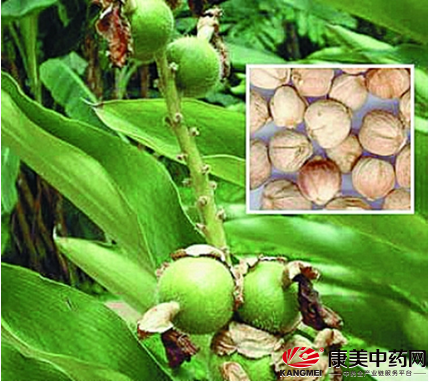
White cardamom is a commonly used traditional Chinese medicine. It is the dried fruit of the ginger family plants white cardamom (Amomum kravanh) and Java white cardamom (Amomum compactum), with the fruit peel removed before use. White cardamom was first recorded in the Song dynasty work "Kaibao Bencao." Its flavor is pungent, and its nature is warm. It enters the lung, spleen, and stomach meridians. Main indications: moves qi, warms the stomach, aids digestion, and relieves abdominal distension. It treats tumors of the digestive system. It is used for stomach pain, abdominal distension, epigastric stuffiness with belching, vomiting and regurgitation, indigestion, and other conditions. White cardamom originated in the tropical rainforests of Indonesia, and China's medicinal cardamom was formerly always imported. After successful introduction and trial cultivation beginning in the 1960s, it filled the gap in China's cardamom seed sources. At present, there is relatively large-scale cultivation on Hainan Island and in Xishuangbanna, Yunnan. White cardamom is highly nutritious, and its flavor is also very good. It has a strengthening effect on our lungs, spleen, and stomach. Therefore, adding white cardamom to rice porridge can play a role in daily health care. White cardamom has very broad medicinal value and is a medicinal herb worth promoting for cultivation. So how is white cardamom cultivated?
[Growth Habits]
Because white cardamom has poor cold tolerance, it is only suitable in areas with an annual average temperature of 22-23°C. If it encounters a low temperature below 4°C, the leaves suffer mild cold damage, and at 0°C all aboveground parts die. The flowering period is relatively sensitive to temperature; when the daily average temperature is below 20°C, the flowers generally do not open. It requires abundant rainfall, generally with annual rainfall above 1500 mm. It requires all-day scattered light and a certain degree of canopy density. During the seedling stage, the canopy density is 85%. As the seedling group grows, the canopy density gradually decreases. To promote flower bud formation, it is generally best to control it at 60%-70%. It requires deep soil, fertile and moist, well-drained sandy loam. Clay soil with low humus content and places prone to water accumulation easily cause root rot and are not suitable for planting.
[Cultivation Techniques]
1. Site selection and land preparation
The seedling-raising site should be near a water source, well drained, and loose and fertile sandy loam used as a seedbed. After plowing the soil, apply sufficient base fertilizer, remove grass roots and stones, and break up clods. Then apply decomposed cattle pen manure or compost as base fertilizer. The bed width is 0.8-1 m, and the ditch width is 40 cm. For the planting site, it is best to choose sloping land in the middle and lower parts of mountainous areas below 700 m in altitude, with a certain number of evergreen broadleaf trees, where the influence of winter cold currents is relatively small, with a southeast aspect, in mountain gullies with mountains on two sides or surrounded by mountains on three sides, or in places near water that are not easily washed out, with humus-rich sandy loam. Plow the land according to a row spacing of 1.5-2 m. In conjunction with land preparation, cut away weeds and trees, dig out tree roots, and open holes. The hole specifications are 50 cm X 50 cm X 30 cm. Apply base fertilizer, and open drainage ditches on sloping land to prevent water accumulation and erosion. Where shade trees are lacking, first plant fast-growing trees.
2. Propagation methods: use seeds and division propagation.
(1) Seed propagation: generally select seeds from early August to September and sow them immediately after harvest. Before sowing, promote germination. If the amount of seed is small, mix the seeds with 4 times their volume of wet sand and place them in a basin, keeping them moist regularly. At a temperature of 30-35°C, germination points generally appear in just over 10 days, at which point take them out and sow. Drill in furrows with a row spacing of 10-15 cm. After sowing, cover with 0.5 cm of soil, and cover the bed surface with grass. Emergence begins in 20-30 days, and from sowing to full emergence requires 40-60 days. When the seedlings have 2-3 leaves, thin them or move them to another bed to promote faster increase in leaves. When they have 5-7 leaves, the plants begin to tiller. When the seedlings are about 30 cm tall, they can leave the nursery for field planting. The planting spacing is 1 m X 1.5-2 m. Plant 2-3 seedling plants per hole. Do not plant too deep, so as not to affect root development and shoot emergence. After planting, press the soil firm and water with rooting water.
(2) Division propagation: in the field, select robust and high-yielding plants, cut off their rhizomes, and each rhizome should have 2-3 aboveground stems. Generally, from vigorously growing biennial clumps, 8-10 small clumps can be taken as planting stock, and they should be planted immediately after digging.
3. Field management
(1) Shading: when the seedlings emerge, gently push the covering grass into the rows to facilitate emergence. When seedlings emerge, set up a shade shed to prevent exposure to fierce sunlight.
(2) Weeding and cutting dead seedlings: after field planting and before the rows close, promptly pull out weeds, taking care not to damage young stems and fibrous roots. After harvesting the fruit, promptly remove dead, weak, diseased, and damaged plants. Where density is too high, cut more weak seedlings.
(3) Topdressing and earthing up: in the early stage after field planting and after the first fruit set, apply heavy applications of human manure and urine or ammonium sulfate aqueous solution to promote the growth of the seedling group. Entering the flowering and fruiting stage, apply a complete fertilizer of nitrogen, phosphorus, and potassium, together with soil manure, burnt soil, and the like. During the fruiting stage, a 2% calcium superphosphate aqueous solution can also be used as foliar topdressing to promote seedlings and flowers, enlarge the fruit, and increase the fruit-setting rate. Java white cardamom is a shallow-rooted plant with many fibrous roots, often scattered on the soil surface. After fertilizing in autumn and winter, earth up the soil, but it should not be too thick, so as not to hinder the emergence of flower buds.
(4) Irrigation and drainage: high temperature and drought can cause leaves to curl, turn yellow and wilt, and plants to grow weak and spindly. If drought occurs during the flowering period, the inflorescence declines early, with fewer flowers and less pollen and stigma mucilage, resulting in unsuccessful pollination or dried and dead young fruit. At this time, irrigate or spray promptly to increase air humidity. In the rainy season, repair drainage ditches well to avoid water accumulation causing root rot and flower rot.
(5) Regulating canopy density: the seedling stage requires 80%-85% canopy density; the flowering and fruiting stage requires 70% canopy density; and in winter it can be increased to 80%.
(6) Artificial pollination: the flower structure of Java white cardamom is special, and self-pollination or cross-pollination is not easy, so artificial assisted pollination is needed. Under normal climate conditions, the flowers open after 7 a.m., pollen is gradually shed after 8 a.m., and the pollen matures at 10 a.m. Therefore, artificial pollination should preferably be carried out from 8 to 12 o'clock each day. The specific method is to use a bamboo stick to lift the pollen and smear it on the funnel-shaped stigma. When there is much pollen, the pollen from 1 flower can pollinate 2-3 flowers.
4. Seed retention techniques
Select excellent varieties, and use plants that grow robustly, have large fruits, plump seeds, and no pests or diseases as mother plants. Generally, in July to early August, harvest when the fruit is light yellow and the seeds are hard and dark brown. Fruit used for seed should not be exposed to fierce sunlight for a long time or stored for too long, so as not to lose germination capacity. Remove the fruit shell, and select fully mature, plump, and large seeds as seed. If sowing in spring the following year, the seeds need to be stored in moist sand in a cool place.
[Pest and Disease Control]