Underground pests in Chinese medicinal herbs cause great damage, how should they be controlled
Most Chinese medicinal herbs are harvested mainly for their underground roots and rhizomes. In recent years, as the cultivation years of medicinal herbs have lengthened and the planting area has expanded, underground pests have occurred more and more severely during the growth and development of Chinese medicinal herbs. Common underground pests include the damage caused by white grubs, black cutworms, click beetles (wireworms), mole crickets, root longhorn beetles, root leaf beetles, root bugs and others, seriously affecting the yield and quality of Chinese medicinal herbs, especially root and rhizome medicinal herbs, causing severely poor growth of the medicinal herb plants, deteriorating the quality of the medicinal materials and reducing the yield. Therefore, controlling underground pests of Chinese medicinal herbs is the key to ensuring robust plant growth and increasing yield. Several commonly used measures for controlling underground pests are introduced below:
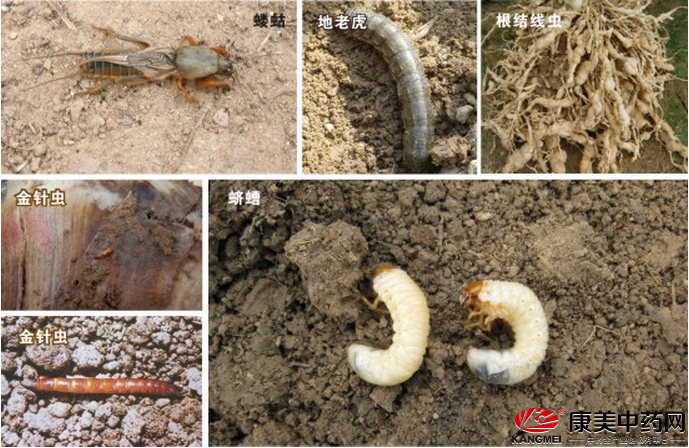
1. Deep ploughing in winter:Plough the soil 35cm deep in winter; by turning the soil, the survival and overwintering environment of the pests is destroyed, reducing the pest population density the following year.
2. Manure treatment:Undecayed farmyard manure is a place where underground pests lay eggs and reproduce. Therefore, fully decayed farmyard manure should be applied to medicinal plants, and when applying it, 500g of 5% carbaryl per mu should be used for harmless treatment, with good results.
3. Cleaning up the field:After the previous crop is harvested, promptly remove weeds from the field to reduce the number of overwintering larvae and pupae. At the same time, during the growing period of the Chinese medicinal herbs, promptly eradicate all weeds in the field, and bury them deep or carry them out of the field to make compost.
4. Seed dressing with chemicals:Per mu, dress seeds with 1kg of 3% carbofuran granules, which can control underground pests such as click beetles (wireworms), mole crickets, white grubs, yellow ants and black cutworms.
5. Root irrigation with chemicals:When pests occur at the seedling stage, if broken seedlings are found and larvae have entered the soil, irrigate the roots with 2.50% deltamethrin 6000-fold solution or fenvalerate 4000-fold solution once every 8-10d, for 2-3 consecutive irrigations, which can kill underground pests such as black cutworms, white grubs and click beetles (wireworms).
6. Broadcasting poisoned soil:Per mu, use 500g of 50% phoxim emulsifiable concentrate, mix with 25-30kg of fine sand or fine soil, open a furrow beside the roots of the medicinal plants and scatter it in, then cover with soil immediately or apply the poisoned soil in combination with intertillage, which can control various underground pests.
7. Trapping and killing adults:Effective methods for trapping and killing adults usually include: (1) The adults of scarab beetles, black cutworms and mole crickets have a strong tendency toward black light lamps; place black light lamps during the peak emergence period of adults to trap and kill them. (2) Dilute 100g of 20% methomyl emulsifiable concentrate with 1kg of water, spray it on 100kg of fresh grass or chopped vegetables (about 16cm long), mix into a poisoned bait, and in the evening place a small pile at certain intervals in the field; use 25kg of poisoned bait per mu to trap and kill black cutworms, with relatively good results.
8. Applying chemicals on the ground:Spray 2.50% deltamethrin 2000-fold solution on the ground in the evening, which can control various underground pests in medicinal herb seedling beds.
9. Applying chemicals to plants:When the seedlings of the medicinal herb plants show damage symptoms such as holes and notches, spray the leaves with 90% trichlorfon 800-1000-fold solution, or 50% diazinon emulsifiable concentrate 1000-1500-fold solution. During the adult occurrence period, spray once every 7-10d in the evening, for 2-3 consecutive sprays to control the pests.