What are the rearing methods and precautions for the scorpion (Buthus martensii Karsch), the most venomous of the "five poisons"?
The scorpion (quanxie) is the dried body of the scorpion species Buthus martensii Karsch of the family Buthidae. In traditional Chinese medicine, the scorpion is called quanxie or quanchong, and is the most venomous of the "five poisons." It has high medicinal value, with effects of calming wind and stopping spasms, unblocking meridians and activating collaterals, reducing swelling and relieving pain, and detoxifying and dissipating masses. For thousands of years, more than 100 kinds of traditional Chinese medicine prescriptions have been made with scorpion. Scorpion is an important raw material for more than 30 kinds of Chinese patent medicines such as Renshen Zaizao Wan, Tongxinluo Capsules, Dahuo Luo Dan, Qizhen Dan, and Qianzheng San. Medicinal scorpions in China are mainly distributed in Shandong, Hebei, and Henan, and are also found in Liaoning, Beijing, Shaanxi, Jiangsu, Hubei, Anhui, Shanxi and other provinces. Shandong scorpions are famous for their large quantity and high quality, and are a traditional authentic medicinal material.
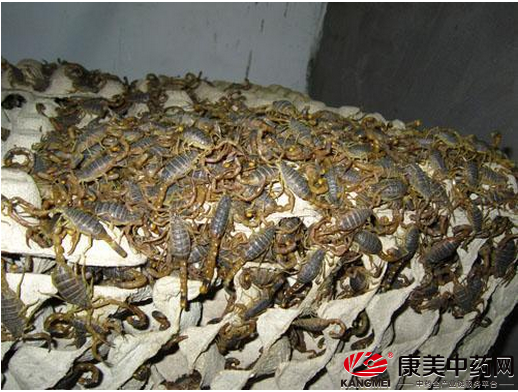
For a long time, commercial scorpions have all come from wild resources, and since scorpions are widely used, market supply has always been relatively tight. Current supply is far from meeting market demand, so commercial artificial scorpion farming needs to be realized as soon as possible. However, when artificially rearing scorpions, one needs to understand the scorpion's living habits and some rearing techniques, and be able to find good treatment methods for sick scorpions. It is best to have technical support for scorpion farming, so that artificial rearing carries the least risk and the greatest profit. Therefore, before rearing scorpions, have you already understood the key technical points and precautions for scorpion rearing? Below is an introduction to the technical methods and key points for scorpion rearing.
[Rearing Techniques]
Artificial scorpion farming has 3 methods: isolated rearing, greenhouse rearing, and domestic breeding with mountain rearing.
(1) Site Selection and Construction
1. For an isolated rearing site, choose sandy loam land that is sheltered from the wind, faces the sun, and has good drainage. On the chosen site, dig a pit 50 cm deep, fill it with stones and soil (ratio 3:1) to make a scorpion nest, appropriately cover the top of the nest with a layer of soil, and build some honeycomb-style holes connected to the area below so that scorpions can enter and exit. Then spray water so that the upper and lower soil layers bond and form soil capillaries. After the nest is built, enclose it with a brick wall about 20 cm high, and embed glass along the top edge of the wall to prevent scorpions from escaping.
2. Build a greenhouse that can maintain 35-38°C year-round, and build scorpion rearing pools inside.
3. For a domestic breeding with mountain rearing site, choose places with rolling mountain terrain, layered rocks, and many interlaced crevices. Within the stocking area, choose a sheltered, sunny, pollution-free spot to build a rearing pool 6 m long, 3 m wide, and 30 cm deep, place crushed stone pieces, tile pieces, and soil so that there are crevices, build three stone weirs on the surface with thin stone blocks each 5 m long and 0.5 m high, and install black-light lamps in the pool. Enclose the perimeter with glass 20 cm high. This is used for pregnant scorpions to give birth.
(2) Rearing Methods
1. Selection of breeder scorpions: Breeder scorpions should be caught nearby, selecting large female scorpions with a plump, full front abdomen. A scorpion can reproduce continuously for several years after mating once, so there is no need to introduce male scorpions. The most suitable season for collecting breeders is from May to late June. This is because after the scorpions emerge from hibernation and forage for a period, their strength has recovered and the time until giving birth is short.
2. Rearing methods: Isolated rearing: In nature, scorpions are a dispersed-living type and seek suitable living environments within a relatively large range. Under artificial rearing conditions, scorpion density is high, and they often interfere with each other or even cannibalize one another. The isolated rearing method disperses a larger group of scorpions into several small isolated areas, which is beneficial to the growth and development of the scorpions. For each 0.2 sq m isolated small area, it is relatively suitable to place 30 pregnant scorpions or about 300 baby scorpions. Isolating individual scorpions gives a high survival rate, but the cost is high and it is not suitable for large-scale production.
Greenhouse rearing: In nature, scorpions have their main growth period in the hotter months of July, August, and September. In winter, as long as suitable temperatures are maintained and enough food is provided, scorpions can still grow and develop normally. The heat source for the rearing greenhouse can use waste heat from factories, or it can be heated separately, or supplemented with solar energy. Keep the temperature at 35-38°C and relative humidity at 70-80%. Baby scorpions can grow into adult scorpions in about 300 days, reproduce, and can also be processed for medicinal use.
Domestic breeding with mountain rearing: The capture of medicinal scorpions is carried out in spring when they are pregnant with young, which is extremely unfavorable to scorpion reproduction. To solve this problem, during the purchasing season, select strong, robust pregnant scorpions and rear them for a period. After giving birth, process them for medicinal use, and release the baby scorpions into suitable wild areas to grow naturally. This method can make full use of wild resources and has the characteristics of simple equipment, short artificial rearing time, and low cost. The method is: in early May, from the purchased live scorpions, select large, robust, uninjured pregnant scorpions, place 0.8-10,000 per pool, and provide an appropriate amount of food so that they give birth. After the baby scorpions molt and leave the mother's body, separate them out and place them into the wild stocking area. When stocking, scatter them in parallel lines at intervals of about 10 m into the selected stocking area, releasing 400-800 per mu. The released baby scorpions, like naturally bred baby scorpions, also need 3 years to grow up. A small-scale experiment in Qingzhou, Shandong showed that the density of scorpions in the stocking area could increase by 48%, the purchase volume could increase by up to 50%, and the recovery rate of female scorpions reached 80%.
(3) Rearing Management
1. Rearing and feeding: Under artificial rearing conditions, the food selected must be what scorpions like to eat and must ensure nutrition for growth and development; the source must be stable and reliable with low cost; and it must be easy for scorpions to catch and not pollute the environment. Many stored-product pests, as well as sow bugs and ground beetles, have nutritional value similar to the wild food of scorpions and can be used as the main feed for artificial scorpion farming. At present, yellow mealworms, foreign grain beetles, and ground beetles have all been successfully reared, thus providing a relatively rich source of feed for artificial scorpion farming.
Under natural conditions, the food sources of scorpions are diverse. The types of feed for artificial rearing should also be diverse. According to experimental observations, rearing baby scorpions with sow bugs alone resulted in almost no growth, basically no increase in body weight, and most could not molt; rearing alternately with foreign grain beetles and sow bugs could significantly promote development, and most could molt; rearing with a mixture of multiple insects resulted in good growth and development of the scorpions. Generally, after the first molt, baby scorpions eat 8-10 mg of small insects each time, and eat again after an interval of about 10 days, about 3 times in total. An adult female scorpion can eat 100 mg of small insects at one time, generally once every 20 days. A postpartum female scorpion can eat 100 mg once a day and continue eating for 2 days. At this point its abdomen is already full; after 10 days, it eats about 100 mg again, totaling about 600 mg until hibernation. During artificial rearing, feed should be provided at the right time and in the right amount, to the extent that little or no feed remains, avoiding environmental pollution and waste.