The sharp-nosed pit viper is fierce and highly venomous, so why do some people still prefer to breed it?
I believe that for many people, "snakes" are animals that inspire great fear. The "sharp-nosed pit viper", also known as the five-step snake, is a very terrifying and vicious animal. Just thinking about it or seeing it makes people stay far away and avoid it. However, as a type of traditional Chinese medicinal material, some people specialize in breeding it and earn considerable profits from it.
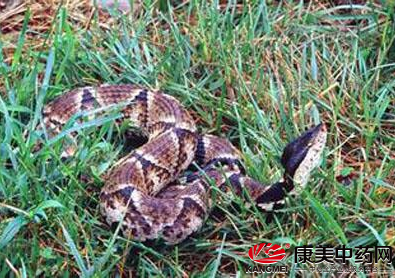
Photo of the original animal of the sharp-nosed pit viper
The sharp-nosed pit viper, also known as the white-flowered snake, the qian-nose snake, the five-step snake, the hundred-step snake, the coiled snake, the chessboard snake, the five-step jumper, and the plowshare snake, comes from the dried body of the five-step snake Agkistrodon acutus (Güenther), a viperid animal. It is mostly captured in summer and autumn, the snake's belly is cut open, the internal organs are removed, it is washed clean, the belly is propped open with bamboo strips, it is coiled into a round disc shape, and after drying the bamboo strips are removed. Its taste is sweet and salty; its nature is warm; it is toxic; it enters the liver meridian; it has the effects of dispelling wind, unblocking collaterals, and stopping spasms. It is mainly used for stubborn wind-damp impediment, numbness and contracture, deviated mouth and eye in stroke, hemiplegia, convulsions and spasms, tetanus, leprosy, scabies and ringworm, and other conditions; the sharp-nosed pit viper has a fairly wide production area, mainly distributed in Anhui, Zhejiang, Fujian, Jiangxi, and Hunan; it is also distributed in Hubei, Sichuan, Guizhou, Guangxi, Guangdong, and Taiwan, China. It is a traditional commonly used animal medicinal material. The sharp-nosed pit viper is a medicinal material native to China, with more than 2,000 years of application history, and to this day it remains an important medicine for treating common diseases such as rheumatism, paralysis, and boils and ringworm, and is also a main raw material in many Chinese patent medicines or traditional powders and medicinal wines. Snake meat, snake gall, snake slough, snake venom, snake oil, snake skin, and so on are all used medicinally. In addition, snake meat is also eaten, and snake skin is used as a raw material for the leather industry; the market demand for the sharp-nosed pit viper is large. As wild sharp-nosed pit viper resources increasingly decline, the price of the sharp-nosed pit viper rises year by year, and now many people have begun to use artificial methods to breed the sharp-nosed pit viper. So how is the fierce and vicious sharp-nosed pit viper artificially raised? Below is an introduction to the artificial breeding techniques and methods for the sharp-nosed pit viper.
Photo of the sharp-nosed pit viper as a traditional Chinese medicinal material
[Breeding Techniques]
I. Site Selection and Site Construction
The snake site should be chosen in a place with high and dry terrain, relatively dense soil, openness and sun exposure, and far from residential areas. The size of the snake-breeding site can be determined according to the number of snakes being kept.
1. Construction of the snake site
Build a surrounding wall 2-2.5 m high; the wall foundation must be deep and firm, and the wall surface smooth and without cracks. No door should be made in the wall; instead, one staircase can be set on each side of the wall, and the staircase inside the wall should be about 1 m away from the wall to prevent snakes from climbing out along the staircase. When people enter the snake site, a wooden plank bridge can be set up, and it can be removed when not in use. The snake site ground should have a certain slope to facilitate drainage. Snake dens should be set up in the site; the height and width of the dens are generally about 0.5 m, and they can be made simply with bricks and stones or with tile vats as walls, with some soil piled outside. One opening should be set on each of the north and south sides of the den wall to connect with the outside. The top of the den should have an opening with a removable lid for observation and taking out snakes. The den bottom should be higher than the ground outside the den, and some sandy soil and thatch should be spread inside the den, paying attention to moisture prevention, ventilation, and heat preservation. It is best to have a small pond, ditch, feed pool, stone pile, cave, and grassland in the site, and to plant some flowers, grass, bamboo, and trees to simulate the wild living environment of the sharp-nosed pit viper. Small animals such as frogs, nestling birds, and nestling rodents can be raised in the site for the snakes to eat at any time. Black light lamps can be installed in the snake site to attract insects for frogs to prey on, which also helps the snakes prey on frogs and other food. Where the ditch enters and exits the snake site, metal screen plates should be used to block it, preventing snakes from escaping and wild animals from getting in.
2. Construction of the snake house
An ordinary house can be modified for use, or one can be specially designed and built (a snake-breeding house). The walls inside the snake house should be smooth and without cracks, ventilated in summer, and insulated in winter. A certain number of snake dens, snake holes, pools, and lawns can be set up in the house. For ease of observation, glass windows can be installed on the walls and protected outside with wire mesh. A corridor can also be separated off inside the house with fine-mesh wire netting, allowing keepers to enter and exit safely and preventing snakes from escaping.
3. Construction of the snake garden
A snake garden is a breeding site combining a snake house and a snake site. The method is to set the snake dens inside the snake house, while the pond, ditch, feed pool, rockery, grassland, and so on are set inside the surrounding wall outside the snake house, with the snake house connected to the snake site. This breeding method is suitable for experimental research on snakes.
II. Breeding Methods
1. Seed source
The sharp-nosed pit vipers being bred generally rely on captured wild adults as breeding snakes. If purchasing from a purchasing department, attention should be paid to selecting adults with uninjured bodies, bright body color, and normal activity as breeding snakes.
2. Stocking density
Healthy breeding snakes are placed in the snake site, snake house, or snake garden for breeding. The stocking number should preferably not exceed 10 snakes per sq m of breeding area. Sharp-nosed pit vipers of different body lengths and ages should be raised separately and not mixed, otherwise they are prone to eating each other and causing losses. During the breeding period, attention should be paid to collecting snake eggs promptly for incubation.
3. Incubation
"Pregnant" female snakes can be kept in snake boxes for feeding so they can lay eggs, and then the eggs are moved into an incubator for incubation. The incubator can be a cement pool, or simply a tile vat or wooden box, placed in a cool, ventilated place, with a 6 cm layer of sand, mud, and weeds spread flat inside. The humidity of the sand should be such that it forms a ball when gripped in the hand, and the grass should be slightly moist. Make the sand or grass into a basin-shaped nest, place the snake eggs in the nest, and artificial incubation can proceed. Under conditions of an air temperature of 19.2-32°C, a soil temperature of 17.5-31°C, and a humidity of 50-95%, sharp-nosed pit viper eggs can hatch young snakes after 26-29 days, and the young snakes mostly emerge from the shells at night.
4. Rearing of young snakes
After young snakes are born, they should be placed separately in snake boxes for rearing. The snake box size is 90×80×50 cm, with sand, mud, and turf spread on the bottom, the box lid made of wire mesh, and thick glass embedded in the front box panel for observation. The temperature inside the box should be kept at about 15°C or slightly higher, and the relative humidity should be kept above 50%. Provide sufficient clean water and feed such as newborn white mice, earthworms, and insects.