How to grow loofah? Cultivation methods of this traditional Chinese medicinal material that is a great material for shoe insoles
Loofah is the vascular bundle of the mature fruit of the cucurbitaceous plant loofah Luffacylindrica (L.)Roem. It is harvested in the second and third seasons of summer and autumn, when the fruit is ripe, the rind turns yellow, and the interior dries up; the outer skin and flesh are removed, it is washed, sun-dried, and the seeds are removed. It was first recorded in the Compendium of Materia Medica. Li Shizhen said: “When this gourd is old, its fibers are woven like silk gauze, hence the name loofah. …… The old loofah has sinews and vessels running through it, with lateral partitions connected throughout, so it can penetrate into the meridians and viscera, and dispel wind-toxin, reduce swelling and resolve phlegm, relieve pain and kill worms, and treat various blood disorders.” He described its form and therapeutic effects in considerable detail. Its taste is bitter, its nature cool; it has the effects of unblocking the meridians and activating collaterals; detoxifying and reducing swelling. It is mainly used for chest and hypochondriac pain; rheumatic arthralgia, meridian spasms, insufficient lactation, lung cough, early-stage carbuncle sores and toxins, other carbuncles and other conditions; it is a relatively commonly used traditional Chinese medicinal material. It is produced throughout the country, with the quality of that produced in Cixi, Zhejiang being the best. It is mostly cultivated.
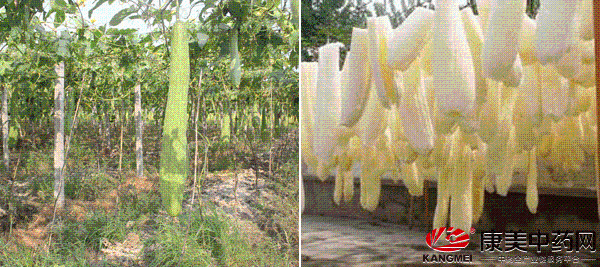
The saponins, the bitter principle of loofah, mucilage, wood gum, citrulline, xylan, interferon and other special substances in loofah have certain special effects. The vitamin b1 it contains, which prevents skin aging, and vitamin c, which whitens the skin, and other components can protect the skin, eliminate blemishes, and make the skin white and delicate, making it a rare excellent beauty product, which is why loofah juice is known as “beauty water.” Loofah has a very strong water-absorbing capacity and is a good material for making shoe insoles. Through professional design and processing, loofah is used in fields such as bathing, foot health care, decoration, toys, and seat cushions. With such a widely economically practical traditional Chinese medicinal product as loofah, how is it cultivated? And what key cultivation technical points need to be mastered to grow it with high efficiency and high yield?
[Cultivation Techniques]
1. Site selection and land preparation: Choose moist sandy soil as the best; generally, semi-moist land or fully moist land is favorable for the growth of loofah. If planted on dry land, the vines are fragile, the gourds are small, and growth is poor. The time for preparing the land and making beds depends on whether there is a preceding crop. For planting loofah on dry land, broad beans, garlic, onions, etc. are most suitable as preceding crops. If there is no preceding crop, prepare the land in winter, wait until after freezing, and then make the beds again before sowing; if there is a preceding crop, when sowing the preceding crop, leave a gap for planting loofah, and plow deeply to make beds, and in spring mix 750 kg of pond mud per 667 sq m with the soil to make gourd mounds, open a hole in the middle of each gourd mound, and at transplanting time use a small scraper to loosen the soil and apply gang yan.
2. Direct sowing and seedling raising:
(1) Seedling method: There are two types, fixed seedbeds and movable seedbeds, with movable seedbeds usually being more commonly used. Sow before Qingming; first soak the seeds in warm water, and after about 2 hours wrap the seeds in a wet cloth, bury them in compost or at the stove entrance to sprout, and after 5 to 6 days, when white roots emerge, they can be sown on the seedbed. The structure of the seedbed can be made by using a board pit, bound around with straw rope. Spread a layer of chaff ash in the middle of the seedbed, spread 7 to 10 cm of river mud on top, and filter off excess muddy water, then insert the loofah seeds into the soil every 5 cm, then cover with a layer of chaff ash and decomposed chicken manure to keep warm and prevent the soil from drying and cracking, so that the soil will not be washed away when watering. The movable seedbed is not large in volume, making it convenient to place in the sunlight every morning to speed up growth, and to move indoors at night or on rainy days. This method produces fast growth and uniform plants, reduces missing plants, and is superior to the direct sowing method.
(2) Direct sowing method: Sowing from Grain Rain to Start of Summer is suitable; first open holes, with row spacing of 170 cm and plant spacing of 50 cm, apply 250 kg of manure per 667 sq m and gang yan, etc. as base fertilizer, sow 4 to 5 seeds per hole, with each seed 3 cm apart, cover with 3 cm of soil, then cover with leaves and grass to maintain moisture and temperature in the soil and facilitate germination; after the seedlings emerge in 7 to 8 days, remove the covering.
(3) Transplanting: When the seedlings grow 3 true leaves, transplanting can be carried out, generally around Start of Summer. First use a knife to cut the soil between the seedlings on the seedbed in rows and between plants, so that the soil of each seedling is separated, then move the soil together with the seedling for planting; in this way the survival rate is high. When directly sown seedlings grow 3 true leaves, thin them out, keeping one vigorous seedling in each hole and pulling out the remaining weak seedlings, so as to facilitate plant growth.
[Cultivation Management]
1. Fertilization: Loofah has a strong nutrient uptake and a large fertilizer requirement, but when fertilizing, it is necessary to apply fertilizer at the right time according to growth conditions, otherwise yield reduction will result. The first time, after sowing, apply 1000 to 1500 kg of river mud per 667 sq m; the base fertilizer must be applied sufficiently, which can make the branches and leaves grow vigorously and increase yield. The second time, before the seedlings go up the trellis, apply 250 to 500 kg of manure per 667 sq m each time, and apply it in small amounts and thinly; this will produce more gourds, otherwise, due to excessive nitrogen fertilizer, the plants will grow vigorously, nutrients will concentrate in the branches and leaves, and it will be easy to cause summer flowers to drop, with few or no summer gourds setting. Wait until after autumn, when the loofah gradually turns yellow, autumn flowers increase, and there are more autumn gourds, but the quality is poor and the yield is low. The third time, when the loofah has gone up the trellis and the gourds hang down in abundance, more fertilizer should be applied, otherwise insufficient nutrients can easily cause uneven sizes; it is best to fertilize once every 7 to 10 days, about 5 times, using 250 kg of human manure per 667 sq m each time; the fourth time, after the first batch of gourds is picked, continue topdressing with 500 kg to increase the yield of autumn gourds.
2. Trellis building: Loofah is a climbing plant; if no trellis is built and it grows prostrate on the ground, the gourds are easily rotted, and at the same time it is impossible to keep seed gourds. The function of the trellis is to use artificial methods during the period of luxuriant leaf and vine growth (April and May) to make the vines twine upward, which is beneficial to the normal growth of young gourds. Around the gourd field, use thick wooden stakes about 10 cm thick for the trellis, with a tripod every 2 stakes, and bury the wooden stakes 34 to 50 cm into the soil to prevent them from being blown over by wind. Beside each loofah plant, a bamboo pole is needed for support, making it convenient for climbing upward; the height of the trellis is 230 to 270 cm, and the top of the trellis is tied with small bamboo in length and breadth into a square shape to allow the gourd vines to extend. The wood material of the gourd trellis can generally be used for about 3 years; to extend durability, finally burn the base of the wooden stakes on all sides with fire into a thin charcoal-like layer, then coat with a little bitumen oil, which can avoid rot and insect damage.
3. Pruning side branches: When the vines are 165 to 200 cm high, the lower forks must be cut off to encourage the upper branches to set more gourds. Because when loofah blooms, it first opens 3 to 4 male flowers, and the female flowers open later; if 3 to 4 female flowers open in succession, it is appropriate to pinch off the top to ensure that each flower plant can set gourds. Therefore, when the loofah fruits are 34 to 40 cm long and more than half of them have reached this stage, concentrated fertilizer should be applied; if too much fertilizer is applied early, nutrients concentrate in the branches and leaves, and female flowers are difficult to retain. The young fruit of the gourd is generally bow-shaped; if allowed to grow naturally, it easily becomes crooked and irregular, so artificial shaping must be used. The shaping method is to tie a small stone or tile fragment with thread to the end of the loofah, so that it slowly straightens, but the weight must be controlled, as too much weight can easily break the gourd or injure it and cause it to wither. If a loofah is found resting on the trellis, it should be promptly adjusted and pulled down so that it hangs below the trellis, so as to grow flat and straight and improve the grade and quality.