How to grow Saposhnikovia divaricata at home: how to achieve high efficiency and high yield?
Saposhnikovia divaricata comes from the family Umbelliferae, genus Saposhnikovia Schischk. It is the dried root of Saposhnikovia divaricata (Turcz.) Schischk., a perennial herbaceous plant. The stem is solitary and dichotomously branched. The basal leaves are pinnately divided, with the ultimate segments lanceolate; the cauline leaves are reduced, with an expanded sheath. The compound umbel bears yellow flowers. The schizocarp is oblong to broadly ovate, flat, with winged lateral ribs; the root is cylindrical or long-conical. The earliest ancient text to record Saposhnikovia divaricata is the Shennong Bencao Jing, where it is listed as a superior grade herb in the materia medica section. Its nature is warm, and its taste is pungent and sweet. It enters the bladder, liver, and spleen meridians. It has the effects of inducing sweating, resolving phlegm, dispelling wind, releasing the exterior, and relieving pain, and is used to treat colds, headache, generalized joint pain, neuralgia, and other conditions. It is mainly produced in Heilongjiang, Jilin, Liaoning, Inner Mongolia, Hebei, Ningxia, Gansu, Shaanxi, Shanxi, Shandong, and other provinces and regions. It grows on grasslands, hills, and gravelly slopes, and is one of the famous medicinal materials of Northeast China; the variety originating from the three northeastern provinces is the best, known as Guandongfangfeng. Saposhnikovia divaricata is an excellent medicine for treating the common illness of externally contracted wind-cold, is used in large quantities nationwide, and is a traditional export commodity. It has great development potential. Saposhnikovia divaricata has strong regenerative capacity and can renew itself naturally, and artificial cultivation has already formed production capacity. So, how should Saposhnikovia divaricata be planted, and what cultivation techniques must be mastered to grow a high-yield crop of Saposhnikovia divaricata?
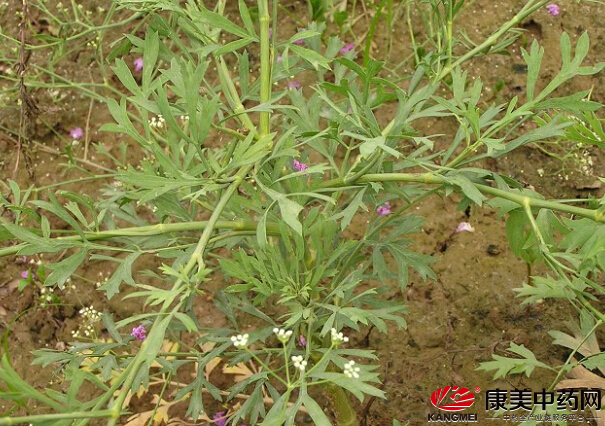
(1) Ecological habits
It is cold-resistant and drought-resistant, but fears waterlogging and standing water. It is suitable for planting in cool summer locations with high, dry terrain; low-lying, easily waterlogged land and saline-alkali land are not suitable for planting. Roots grown in heavy clay soil are short with many branches and poor quality. In the field, soil moisture-holding capacity for Saposhnikovia divaricata must be 60-70%, and at a temperature of 20°C the seeds emerge in one week. At 15-17°C they emerge in two weeks. In addition, note that Saposhnikovia divaricata likes conditions of sufficient sunlight and a large diurnal temperature difference.
(2) Cultivation conditions
1. Land selection and land preparation
1.1 Land selection
Saposhnikovia divaricata is not very strict about soil requirements, but sunny land with high, dry terrain should be selected, and loose, fertile, deep sandy loam with good drainage is most suitable. Clay, waterlogged lowland, strongly acidic soil, or heavily saline-alkali land should not be planted.
1.2 Land preparation
Saposhnikovia divaricata is a deep-rooted plant, and in the second year the root can reach 50-70 cm long. Therefore, in autumn the land should be deep-plowed to more than 40 cm, and in early spring it should be leveled and harrowed fine, with root stubble and debris picked out clean, creating good basic conditions for the growth of Saposhnikovia divaricata.
1.3 Fertilization
To meet the nutrient needs of perennial Saposhnikovia divaricata for growth and development, sufficient base fertilizer must be applied: 3000-4000 kg of high-quality farmyard manure per mu, with 20-30 kg of superphosphate or 8-10 kg of diammonium phosphate added. It is best to apply it to the soil surface before deep plowing in autumn, and then turn it into the plow layer. At the latest, it must be applied before land preparation and bed making. Fertilization must be uniform.
2. Bed making, seedling raising, and sowing
Saposhnikovia divaricata can be propagated either by direct seeding or by raising seedlings and transplanting. In production practice, it has been found that raising seedlings in the first year and transplanting in the second spring can achieve multiple benefits: saving seeds, facilitating centralized management, and saving land.
Where conditions permit, root segment propagation can be used, utilizing root segment sprouting and rhizomes. Cut root segments 5 cm long, open furrows in early spring, and plant the root segments. Use 35-40 kg of planting root segments per mu. After planting, cover with soil and water to preserve moisture.
2.1 Bed making
There are two types of bed seedling raising: open-field direct seeding seedling raising and protected plastic arched shed seedling raising, which can be chosen according to local conditions.
2.1.1 Open-field direct seeding bed The length and width of the bed surface are generally determined by the terrain conditions, should be adapted to local conditions, and should follow the principle of being convenient for management. The bed surface must be level, the ridges straight, and the bed firm.
2.2.2 Medium shed: bed width 2.4 m, bed length 15-20 m. Small shed: bed width 1.2 m, bed length 15-20 m. The spacing between beds is 40 cm, and all are made with walkway trenches 10-15 cm below ground level.
2.2 Suitable sowing time
2.2.1 Seedling field When using plastic arched sheds for early spring seedling raising, the time should be 7-10 days earlier than open-field direct seeding seedling raising, because covering the shed has the effect of preserving moisture and increasing temperature. The sowing method is mainly broadcast sowing.
2.2.2 Open-field direct seeding This should be carried out in early spring when the temperature reaches above 15°C, in early to mid-April, and ridge (row) sowing is preferable.
3. Seed treatment and sowing
Soak the carefully selected seeds in warm water 3-5 days before sowing. Soak in 35°C warm water for 24 hours, or in 40°C-50°C warm water for 8-12 hours, so that the seeds fully absorb water and germinate easily. During soaking, stir while sprinkling in the seeds, remove the shriveled seeds and impurities floating on the water surface, take out the plump seeds that sink to the bottom after soaking, dry them slightly, and then sow.
For broadcast sowing in a shed-covered seedling field, prepare the bed surface well, spray it thoroughly with water, then sow the seeds by hand, using 2.5-3.0 kg of seed per mu. After uniform broadcasting, sieve on 2.0 cm of moist new soil with a bamboo sieve or iron sieve to preserve moisture, cover the seeds completely, then insert the arches and cover with film.
Open-field flat-bed seedling raising uses drill sowing. Open furrows by hand with a hoe, with row spacing of 15-20 cm and furrow depth of 2-3 cm (slightly shallower in loam, slightly deeper in sandy soil). Sow the seeds evenly in the furrows with a dibbler, cover with 1-1.5 cm of soil, and after it dries slightly, press it down to preserve moisture.
For direct seeding in the production field, the sowing method is basically the same as for open-field seedling raising, but the row spacing should be increased to 25-30 cm, and the seeding rate per mu should be reduced to 1.0-1.5 kg.
4. Field management
4.1 Seedling stage management
For seedling raising in plastic film arched sheds, the period from sowing to emergence is the closed period. Check frequently and control the temperature inside the shed well; generally 20°C-25°C is the suitable temperature. If the weather is too hot and the temperature inside the shed is too high, add straw mats for shade to lower the temperature. When the seedlings on the bed surface turn green, adjust the temperature inside the shed by uncovering the film for ventilation. As the seedlings grow, gradually enlarge the ventilation holes for hardening the seedlings until the plastic film is removed. If weeds appear in the bed, remove them promptly.
4.1.1 Drought resistance and moisture preservation, striving for full stands For open-field seedling fields and direct-seeded production fields, management during the period from sowing to emergence is very important. During this period, all measures for drought resistance and moisture preservation should be adopted, using pressing, treading, raking, rolling, and stone rolling as appropriate to local and timely conditions, to ensure sufficient soil moisture in the sowing layer and meet the needs for germination, strictly prevent the occurrence of soil "drying out" and seeds "sprouting dry," and strive to achieve full and strong stands.