Detailed Guide to Growing the Chinese Medicinal Herb Terminalia chebula, With Strong Market Uses
Terminalia chebula was originally called He Li Le, and is the dried ripe fruit of the plant Terminalia chebula Retz. or T. chebula Retz. var. tomentella Kurt. of the family Combretaceae. It was first recorded in the Tang Dynasty text "Tang Bencao," and the young fruit is also used medicinally, known commercially as Xi Qingguo, also called Zang Qingguo. Its taste is bitter, sour and astringent, and it is neutral in nature. It enters the Lung and Large Intestine meridians. It has the effects of astringing the intestines and lungs, and reducing fire to soothe the throat. It is used for chronic diarrhea and chronic dysentery, bloody stool and rectal prolapse, lung deficiency with wheezing and coughing, persistent chronic cough, sore throat and hoarseness. Terminalia chebula is mainly distributed in Yunnan, Guangdong, Guangxi and other provinces and autonomous regions; T. chebula var. tomentella is mainly produced in Yongde, Zhen, Longling and other places in Yunnan. Most are wild, with a small amount cultivated, in the suburbs of Guangzhou and Zengcheng County, Guangdong. A small amount is also cultivated at home in Yongning County, Nanning, Guangxi.
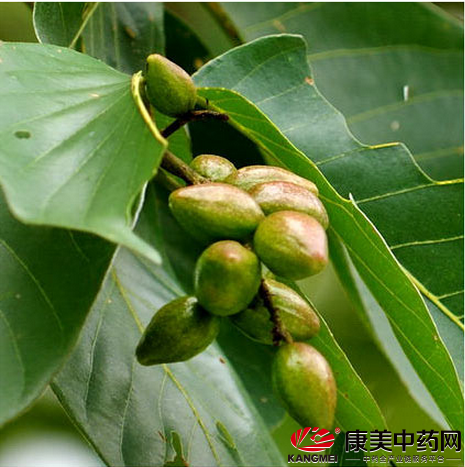
Terminalia chebula has a fairly good market in China. It has a long history of medicinal use, not only applied in prescriptions but also one of the raw materials in the production of Chinese patent medicines; besides medicinal use, it is also a raw material for health foods and industrial leather making. Terminalia chebula preserved fruit health food is sweet and sour, fragrant and tasty, serving as both medicine and food, and is quite popular on the market. The fruit peel of Terminalia chebula contains tannins and is an ideal raw material for leather making; thick leather tanned with the fruit peel infusion has better softness than leather tanned with roasted gum. The trunk is also a high-quality construction timber. Terminalia chebula has considerable production potential. In China, there are many suitable growing areas in Yunnan and Guangdong; it grows easily, and both sexual and asexual propagation can be used. Production costs are not high and it does not require much labor, so people are willing to grow it. As long as policies are right and measures are appropriate, it has very good development prospects. As an economically practical medicinal material, Terminalia chebula has very good development prospects. So, what is the growing method for Terminalia chebula? And what cultivation technical points need to be mastered? The growing techniques and methods for Terminalia chebula are introduced here for everyone.
(1) Site selection and land preparation
The seedling-raising land should be chosen as sunny, well-drained sandy loam, forest podzolic soil or alluvial soil near a water source. Pick out all stones and weeds, plow deeply and harrow finely, then make beds; the width and length of the beds depend on the terrain. Add sand to the surface soil layer of the bed and mix evenly, then set aside for use.
The transplanting land should be chosen as sunny open forest hillsides, hills, in front of and behind houses, and at the edges of gardens and fields. The soil is best as fertile, loose, deep, well-drained sandy loam, humus soil, forest podzolic soil or alluvial soil. After selecting the land, clear away the surrounding weeds and dig holes; the holes depend on the size of the seedlings, generally 40-50 cm wide and about 30-40 cm deep, with fully decomposed farmyard manure applied at the bottom of the hole as base fertilizer.
(2) Planting methods
1. Sexual propagation. Seed selection: There are many varieties of Terminalia chebula, and the fruit shapes and sizes differ greatly. Guangdong divides them into large Terminalia chebula and small Terminalia chebula (also called Yu He). The large Terminalia chebula fruit is elliptical, with obvious five ridges, large fruit and thin flesh; the small Terminalia chebula fruit is ovate, with indistinct ridges, small fruit and thick flesh, of better quality, and can be used as seed. Yunnan Terminalia chebula commodities are divided into long-fruit shape and round-fruit shape. The dried fruit of the long-fruit shape has wrinkled skin and 5-6 ridges, is of better quality, and is mostly selected from such mother plants for seed use. Select strong-growing, high-yielding, good-quality trees about 20 years old, and in winter pick large, plump, fully mature yellow fruits as seed. Remove the flesh, gently split open from the middle of the seed shell with a sharp knife, take out the seed kernel, and slightly sprout it.
Sprouting: Choose a sunny, high, dry, flat place near a water source, spread clean sand evenly on the bottom, place the seed kernels evenly on the sand surface, cover with a layer of fine sand, then place another layer of seed kernels, and so on for 5-8 layers, with the top layer covered with 4-5 cm of fine sand. Pour water until the sand layer is completely soaked through, then cover with plastic film. When sprouting in February-March, germination occurs in about 5 or 6 days. The germination rate is generally about 60-80%. The higher the temperature, the faster the germination. When a large number of seeds have germinated, they can be sown.
Sowing: Dibbling. Open furrows on the bed, place 1 seed at a row spacing of 30 cm and a plant spacing of 25 cm, cover with 3-4 cm of soil, then cover the bed surface with rice straw to maintain moisture and help germination. In the dry season, pay attention to shading and water frequently to keep the seedbed moist. About 10 days after sowing, seedlings emerge one after another. Each mu can raise 6-7 thousand seedlings.
Field planting: After 2-3 years of seedling raising, when the seedlings are about 1 m tall, carry out field planting at a row spacing of 10-13 m.
Using seed propagation results in late fruiting, low yield and poor quality, so it is generally not used in production.
2. Asexual propagation. There are two types: grafting and root-sucker propagation. In production areas, grafting is the main method. The rootstock used for grafting is a seedling grown from seed, and the scion is a strong branch from a high-yielding mother tree in the full fruiting stage. Grafting methods include wedge grafting (also called branch grafting) and bud grafting. Wedge grafting: On a young tree about 3 years after field planting, cut a trunk about 10 cm thick, split the cut surface vertically with a sharp knife to a depth of 10-15 cm, whittle the scion of a fine variety (1.5-3 cm thick) into a wedge tip shape (like a V shape) and insert it into the vertical split, so that the cambium layers fit tightly together, coat the joint with wax, then wrap well with plastic film to ensure survival. Graft in March-April, and in about 30 days it can heal and sprout.
Bud grafting: One-year-old seedlings about 1 m tall can be used. From the bud stick of a fine variety, cut a duck-tongue-shaped bud piece, carefully peel off the xylem, cut open a bark layer of the same shape but slightly larger on the rootstock, peel open the bark, and attach the bud; tie tightly with plastic film from bottom to top, ring pressing against ring, being careful not to press the bud eye. The survival rate can reach about 86%. Bud-grafted seedlings grow rapidly and can reach about 3 m in 2 years.
Root-sucker propagation: After Terminalia chebula is cut down, a large number of new shoots sprout from the roots. These new shoots can be used for transplanting, or they can be allowed to reproduce and grow naturally.
(3) Field management
1. Building sheds. After emergence, remove the covering straw in good time, set up a shade shed, and keep the shade degree at about 30%.
2. Fertilizing and weeding. When the seedlings are about 9 cm tall, apply dilute human manure and urine water at a concentration of 1:5. After that, fertilize once every 1-2 months, and the concentration can be gradually increased. Weed and loosen the soil regularly, and in the rainy season pay attention to drainage to prevent waterlogging. During the young tree period, fertilize 2-3 times each year, using human manure and urine mixed evenly with clear water at 1:4, and apply by opening furrows beside the trees. For fruiting trees, in June-July before flowering, apply pond mud or fully decomposed pig, cattle, sheep manure, etc., to increase nutrients and promote flowering and fruiting. After harvesting the fruit, apply fertilizer once more so that the trees quickly recover their growth. Fertilizing should be combined with weeding.