Detailed Explanation of the Key Cultivation Techniques for the Medicinal and Spice Plant Caoguo
Caoguo is the dried ripe fruit of the ginger family plant Amomum tsao-ko Crevost et Lemaire. It is a traditional Chinese medicinal material and a famous seasoning and spice ingredient, and is a well-known Chinese medicinal material used both as medicine and food. Its taste is pungent, its nature is warm, and it enters the spleen and stomach meridians. It has the effects of drying dampness and warming the middle, and of checking malaria and eliminating phlegm. In addition to product development for medical applications, Caoguo can also be developed into many kinds of products such as seasonings, health foods, essential oils, flavoring agents, feed, and additives. Caoguo is cultivated in Yunnan, Guangxi, Guizhou, Sichuan, Fujian and other provinces and autonomous regions. Developing the Caoguo planting industry is a way for mountain farmers to increase income and become prosperous. So, what are the key points of Caoguo cultivation techniques? The following introduces Caoguo planting techniques:
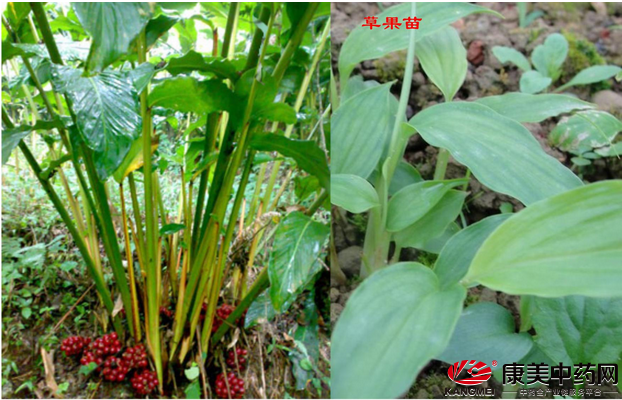
(1) Site Selection and Land Preparation
1. Site Selection
Caoguo is suitable for planting at an altitude of 1200-1800m. It is advisable to choose gently sloping valleys or sandy loam soil beside streams with a water source, shade from trees, thick and fertile soil rich in humus, and a loose and moist texture. Poor soil and heavy clay soil are not suitable for planting.
2. Land Preparation
Cut down excessively dense forest trees, and clear away tree roots, weeds, shrubs and stones. Before sowing, plow the soil to a depth of 20—25cm, break up the clods by plowing, apply sufficient base fertilizer, and apply plant ash at 30.0-37.5t/hm2.
Make high beds for sowing: bed height 20cm, width 120-150cm. Dig holes in the beds, with hole specifications of 40 cm×40cm×30cm. Apply compost, barnyard manure and burned soil etc. in the holes as base fertilizer, mix well with the topsoil, and then wait to plant.
(2) Planting Methods
1. Seed Propagation
In August to September the seeds enter the mature stage. Choose fruits with purple-red skin and silver-gray seeds. Pick fruits that taste sweet when chewed, are large and plump, then select plump, fully mature fruits free of pests and diseases as seeds. It is best to sow as soon as they are collected. Before sowing, first peel off the fruit skin, wash off the pulp, soak the seeds in clean water for 10-12 hours, then rub them with plant ash or coarse sand, then wash off the surface gelatinous layer with clean water, and then sow, or dry them in the shade (do not dry in sunlight) and store them in an earthenware jar until sowing in the following spring. There are two sowing seasons: spring sowing and autumn sowing. Autumn sowing must not be later than mid-October. For autumn sowing, the monthly average temperature should be above 18-20℃. The sowing method uses drilling: open furrows on the bed surface at a plant spacing of 6cm, row spacing of 20cm, and depth of 1.5cm, sow 1-2 seeds per spot, cover with soil, cover with grass, and water to keep moist. About 1-2 months after sowing the seedlings emerge, and the germination rate can reach more than 90%. After emergence, promptly remove the covering grass, always clear weeds, and thin out the denser and weaker seedlings, to prevent excessive rain from causing the seedlings to soften and rot. Spring sowing should be carried out when the temperature rises above 18℃, generally sowing in February to March of the following year.
2. Division Propagation
When the seedlings grow to 60-120cm, they can be transplanted. Before the new buds emerge each spring, dig out the clustered rhizomes with buds, cut them apart, and separate 1-year-old or 2-year-old single plants as planting stock, and plant them by division. After separation, cut off the lower leaves, leaving only 2-3 upper leaves, to reduce water evaporation and help the transplants survive.
(3) Field Management
1. Cultivation and Weeding
Within 1-2 years after planting, the principle of “remove every weed” should be adhered to. Weeding should be done 3-4 times each year, which can be carried out in February, May and August respectively. After 3 years of planting, the plants become closed in and begin to enter the flowering and fruiting stage, and generally weeding is done 1-2 times each year. The 1st time is before the inflorescences form in January to February, to clear weeds, prune dead, weak and diseased seedlings and excessively dense spring shoots, and clear away excessive fallen leaves on the ground, and carry the weeds out together for composting. Dead and diseased seedlings must be burned to prevent disease. The 2nd time is after fruit harvest.
2. Topdressing
Caoguo is a fertilizer-loving plant. After planting, in combination with cultivation and weeding, topdressing should be applied 2-3 times each year. The 1st topdressing is a mixed fertilizer of green manure, barnyard manure, compost and superphosphate, and an appropriate amount of nitrogen fertilizer may also be added. The application rate is preferably organic fertilizer at 15-22.5t/hm2 and superphosphate at 225-300 kg/hm2. Superphosphate is best composted and fermented with organic fertilizer, and then mixed with 15-30 ks/hm2 urea and broadcast. The fertilization time is chosen around the “Spring Equinox” in March. At this time the temperature rises, rainfall is greater, humidity is higher, and it is the vigorous period of Caoguo growth and development. It is the most suitable period for fertilization and is beneficial to the growth of Caoguo plants. The 2nd topdressing should be chosen around the “End of Heat” from the end of August to mid-September, mainly to improve the cold resistance of the seedling group. The fertilizer type is plant ash or burned soil mixed with an appropriate amount of phosphate fertilizer, mixed evenly and broadcast, then earthed up with an appropriate amount of topsoil and fertile mud around the base, to lay a material foundation for promoting flowering and fruiting the following year. The application rate is preferably plant ash at 2250-3000 kg/hm2 and burned soil at 30-37.5 t/hm2. When the Caoguo population of plants enters the flowering and fruiting period, fertilizer should be applied 4 times each year. The 1st is the seedling-promoting fertilizer. In November to December after fruit harvest, in combination with cutting dead, old and diseased seedlings, heavily apply organic fertilizer at 18-37.5 t/hm2, and superphosphate at 300-375 kg/hm2, and after application earth up appropriately, to the extent of covering 1/2 of the creeping stems. The 2nd is the flower-strengthening fertilizer. Around the “Awakening of Insects” to the “Spring Equinox”, apply human feces and urine at 1500 kg/hm2 and urea at 30-60 kg/hm2. The 3rd is around the “Grain Rain”. To ensure the development of Caoguo pollen, foliar fertilization may be carried out, spraying the leaf surface with a mixed liquid of 1200-1500kg/hm2 potassium dihydrogen phosphate (0.3%) and 0.01% boric acid. The 4th is around the “Grain Full” to the “Grain in Ear”, when the fruits have formed, apply 1 fruit-preserving fertilizer. A 2% potassium dihydrogen phosphate solution with 5 mg/kg 2,4-D added may be sprayed on the fruits to promote the growth of young fruits and reduce the fruit drop rate. Spray once every 5-8 days, using about 750 k g/hm2 of liquid each time.
3. Earthing Up
From planting until flowering, Caoguo should be earthed up to make the young buds grow vigorously. After flowering, do not earth up, so as to avoid smothering and injuring the flower buds, causing rot and no fruiting. During each weeding, if fibrous roots exposed above the soil are found, a small amount of humus soil may be earthed up at the fibrous roots to help the roots absorb nutrients.
4. Drainage and Irrigation
The yield of Caoguo is greatly related to whether there is a water shortage during the flowering period. If there is too much rain during the flowering season, the flowers rot easily, so during land preparation a ring-shaped drainage ditch should be dug around the bed in advance; if it is too dry, the flowers tend to wither, causing reduced yield. Therefore, when drought occurs, water should be diverted for irrigation. Where conditions permit, grass may be spread to reduce water evaporation and keep the soil moist; if there is too much rain, drainage work should be done well to reduce flower bud rot.